Multi-IMSI and the End of the “One SIM, Many Countries” Myth
If you travel a lot, you know the moment. You land, you turn off airplane mode, and you wait for that little network name to pop up.
Sometimes it does instantly. Sometimes it hesitates. Sometimes it connects, but your data feels like it is wading through wet concrete.
For years, the industry sold “global” connectivity like it was a single switch. One SIM, one plan, everywhere. In reality, it was usually one identity plus a patchwork of roaming deals. And that patchwork is exactly where the pain lives.
Now, a quiet telecom concept is showing up more and more behind the scenes of travel eSIMs, IoT SIMs, and cross-border enterprise deployments: multi-IMSI.
It is not marketing glitter. It is a technical workaround for a very specific problem: your device’s identity, and how that identity behaves when you cross borders.
Quick refresher on the identity problem
At the center of this is the IMSI, the International Mobile Subscriber Identity. It is the core identity used by cellular networks to recognize a subscriber. In the ITU E.212 identification plan, the IMSI is structured with MCC (country code), MNC (network code), and MSIN (subscriber number), defined by the International Telecommunication Union.
3GPP specifications describe how that identity is used operationally for authentication, mobility management, and roaming behavior, maintained by 3GPP.
Here is the practical issue: if you have one IMSI tied to one “home” network identity, then everything you do internationally relies on roaming behavior. Roaming is not evil, but it is variable. Different partners. Different steering priorities. Different quality. Different pricing.
And for travel eSIM brands trying to deliver a smooth “works everywhere” experience, variability is the enemy.
What multi-IMSI actually is
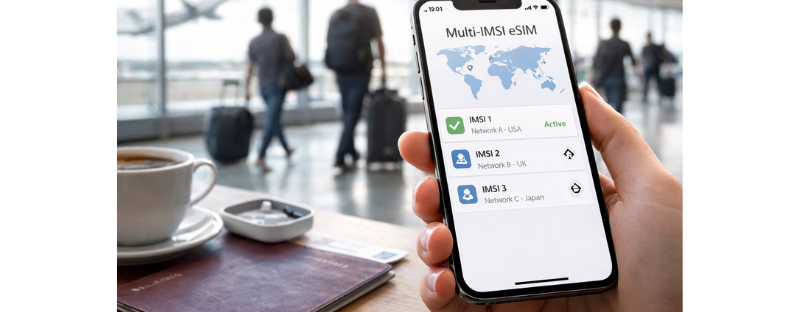
A multi-IMSI SIM or eSIM holds more than one subscriber identity. Not “multiple networks available” in the vague sense. Multiple actual IMSIs, meaning multiple home identities a device can present, depending on where it is and how the provider orchestrates connectivity.
The reason this matters is simple: an IMSI influences which network relationships you can use, how you are treated for routing, and how your traffic is handled commercially. If you can switch identities, you can often switch the commercial and technical path your connectivity takes.
Some implementations are fixed multi-IMSI, meaning identities are preloaded and rotated between. Others combine multi-IMSI with eSIM remote provisioning, where identity and profile management can evolve over time.

Why multi-IMSI solves the “one SIM, many countries” problem
A single-IMSI “global” SIM is effectively saying: I have one home identity, and I will roam everywhere.
Multi-IMSI says something different: I can behave more like a locally routed subscriber from a network access perspective in more places, by selecting an identity that has stronger partner relationships, better wholesale economics, or broader network reach in that region.
That one shift unlocks several practical improvements.
Better network reach without SIM swapping
If identity A has strong agreements in Europe but weak options in parts of Asia, identity B can take over when you land. This reduces those moments where you are technically connected but practically stuck on a poor partner network.
More control over cost and quality
Multi-IMSI is often paired with network steering logic. Providers can prefer certain carriers in certain regions because the commercial terms are better or because performance is more stable. That is how providers move toward predictable connectivity, not just cheap data.
Resilience when networks degrade
Some providers use multi-IMSI rotation or fallback, where orchestration allows re-attachment, to restore service when the “best” option stops being best. This is not instant magic switching, but it does give operators an additional lever when conditions change.
Multi-IMSI vs eSIM profiles
This is where confusion often creeps in.
eSIM, as standardized by the GSMA, is about remote SIM provisioning and secure profile lifecycle management. The widely referenced consumer architecture is defined under SGP.22 by GSMA.
Multi-IMSI, on the other hand, is about having multiple subscriber identities available. You can implement that on a physical SIM, on an eSIM, or alongside remote provisioning. In IoT, many providers are explicit that multi-IMSI does not automatically imply on-demand profile downloads in the consumer eSIM sense.
A useful mental model:
- eSIM is the “how” of managing profiles remotely and securely
- multi-IMSI is the “what” inside the SIM, meaning multiple identities
When combined, you get multi-IMSI eSIM, where orchestration decides which identity and which profile should be active based on geography, network conditions, and commercial logic.
The regulatory pressure nobody markets
There is also a less glamorous driver behind multi-IMSI adoption: regulation and permanent roaming constraints.
In several regions, devices that appear to roam indefinitely face commercial or regulatory pushback. This has been a long-standing issue in IoT, but it increasingly affects long-stay travelers, enterprise mobility, and “always-on” travel subscriptions.
This pressure is one reason the industry is investing in newer eSIM IoT standards such as SGP.32, which aim to make large-scale identity and profile management more flexible across device classes. While SGP.32 is IoT-focused, the architectural direction matters for travel connectivity as well.

Where is it showing up in travel today?
Multi-IMSI has historically been strongest in IoT, but travel connectivity is catching up for the same reason: reduce friction across borders while keeping control over experience and cost.
You see this in:
- long-term global eSIM subscriptions
- enterprise travel connectivity programs
- “install once, travel everywhere” models
Under the hood, only a few mechanisms can support that promise reliably:
- smarter roaming orchestration
- eSIM profile management
- multiple IMSIs
- usually a combination of all three
This stack is becoming a competitive differentiator, even if end users never hear the term IMSI.
What to watch next
Multi-IMSI is rising because the market has moved past “does it connect” to “does it stay predictable.”
Signals worth watching:
- greater transparency around network selection and orchestration
- convergence between travel eSIM and IoT connectivity platforms
- deeper reliance on GSMA standardization to reduce fragility
- declining dependence on single-IMSI roaming models for long-duration use
Conclusion: Multi-IMSI is the bridge, not the destination
Multi-IMSI is not a magic network upgrade. It is a bridge technology that patches a structural weakness in the original “one SIM, many countries” promise.
Single-IMSI global roaming is easy to sell but inherits all the variability of roaming economics and partner networks.
Pure eSIM multi-profile provisioning is standards-driven and clean, but still depends on how quickly profiles can be localized and how intelligently they are orchestrated.
Multi-IMSI sits between those two approaches. That is why it is gaining traction. It gives providers additional identities to work with, more leverage over partner networks, and more control over consistency when paired with modern orchestration.
The broader trend is clear. Global connectivity no longer scales on roaming agreements alone. It scales on identity management, orchestration, and standards.
Multi-IMSI does not solve everything, but right now, it is one of the most practical ways to make “one SIM, many countries” feel less like a promise and more like a default.