Malaysia Taps Alipay+ and Weixin Pay to Attract 6 Million Chinese Tourists
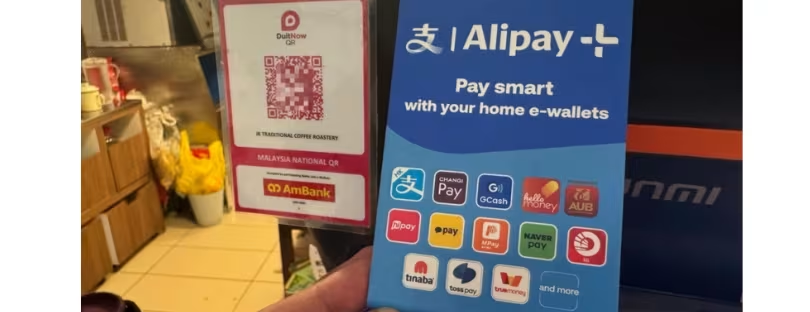
National payments network, Payments Network Malaysia Sdn Bhd (PayNet), has teamed up with top Asian payment platforms, Alipay+, and Weixin Pay (commonly known in Malaysia as “WeChat Pay”), to drive Chinese and regional tourist spending across Malaysia. As the summer travel season begins, both Alipay+ and Weixin Pay are rolling out targeted campaigns to promote Malaysia as a top destination.
The campaigns will boost cross-border spending via PayNet’s DuitNow QR ecosystem and make travel in Malaysia more seamless and rewarding for visitors.
Connecting Tourists with Malaysian Businesses
“This is what smart tourism looks like, seamless for travellers, transformative for our MSMEs. By enabling tourists to use their home wallets via DuitNow QR, we are opening up more than 2.5 million Malaysian businesses, many of them small and family-run, to global spending power. It’s a digital solution with real-world economic impact,”
said PayNet Chief Marketing Officer, Gary Yeoh.
Empowering MSMEs, Strengthening the Economy
This multi-partner initiative aims to increase sales by 20% for participating merchants during the summer campaign period. In the long run, the campaign underpins Malaysia’s goal of becoming a cashless tourism leader, while helping more businesses tap into digital payments.
Tourism Malaysia Director General, Datuk Manoharan Periasamy, highlighted that the summer campaigns play a vital role in reaching the target of six million Chinese tourist arrivals this year.
“We believe that making travel simple, welcoming, and convenient is the key to attracting more visitors,” he said. “With DuitNow QR accepted via Alipay+ and Weixin Pay, tourists can enjoy a smoother, more enjoyable travel experience. This initiative not only adds comfort and familiarity for our guests but also creates meaningful opportunities for local businesses and boosts the overall tourism economy”.

China Summer Campaign Highlights
PayNet, Alipay+, and Weixin Pay are launching three targeted campaigns that reward spending, celebrate local experiences, and deepen tourism-driven economic impact:
| Partner | Campaign Details |
| Alipay+ | Lucky Draw: Win a Premier League Football Experience
|
Spend and Save: Eat, Play & Save
|
|
| Weixin Pay | Collect Badges, Get Rewards
|
As tourist arrivals to Malaysia continue to grow, the partnership between PayNet, Alipay+, and Weixin Pay showcases the power of digital payments to fuel economic growth. In line with this momentum, the target for 2025 is to increase DuitNow QR transactions through Alipay+ and Weixin Pay by more than 130% year-on-year.
By empowering local businesses and simplifying how tourists pay via trusted mobile payment methods, this summer campaign marks a meaningful step forward in strengthening Malaysia’s tourism economy and boosting regional economic integration.
¹Tourists using Alipay+ from the countries listed below are eligible to participate in the contests:
Alipay (China), AlipayHK (Hong Kong SAR, China), MPay (Macao SAR, China), TrueMoney, Kbank (Thailand), Changi Pay (Singapore), Hipay (Mongolia), HelloMoney, GCash (Philippines), Tinaba (Italy), Kaspi (Kazakhstan), BigPay (Singapore, Thailand), Kakao Pay, Naver Pay, and Toss (South Korea).
Final thoughts about Alipay+ Malaysia
The collaboration between PayNet, Alipay+, and Weixin Pay signals more than just a seasonal tourism boost—it’s a strategic leap toward regional payment interoperability and economic digitization. While Europe continues to grapple with fragmented payment ecosystems and often outdated POS infrastructure, Malaysia is quietly emerging as a leader in mobile-first, cross-border payment innovation. With DuitNow QR acting as a unifying interface across multiple global wallets, the country is executing what the EU’s PSD2 and EPI initiatives are still aiming for: a seamless, inclusive payment experience that works across borders, benefits small merchants, and appeals to global consumers.
Southeast Asia’s embrace of mobile wallets—driven by tourism, smartphone penetration, and regulatory support—has positioned the region years ahead in digital payment fluidity. In contrast, many European markets remain dominated by cards and local schemes, with limited compatibility for tourists using Alipay or WeChat Pay. Malaysia, by accepting these wallets natively via QR code, isn’t just welcoming tourists—it’s integrating into the digital lifestyles of its most valuable visitors.
The broader trend is clear: interoperability is no longer a technical challenge but a strategic imperative. Countries and platforms that act early—by opening up national systems like PayNet has—stand to gain not just tourist dollars, but long-term relevance in the evolving digital economy. Malaysia’s model offers a glimpse of what a truly borderless payments future could look like—fast, familiar, and frictionless. Europe, take note.
About PayNet