NuvoLinQ’s LinQ1Zero Redefines Always-On eSIM Connectivity with GSMA SGP.32
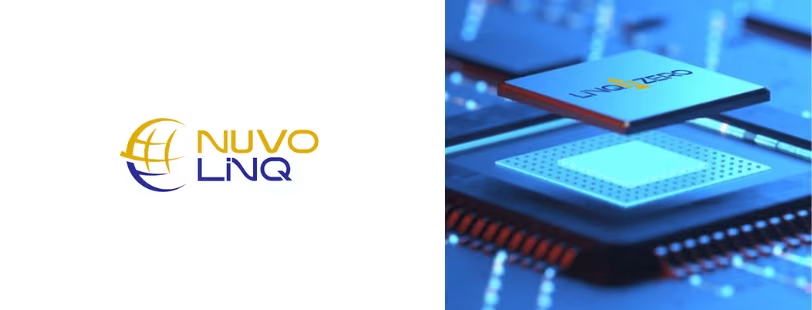
NuvoLinQ just took the wraps off LinQ1Zero, a next-gen eUICC/iUICC solution built for devices that can’t afford to go offline—think payment terminals, meters, trackers, and fleet hardware. The launch ties directly into the GSMA’s latest IoT eSIM standards (SGP.31/32) and leans on partners BICS and Kigen for orchestration and secure bootstrap profiles. LinQ1Zero eSIM connectivity

In short: one SKU, zero-touch provisioning, multi-network redundancy, and a roadmap that spans SIM, eUICC, and iSIM.
What’s actually new here
Under LinQ1Zero, device fleets ship “connectivity-ready” and get operator profiles pushed remotely—before or after deployment—so you’re not juggling plastic, distributors, or warehouse SIM swaps. That’s the SGP.32 promise in action, with the eSIM IoT Manager (eIM) and IoT Profile Assistant (IPA) handling lifecycle and profile moves in the background. NuvoLinQ’s stack positions BICS as the eSIM orchestrator layer and Kigen for eSIM OS/management—exactly how the new GSMA architecture was designed to be used.
Why SGP.32 matters (and why now)
SGP.32 was created for constrained IoT hardware (low power, limited UI) and formalizes roles like the eSIM orchestrator to make global rollouts hands-off. Compared with older consumer standards (SGP.22), it enables push-based provisioning at scale, reduces errors, and cuts time-to-activate—practical wins that show up as real OPEX savings across large fleets. If you’ve been waiting for eSIM to “just work” for IoT, this is the tipping point.
Why LinQ1Zero?
Managing IoT connectivity has never been more challenging. Businesses face rising costs, permanent roaming restrictions, and MNO (Mobile Network Operator) dependencies, all while needing secure, scalable, and high-availability connections. LinQ1Zero addresses these challenges with an intelligent over-the-air (OTA) profile management system, delivering:
→ No More SIM Swaps – Eliminate physical SIM swaps with remote eUICC provisioning for instant carrier switching.
→ Reliable, Always-On Connectivity – Built-in automatic failover ensures devices stay online across multiple networks.
→ Lower Latency, Higher Efficiency – Optimize power consumption, enhance network reliability, and reduce network failures.
→ Total Control Over Connectivity – Decouple from restrictive MNO processes while maintaining full compliance with their terms and conditions.
→ Enterprise-Grade Security – Designed to meet GDPR and global regulatory standards, ensuring data protection and encryption.
→ Cost Savings on Global Roaming – Avoid permanent roaming charges through local MNO integration, optimizing data costs and improving regulatory compliance.
Where LinQ1Zero sits in the market
NuvoLinQ is not alone in chasing “always-on” IoT with SGP.32 tooling:
- BICS launched its eSIM Hub to play that orchestrator role at global scale (700+ operator access), and NuvoLinQ is effectively productizing that capability inside LinQ1Zero.
- Kigen is a reference vendor for eIM and eSIM OS; LinQ1Zero’s secure bootstrap and remote management lean on that pedigree.
- Soracom is pushing a “Connectivity Hypervisor” that juggles multiple profiles (including third-party) and is openly aligning to SGP.32 for orchestration and automotive use—strong for developers who want deep API control.
- 1GLOBAL (ex-Truphone) and Hologram are educating the market, emphasizing the eIM/IPA split and zero-touch onboarding; both are credible options for enterprises that want managed eSIM without building their own plumbing.
LinQ1Zero’s angle is appliance-like simplicity (“one SKU, zero-touch”) with enterprise-grade redundancy via BICS’s orchestration and Kigen’s security stack. That combo is meaningful if your devices live in places where a truck roll costs more than your connectivity bill.
Early use cases to watch
Payment and retail are first out of the gate: NuvoLinQ has previously teamed with BICS and Kigen on secure POS connectivity, featuring backup options to keep card readers transacting even when a network hiccup occurs. Expect similar “can’t fail” patterns in EV charging, smart vending, healthcare telemetry, and logistics—anywhere a lost packet equals a lost sale or compliance headache.
“We are proud to support NuvoLinQ in advancing IoT innovation with the GSMA SGP.32 standard,” said Vincent Korstanje, CEO of Kigen.
“By combining the unique strengths of Kigen’s eSIM solution and eSIM OS, LinQ1Zero delivers new levels of connectivity flexibility and secure provisioning—critical for resilient IoT systems where network availability matters most.”
The Alertify take
LinQ1Zero looks less like yet another eSIM and more like a packaged SGP.32 play that abstracts the messy bits: role separation, bootstrap security, and multi-profile orchestration. Against peers:
- Soracom is the developer’s playground—powerful APIs and profile mixing for teams that want to tinker.
- 1GLOBAL and Hologram offer “full-service” eSIM with clear SGP.32 messaging, good for companies standardizing on a single provider UI.
- NuvoLinQ’s LinQ1Zero is compelling if you value turnkey rollout over DIY. By anchoring to BICS’s orchestrator and Kigen’s eIM/OS, it trades breadth of in-house tooling for reliability and speed to scale, which many OEMs actually need right now.
Zooming out: the market is finally executing on what eSIM promised a decade ago—remote, reversible, vendor-agnostic connectivity. SGP.32 is the reason, and solutions like LinQ1Zero accelerate mainstream adoption by hiding the complexity. If you’re shipping thousands of devices across borders in 2026, your checklist should read: SGP.32-native, orchestrator-backed, zero-touch, multi-profile. On that test, LinQ1Zero checks the boxes—and looks ready for prime time.
- AIRALO
-
eSIM for
Europe
39 countries
-
1 GB – 7 days – €4.27
3 GB – 30 days – €11.09
10 GB – 30 days – €31.57


- AIRHUB
-
eSIM for
Europe
34 countries
-
1 GB – 7 days – €2.99
3 GB – 30 days – €5.12
10 GB – 30 days – €11-09


- aloSIM
-
eSIM for
Europe
32 countries
-
1 GB – 7 days – €5.00
3 GB – 30 days – €13.00
10 GB – 30 days- €36.00


- GigSky
-
eSIM for
Europe
36 countries
-
1 GB – 7 days – €6.99
3 GB – 15 days – €11.19
10 GB – 30 days – €27.99


- iRoamly
-
eSIM for
Europe
39 countries
-
1 GB – 7 day – €6.83
3 GB – 15 days – €10.24
10 GB – 30 days – €18.77


- Maya Mobile
-
eSIM for
Europe
34 countries
-
1 GB – 7 days – –
5 GB – 15 days – €5.99
10 GB – 30 days- €13.99


- NOMAD
-
eSIM for
Europe
36 countries
-
1 GB – 7 days – €4.71
3 GB – 15 days – €10.27
10 GB – 30 days – €15.41


- UBIGI
-
eSIM for
Europe
29 countries
-
500 MB – 1 day – €2.00
3 GB – 30 days – €8.00
10 GB – 30 days – €19.00


- VOIA
-
eSIM for
Europe
34 countries
-
1 GB – 7 days – €2.69
3 GB – 15 days – €5.05
10 GB – 30 days- €11.70

The Best eSIM Finder brings together 100+ providers in one place, giving you a clear view of everything from data limits and business options to tethering, crypto payments, coverage, travel extras, refund policies, discounts, and reviews—so you don’t just compare plans, you understand which one truly fits your needs. Start exploring today and find the plan that fits you best.