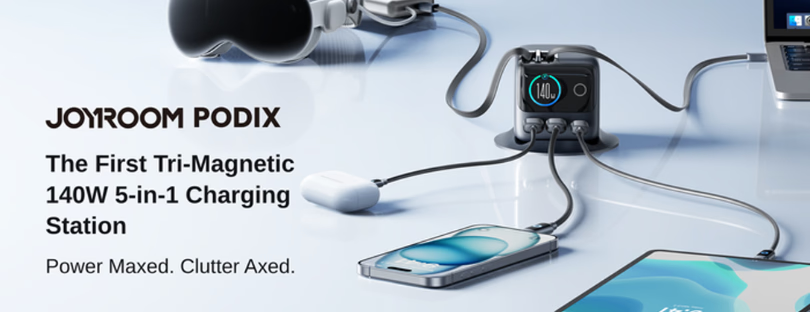
JOYROOM PODIX: A 140W GaN Charging Hub Built for Travel
JOYROOM is stepping into the premium-charging arena with something genuinely different: the PODIX, the world’s first Tri-Magnetic 140W 5-in-1 GaN Charging Station. If you’ve ever juggled too many cables, too few ports, or a desk that looks like a power strip exploded on it, this is JOYROOM’s pitch for a cleaner, smarter, more enjoyable everyday charging experience.

And clearly, people cared. Launched on Kickstarter in September, PODIX didn’t just meet its target—it detonated it. The campaign raised over $132,000 in a single month, closing at 6,633% of its goal with 1,385 backers from all over the world. That level of early traction says two things: the charging market is getting more competitive, and travelers, digital nomads, and work-from-anywhere professionals want solutions that feel engineered, not just incremental.
Dual Auto-Retracting Cables and a Tri-Magnetic Base That Actually Makes Sense
Most charging hubs still rely on a tangle of user-supplied cables, but PODIX builds them in—two 31.5″ (80cm) auto-retractable cables designed to quietly snap back into place. Combined with a 59″ (150cm) power cable, there’s more flexibility and less clutter, which is essential for people who shift between work zones throughout the day.
The standout feature, however, is the tri-magnetic base with 180° rotation. It takes one-hand cable extension from “nice idea” to “oh wow, this is actually practical.” The magnets keep everything stable even when you yank a connector at an odd angle, and the rotating top means the hub adapts to your layout, not the other way around.
Five Ports, 140W Power, and No More Fighting for Outlets
PODIX offers five ports—two USB-A and three USB-C—with total output up to 140W. That’s more than enough to fast-charge a 16″ MacBook Pro from 0% to 50% in roughly 25 minutes, while also powering a phone, tablet, watch, headphones, and maybe even a portable console.
What’s appealing is the flexibility: it replaces multi-brick setups, reduces socket dependency, and keeps high-drain devices charging at full speed without competing with everything else on your desk. For remote workers and travelers who always need one more port, this is the type of hub that becomes part of your daily routine.

Intelligent Power Recognition That Balances Safety and Speed
Power distribution is handled automatically—PODIX detects what’s connected and allocates up to 140W where it’s needed. From tiny earbuds to power-hungry laptops, each device gets a tailored charge. Meanwhile, thermal monitoring runs continuously in the background to avoid overheating and extend battery health.
It’s a small detail, but in an era where fast charging is great until it cooks your battery, having smart, automatic load balancing goes from a “nice-to-have” to essential peace of mind.
A Surprisingly Charming LCD Display With Live Power Data and Animated UI
Most charging hubs keep you guessing about what’s happening under the hood. PODIX goes the opposite direction with a 1.54″ LCD that shows live wattage, voltage alerts, current flow, and fast-charge indicators. And then there’s the playful part: UI emojis. Little animations—fireworks, bubbles, pinwheels—appear during charging sessions, adding a visual twist to something usually invisible. It’s subtle, but it makes power management feel more interactive and less like plugging devices into a block of plastic.
Built for Durability, Tested for Real-Life Stress
JOYROOM put PODIX through four durability tests, including 10,000 cable bends and 15kg of pulling force on the internal cable structure. The display is rated for 100,000 hours of uptime, and the device survives 1m drops without losing functionality. This matters because retractable systems can sometimes be failure-prone; JOYROOM clearly wanted to reassure buyers that the mechanism isn’t delicate.

A Charging Hub Designed for Every Scenario
From home offices to coworking spaces, cafés, gaming setups, or travel desks, PODIX works across a wide device ecosystem. Laptops, phones, tablets, handheld consoles, wearables—anything with USB-C or USB-A fits into the system. It’s not trying to be a travel-only charger or a desktop-only charger; it’s built as a hybrid, which is increasingly the expectation as work and travel continue to blur.
Price and Early Availability
PODIX officially debuts on Allegro on November 24, 2025, with a limited-time Super Early Bird price of 399zł. Given its Kickstarter traction, expect early stock to move fast.
About JOYROOM
JOYROOM, founded in 2009, has built a global following across more than 130 countries. With a focus on simplifying tech experience through design, the brand aims to build electronics that blend into modern life without feeling complicated or fragile.
Conclusion: How PODIX Fits Into a Market Getting Smarter, Faster, and More Competitive
The charging-station market has evolved rapidly in the last two years, pushed by GaN technology, multi-port power bricks, and the expectation that one charger should handle everything. Brands like Anker, UGREEN, and Baseus have set the bar for power density and reliability, while ESR and VOLTME introduced creative magnetic and travel-friendly solutions.
PODIX enters the conversation differently: instead of just offering more power, it rethinks usability. The retractable cables, tri-magnetic base, rotating structure, and UI-driven display distinguish it from the more utilitarian chargers dominating today’s rankings on platforms like GSMArena, Wirecutter, and Android Authority. While Anker still leads in efficiency benchmarks and UGREEN holds a strong grip on the multi-port GaN market, JOYROOM is carving out territory in design-forward charging—with PODIX feeling more like a desk companion than a power tool.
For travelers, remote workers, and gadget-heavy users, PODIX isn’t just another GaN brick—it’s a sign of where charging stations are heading: smarter interfaces, cleaner cable management, and hardware that fits the rhythm of hybrid work.
If JOYROOM can maintain this design-centric momentum, PODIX may well be the first of many products reshaping what we expect from everyday charging.