Guangdong’s New Tourism Frontier: When Tech Labs Become Travel Destinations
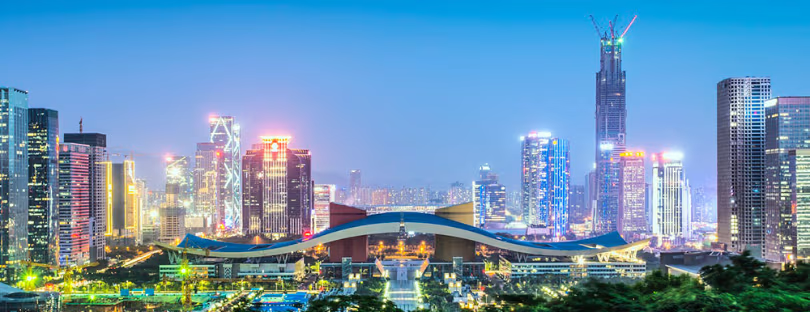
In a move that blends innovation with exploration, South China’s Guangdong Province has unveiled a new tourism plan that puts technology at its core. The provincial government’s latest initiative aims to design high-quality travel routes that connect universities, research institutes, technology parks, and major infrastructure projects—inviting travelers to experience the world of AI, drones, and autonomous vehicles up close. Guangdong technology tourism

This is not your typical sightseeing circuit. Instead of ancient temples and mountain trails, visitors can now wander through smart factories and next-gen labs, watching robotic arms assemble parts with surgical precision or testing AI-driven systems that may soon power the cities of the future.
Guangdong’s approach signals a broader trend sweeping across China: the rise of technological industry tourism—a new form of travel that merges education, innovation, and leisure.
From Factory Floors to Tourist Trails
Just a decade ago, factory floors in China were strictly off-limits—defined by the hum of heavy machinery and the rhythm of production lines. Today, they’re attracting travelers, students, and tech enthusiasts eager to see how China builds the world’s future.
Industrial heritage sites and modern assembly lines have been reimagined as interactive learning environments. Visitors can explore clean, automated facilities where robots outnumber humans, or take part in workshops that demonstrate how AI and automation are reshaping manufacturing.
During this year’s National Day holiday, high-tech study tours became one of China’s surprise travel hits, according to Economic Information Daily. Aerospace and automotive experiences accounted for more than 20% of bookings, reflecting how curiosity about China’s innovation edge is shaping new kinds of travel. Even international visitors—especially younger ones—are joining in. One educational travel agency noted that foreign teenagers are increasingly fascinated by China’s progress in AI and autonomous driving.
51 Routes, 300 Sites, Endless Curiosity
Guangdong’s plan is both ambitious and methodical. The province has already mapped out 51 curated industrial tourism routes and aims to expand that network to about 300 destinations by the end of 2025.
These routes are designed to showcase Guangdong’s strengths—its research clusters, high-tech manufacturing zones, and innovation-driven enterprises. From AI labs in Shenzhen to drone factories in Dongguan, the province offers a dense concentration of world-class technological landmarks.
But this is not just about sightseeing. The initiative taps into an educational movement as well. Parents are booking these tours to spark scientific curiosity in their children, while companies are using them for team-building and talent attraction. It’s tourism with a purpose—bridging the gap between public curiosity and China’s industrial transformation.
The Broader Shift: China’s Factories as Classrooms
While Guangdong might be leading the charge, the model is spreading nationwide. Across China, factories and tech parks are rebranding themselves as “innovation destinations.”
The Beijing Economic-Technological Development Area—better known as Beijing E-Town—has become a magnet for industrial tourists. Visitors can see humanoid robots in action, ride in unmanned vehicles, and explore aerospace bases or next-gen car factories. Similar experiences are emerging in Shanghai, Chengdu, and Xi’an, where smart production lines and robotics exhibitions are becoming part of the tourism circuit.
This surge in tech-themed travel is also a boon for local economies. It drives not just tourism, but also related industries like hospitality, dining, and education. According to Science and Technology Daily, the Xi’an Science and Technology Museum saw a 600% spike in ticket revenue during a recent national holiday. The message is clear: science sells.
China’s Industrial Tourism: Young, Ambitious, and Growing Fast
Despite its rapid momentum, China’s industrial tourism sector is still relatively young. As of early 2024, the country had over 1,200 industrial tourism enterprises, with the market expected to surpass 100 billion yuan ($14 billion) by 2030, according to Science and Technology Daily.
By comparison, Germany—often seen as the birthplace of industrial tourism—has long turned its manufacturing heritage into visitor experiences, from the BMW Museum in Munich to the Volkswagen Autostadt in Wolfsburg. Japan, too, has refined factory-based tourism, integrating it into corporate branding and educational programs.
China is now building its own version of that success story—but with a uniquely forward-looking twist. Rather than focusing solely on industrial heritage, the emphasis is on emerging technologies—AI, robotics, autonomous vehicles, renewable energy, and aerospace.
Beyond Sightseeing: The New Language of Innovation Tourism
What makes China’s approach so fascinating is how it redefines what tourism means in a digital age. These aren’t passive tours; they’re immersive experiences where visitors can touch, test, and learn.
A student visiting a drone facility in Shenzhen might pilot a prototype under supervision. A business traveler in Zhuhai might sit through a guided demo of autonomous delivery vehicles. These experiences don’t just entertain—they educate and inspire, turning travelers into advocates for innovation.
This blending of travel and technology also aligns with global shifts. The UN World Tourism Organization (UNWTO) has repeatedly emphasized the need for tourism to evolve toward knowledge-sharing and sustainable innovation. China’s new model fits squarely within that vision, transforming tourism from simple leisure into a driver of scientific literacy and economic growth.
Conclusion: China’s Smart Tourism Playbook Is Just Getting Started
Guangdong’s tourism pivot is more than a provincial initiative—it’s a reflection of China’s emerging strategy to brand its innovation ecosystem as a global attraction. If Germany’s industrial tourism celebrates craftsmanship and Japan’s factory tours embody precision, China’s technological industry tours celebrate scale, ambition, and the future.
This new wave of tourism represents a deeper cultural shift: curiosity about technology is no longer limited to scientists or entrepreneurs—it’s becoming part of everyday life. In a world where travelers increasingly seek meaning, learning, and engagement, China’s model could become a blueprint for others to follow.
As provinces like Guangdong, Beijing, and Zhejiang continue to open their innovation hubs to the public, industrial tourism might just evolve into one of China’s most distinctive exports—a tourism model where the souvenir isn’t a photo, but a newfound fascination with the technologies shaping tomorrow.