Freedom Bank Launches eSIM Inside Its SuperApp
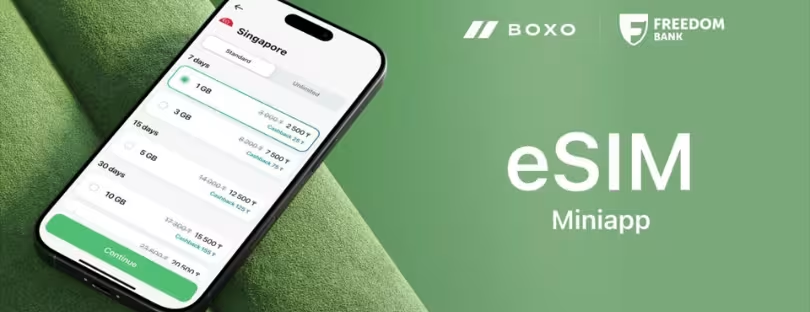
Freedom Bank Kazakhstan, a subsidiary of Freedom Holding Corp., has taken another decisive step in redefining what a modern banking app can be. This week, the bank introduced an embedded eSIM mini-app inside its SuperApp, enabling users to purchase, activate, and manage international mobile data plans directly within their banking interface.
This is not a flashy gadget launch or a side experiment. It is a clear signal that connectivity is becoming a core digital service, not just a travel add-on. For Freedom Bank’s increasingly mobile customer base, particularly frequent travelers, entrepreneurs, and remote professionals, the timing is perfect.
The new eSIM functionality is powered by Boxo, a platform specializing in embedding third-party miniapps into large digital ecosystems. Through this integration, Freedom Bank customers can access international data plans, including unlimited packages lasting up to 30 days, directly inside the SuperApp.
No separate app. No physical SIM. No roaming anxiety at the airport.
Banking meets global mobility
Freedom Bank’s SuperApp strategy has always gone beyond traditional banking. Over the past few years, the bank has positioned itself as a regional digital innovator in Kazakhstan, rolling out fully digital mortgages, investment-linked cashback programs, and a tightly integrated financial ecosystem.
The eSIM launch fits neatly into that vision.
According to Vyacheslav Kim, CEO of Freedom SuperApp, the goal is simple and ambitious at the same time. Essential services should live in one place. Sending money, paying a bill, booking a service, or getting connected abroad should feel equally seamless.
For travelers, roaming is one of the last remaining pain points of digital life. Despite years of warnings, bill shocks, confusing tariffs, and unreliable hotel Wi-Fi remain common. By embedding eSIM connectivity directly into the banking flow, Freedom Bank removes multiple layers of friction at once.
The banking app becomes something closer to a digital travel companion.

Why eSIM inside a bank app actually makes sense
At first glance, mobile connectivity may seem like an odd fit for a bank. In reality, it is one of the most logical extensions a SuperApp can make.
Travel and payments are inseparable. The moment a customer lands in another country, they need data to access maps, ride-hailing apps, messaging, and of course their bank. When connectivity fails, everything else follows.
Embedding eSIM solves several problems at once:
Benefits for users
- No physical SIM cards to buy, swap, or lose
- No dependence on airport kiosks or local carriers
- Transparent pricing without roaming surprises
- Immediate activation before or upon arrival
- Direct billing inside a trusted banking environment
From a trust perspective, banks are in a unique position. Users already associate them with security, identity verification, and regulated services. Buying mobile data through a bank feels safer than downloading yet another unknown travel app.
This trust advantage is something many standalone eSIM providers still struggle to build at scale.
The Boxo infrastructure behind the scenes
The technical backbone of the launch comes from Boxo’s superapp SDK, which allows platforms to embed miniapps through a single integration. Instead of Freedom Bank negotiating with multiple telecom operators, managing provisioning systems, and handling compliance across countries, Boxo abstracts that complexity.
Behind the scenes, Boxo handles carrier relationships, global coverage, provisioning logic, and scaling. For Freedom Bank, this means faster time to market and less operational risk.
Kaniyet Rayev, CEO of Boxo, framed the integration as a natural evolution of digital ecosystems. Money and mobility are two everyday essentials, and users increasingly expect them to work together without friction.
This approach mirrors what we are seeing in Asia, where superapps like Grab, GCash, and Alipay have long bundled financial services with transport, insurance, and connectivity.
Freedom Bank is effectively applying that playbook to Central Asia and beyond.
How does this compare to global players
Freedom Bank is not alone in exploring embedded connectivity, but its execution stands out.
Revolut, for example, recently launched its own eSIM offering, targeting European travelers directly inside its app. Wise has experimented with travel-focused perks but stopped short of full connectivity integration. N26 and Monzo still rely heavily on partnerships and external services rather than native eSIM features.
Outside banking, airlines like Lufthansa and Emirates have tested bundled connectivity offers, while Apple and Samsung continue to push eSIM adoption at the device level.

What sets Freedom Bank apart is the combination of:
- Full banking functionality
- SuperApp architecture
- Native eSIM integration
- Regional focus with global reach
Rather than treating eSIM as a marketing add-on, Freedom Bank positions it as a utility. Something you turn on when you need it, just like a payment card.
A sign of where digital banking is heading
This launch also reflects a broader industry shift. Digital banks are under pressure to increase engagement beyond low-margin transactions. Payments alone are not enough. Users open apps more often when they solve real, frequent problems.
Connectivity is one of those problems.
According to GSMA data, eSIM adoption is accelerating globally, with hundreds of millions of eSIM-enabled devices already in use. Juniper Research estimates that eSIM-based roaming users will grow exponentially over the next five years as travelers seek alternatives to traditional roaming.
Banks that move early can capture this demand while reinforcing their role as daily digital hubs.
Freedom Bank’s move suggests that the future bank app will look less like a ledger and more like an operating system for everyday life.
What this means for the eSIM market
For standalone eSIM providers, this trend is both an opportunity and a warning.
On one hand, partnerships with banks, airlines, and superapps offer massive distribution potential. On the other, the user relationship increasingly belongs to the platform, not the connectivity brand.
Boxo’s role here is especially interesting. By positioning itself as infrastructure rather than a consumer brand, it becomes the enabler of these embedded models without competing for user attention.
We are likely to see more banks follow this route, especially in emerging markets where SuperApps are culturally accepted and mobile-first behavior is dominant.
Conclusion
Freedom Bank Kazakhstan’s embedded eSIM launch is not just another feature update. It is a clear signal that connectivity is becoming a native layer of digital finance.
As banks compete to become everyday platforms rather than transactional tools, services like eSIM will move from optional extras to expected functionality. Freedom Bank is ahead of the curve, borrowing proven SuperApp strategies from Asia and applying them to a region where digital banking adoption is already strong.
For travelers, this means fewer apps, fewer surprises, and one less thing to worry about before boarding a plane. For the industry, it confirms a trend Alertify has been tracking closely: the convergence of finance, travel, and connectivity into a single digital experience.
Reliable sources like GSMA, Juniper Research, and ongoing launches from players such as Revolut all point in the same direction. The question is no longer whether banks will offer connectivity, but how quickly others will catch up.
Freedom Bank has made its move.