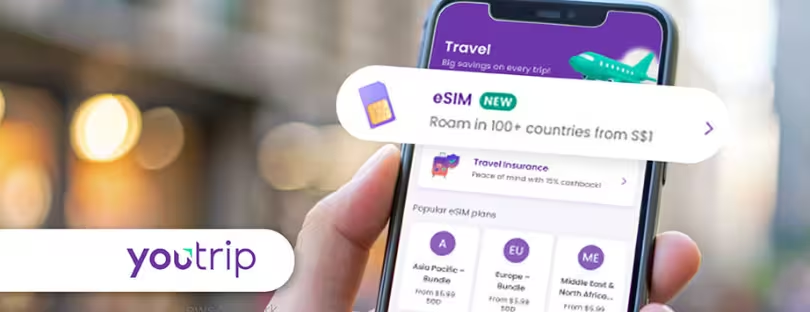
How eSIM Enhances the User Experience Compared to Traditional SIM Cards
If you’ve traveled even once in the last five years, you’ve probably had that classic airport moment: you land, switch off airplane mode, and… nothing. No data. No signal. Just a silent, empty status bar and the sudden realization that you’re about to rely on airport Wi-Fi to navigate a city you don’t know. So you end up in a SIM shop, pointing at a laminated price list, hoping you’re not getting wildly overcharged because you’re tired, hungry, and just want to get to your hotel.

This exact moment is why eSIM feels like such a breath of fresh air.
It takes something that used to be inconvenient—sometimes even stressful—and turns it into something that just quietly works in the background. That’s the biggest difference between eSIM and the traditional SIM card experience: one requires your effort, and the other simply fits into your life.
Let’s walk through why the shift to eSIM is such a big deal, especially if you travel.
How eSIM Removes the Hassle of Physical SIM Cards
The first thing everyone notices is the sheer convenience. Traditional SIM cards are tiny, fragile pieces of plastic that you always misplace at the worst possible moment. They hide in pockets, fall behind furniture, and love disappearing into airport carpet. And unless you’re the kind of person who travels with a dedicated SIM pouch (very few do), you’ve probably lost at least one.
With eSIM, you suddenly don’t have to deal with any of that. No tray, no tool, no swapping, no fiddling. You buy a plan online, scan a QR code, and you’re connected before you’ve even reached the baggage carousel. For a traveler, that single change feels almost luxurious. It removes friction from a process we all just assumed had to be annoying.
Why Instant Activation Changes Everything
But convenience is only the starting point.
The real magic of eSIM is how it gives you control. Think about the last time you bought a physical SIM abroad. You had to go to a store, explain what you needed, hand over your passport, wait for activation, and hope the plan is exactly what was advertised. With eSIM, the entire experience moves to your phone. You browse plans like you’d browse hotels on Booking.com, you choose the one that fits your trip, and you activate it instantly. If you don’t like a plan, you switch. If you need more data, you top up. If you want a backup provider, you add one.
That level of flexibility is something physical SIMs simply can’t match.

Managing Multiple Plans Without Swapping Cards
Another underrated benefit is how many eSIM profiles you can store. Traditional SIMs force you into one slot. Two, if your phone has dual SIM. That’s it. eSIM lets you keep multiple plans ready to go. Imagine you’re doing a multi-country trip across Europe: you can store plans for Spain, Italy, France, and Germany all at once, and just activate whichever one you need with a tap. No swapping. No labeling of little plastic cards. No fear of losing the one you need most.
And switching plans is instant. You don’t turn off the phone. You don’t pull out a tray. You don’t wait for anything. It just switches — the way Wi-Fi networks do. For digital nomads or business travelers who jump between networks frequently, that alone feels like a superpower.
The Security Advantage You Don’t Get with Traditional SIMs
There’s also the security side of things, which doesn’t always get talked about, but should. If someone steals a phone with a physical SIM, they can eject that SIM and plug it into another device. That means access to SMS, potentially banking codes, and a lot of personal info. With eSIM, the profile is locked to the device. You can’t physically remove it. You can’t plug it into anything else. That adds a layer of safety you don’t fully appreciate until you’re moving through busy airports, crowded metros, or chaotic taxi lines with your phone as your everything—wallet, map, inbox, boarding pass, bank.
Why eSIM Gives You More Choice and Better Prices
Then there’s the part that travelers feel the most: costs. Traditional SIM shopping abroad usually gives you limited options. The price you see is the price you accept because you don’t have time to compare. With eSIM, suddenly you’re not stuck with what the airport kiosk offers. You can compare multiple providers, regional plans, unlimited data packages, country-specific deals, and short-duration packs—all before you’ve even packed your suitcase. Competition makes things cheaper, and eSIM has opened the door to dozens of travel-focused operators offering real value.
But beyond price, it’s also transparency. Plans are clearly listed, validity is clear, and data amounts are clear. It’s harder for a traveler to get tricked or upsold. And that clarity makes the whole experience feel better, even before you connect.

Why eSIM Is a Game Changer for Business Travelers Too
Business travelers feel the benefits of eSIM even more intensely than holidaymakers, mostly because their trips come with pressure: meetings, client calls, roaming-heavy days, and almost zero tolerance for connectivity issues. With eSIM, business users finally get a setup that matches the pace of their work.
First, there’s the flexibility. Business travelers jump between countries, airports, and time zones with barely a pause. With eSIM, they can store multiple regional or global plans on one device and switch instantly. No SIM swapping in airport lounges, no accidentally leaving a SIM in a hotel desk drawer, no “Where did I put that backup SIM?” panic on the way to a meeting.
Then there’s reliability. Because eSIM lets you keep backup plans stored and ready to activate, business users can switch networks the moment coverage drops. No more losing signal in the middle of a Zoom call from a taxi or failing to load a presentation right before a meeting because hotel Wi-Fi is crawling.
Cost control is another big one. Corporate travelers often deal with surprise roaming charges, especially when hopping borders or connecting through multiple regions. eSIM shifts control back to the traveler—they can compare global business plans, activate short-term data packs, and choose providers with strong coverage where they actually travel. No unexpected bills, no “bill shock,” and no expensive roaming add-ons.
Security matters too. Business phones often store sensitive emails, contracts, client info, and authentication apps. With eSIM, the profile can’t be removed or cloned. If a phone gets stolen in a busy airport or café, the eSIM stays locked to the device. For companies, that’s a much higher level of protection than any physical SIM offers.
And finally, productivity. eSIM simply removes wasted time. No shops. No forms. No passport registration lines. No waiting for activation. Business users land, connect instantly, get online, respond to messages, check calendars, and keep moving. For anyone working on the road, that kind of seamlessness isn’t a luxury—it’s the difference between staying ahead or falling behind.
 What eSIM Means for the Future of Smartphones
 What eSIM Means for the Future of Smartphones
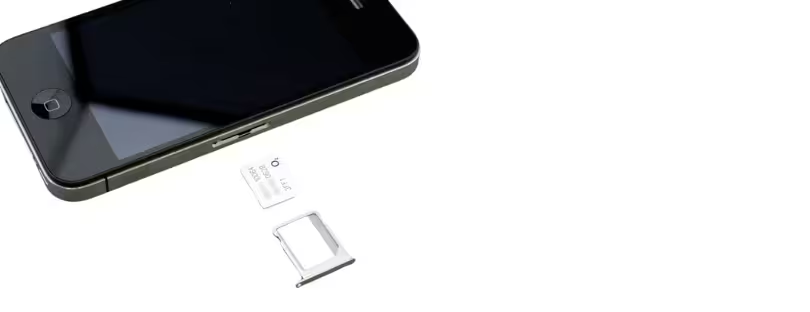
Another thing eSIM improves, even if we don’t think about it: device design. Removing the SIM tray means more space for better waterproofing, stronger build quality, and potentially larger batteries. Apple’s eSIM-only iPhones in the US weren’t a one-off experiment—they’re the roadmap. Android brands are moving in the same direction. In a few years, the SIM tray will feel as outdated as the headphone jack. eSIM isn’t just the present; it’s the direction the entire industry is moving.
Why Travelers Never Go Back After Trying eSIM
But the part that resonates most with travelers is simple: eSIM matches the spontaneity of modern travel. You can buy a data plan while waiting in a boarding queue. You can switch providers in a taxi. You can activate a new plan at 3 a.m. in a hotel lobby with nobody around to help. If your original plan runs out halfway through a train ride across Europe, you can top it up before you reach the next station.
There’s something incredibly freeing about not depending on physical availability. No shops. No clerks. No opening hours. With eSIM, connectivity becomes something you manage on your terms, quietly and independently.
When you zoom out, the difference between an eSIM and a traditional SIM card becomes really clear. Traditional SIMs require planning, effort, and physical handling. eSIM gives you speed, flexibility, and control. One belongs to the old world of telecom; the other matches the way we actually live now—fluid, mobile, constantly moving, constantly connected.
And once you’ve used an eSIM on a trip, it’s hard to imagine going back to juggling SIM cards at airport shops. It feels almost prehistoric. eSIM takes a necessary but annoying part of travel and makes it effortless. And for something as essential as staying connected, that improvement is huge.
The bottom line? eSIM enhances your user experience because it respects your time. It respects your travel style. It respects the way you move through the world.
And connectivity, when it’s done right, should feel exactly like that: smooth, simple, and invisible.
If you ever want to compare the best travel eSIM plans before your next trip, Alertify makes it easy—just pick your destination, check the options, and choose the one that fits. That’s the beauty of eSIM. It puts the traveler back in control.