eSIM Is Inevitable. The Panic Is Optional.
Let’s get this out of the way early: physical SIM cards are not sacred objects. They are not vinyl records, mechanical watches, or handwritten postcards. They are tiny pieces of plastic that exist because, in the 1990s, that was the best idea we had. And like many ideas from the 1990s, they’ve overstayed their welcome.

Yes, SIM cards worked. So did fax machines. So did maps printed on paper that folded into impossible origami shapes. Functionality alone is not a compelling argument against progress.
eSIM is not perfect, but pretending that physical SIM cards are some kind of flawless, foolproof system is selective memory at best.
The “It Just Works” Myth of Physical SIMs
There is a lot of nostalgia baked into the love for physical SIM cards. Pop it out, pop it in, done. No software, no apps, no QR codes, no carrier portals. Sounds great until you remember the rest of the experience.
SIM cards get lost. They get bent. They get cut badly by people with shaky hands and an irrational confidence in scissors. They get stuck in trays. They fall on hotel carpets and disappear into another dimension. They are forgotten at home when switching phones while traveling. They are stolen along with phones and immediately used for SIM-swap fraud.
The idea that physical SIMs “never fail” only holds true if you define failure very narrowly. They fail all the time. We have just normalized those failures because they look analog and familiar.
eSIM failures feel more dramatic because they are visible, logged, and involve software. That does not make them more frequent. It makes them harder to romanticize.
eSIM Is Not the Problem. Authentication Is.
Most eSIM horror stories collapse into the same root cause: carriers still treating SMS as a secure authentication method. That is not an eSIM flaw. That is a carrier policy failure.
Blaming eSIM for broken identity verification is like blaming email because someone forgot their password and used “123456” as a recovery option.
If your entire digital life collapses when SMS stops working, the problem is not that your SIM is embedded. The problem is that phone numbers were lazily promoted to universal identity keys.
This was a bad idea with physical SIMs, too. We just didn’t talk about it as much.
Software Problems Are Fixable. Plastic Is Not.
Here is the uncomfortable truth: software systems improve. Hardware limitations do not.
eSIM provisioning flows today are already significantly better than they were three or four years ago. Transfer tools exist. Cloud-linked profiles exist. Carrier apps exist. Platform-level protections exist. None of this was true when eSIM launched.
Meanwhile, the physical SIM has reached the end of its evolutionary path. You cannot update it. You cannot secure it remotely. You cannot back it up. You cannot revoke it instantly if stolen without human intervention.
An eSIM can be remotely disabled, reprovisioned, migrated, and protected with account-level security that does not depend on a piece of plastic behaving itself.
That is not a theoretical advantage. That is the foundation of modern infrastructure.

“I Had to Go to a Store” Is Not a Timeless Argument
Having to visit a carrier store when something breaks is not new. It is not exclusive to eSIM. It has been the default experience of mobile networks for decades.
The difference is expectation. We expect digital systems to be instant and perfect, while we tolerate analog inconvenience because we are used to it.
Standing in line for an hour feels outrageous when you believe the solution should be digital. Standing in line for an hour felt normal when SIM cards were invented.
That is not an argument against eSIM. That is an argument for carriers to finally modernize their support models.
The Battery Argument Misses the Point
The fixation on battery gains misses a much bigger picture. eSIM is not just about space. It is about flexibility.
It enables:
- Multiple active profiles without juggling trays
- Instant connectivity when traveling
- No waiting for physical delivery
- No country-specific SIM hunting
- No “my phone doesn’t accept that SIM size” nonsense
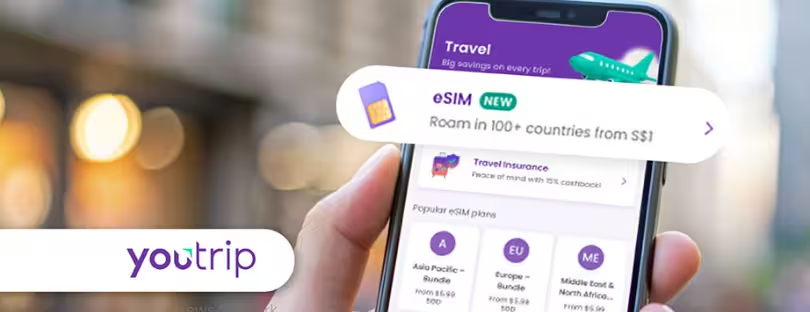
For travelers, remote workers, and anyone who crosses borders more than once a year, eSIM is not a downgrade. It is liberation.
And yes, maybe the battery gain is only single-digit percentages today. So were early gains from removing CD drives, VGA ports, and physical keyboards. The real payoff comes later.
Security Is Better Than We Pretend
Physical SIM cards are incredibly easy to misuse. Anyone who has ever dealt with SIM-swap fraud knows this.
An eSIM tied to an account protected by passkeys, hardware security keys, or app-based authentication is objectively harder to hijack than a piece of plastic that can be socially engineered out of a retail employee.
If your carrier still relies on SMS for everything, that is not an indictment of eSIM. It is an indictment of the carrier.
The future is account-centric security, not object-centric security.
Progress Always Feels Worse Mid-Transition
We are in the awkward middle phase. The systems are half modern, half legacy. Carriers are cautious. Users are confused. Support teams are undertrained. That is exactly how every infrastructure shift feels while it is happening.
We went through this with online banking. With cloud storage. With two-factor authentication. With contactless payments. Every time, the early complaints sounded identical.
And every time, going back was never the real solution.
Let’s Talk About the Roaming Bills We Pretend to Forget
And let’s not pretend the physical SIM era was some golden age of consumer protection, because it absolutely was not. This is the same system that happily allowed bill shock to become a rite of passage for travelers, where landing abroad meant either switching your phone off like it was 2003 or risking a roaming bill that looked more like a ransom note than an invoice. We paid €10 per megabyte, €100 for accidentally opening Instagram, and hundreds for doing absolutely nothing while our phones quietly synced in the background. Physical SIMs did not protect us from that; they enabled it, locking us into single-network dependency with zero transparency and zero real-time control. eSIM did not invent roaming chaos; it exposed it, and more importantly, it gave us a way out by making it normal to switch networks, compare prices instantly, and treat connectivity like a service you choose, not a punishment you endure.
The Plastic SIM Is Not a Hill Worth Dying On
The physical SIM card had a good run. A surprisingly long one. But defending it now feels less like pragmatism and more like fear of change wrapped in nostalgia.
eSIM is not perfect. It still needs better carrier UX, better recovery flows, and better user education. But it is fundamentally more aligned with how modern digital systems work.
The future of connectivity is software-defined, remotely managed, and identity-driven. Plastic does not belong in that sentence.
And no, we are not giving things up “for nothing.” We are trading a comforting object for a system that can actually evolve.
History tends to reward that choice, even when it is annoying at first.