Why the Hotspot Problem Keeps Catching Travelers Off Guard
There’s a certain kind of panic you only feel once: the moment you land, fire up your travel eSIM, try to open your laptop, hit “Personal Hotspot”… and realize the toggle is completely dead. No hotspot. No tethering. No way to connect your laptop, tablet, or partner’s phone. Just you, a bright green “Mobile Data” icon, and a greyed-out hotspot switch staring back at you like, “Don’t even try.”

If you’ve experienced this, you probably did what everyone does first:
Blame the phone.
Restart the phone.
Shout at the phone.
Google “hotspot not working eSIM,” which of course requires the hotspot to work in the first place.
And then, after ten minutes of self-doubt, you learn the truth no one tells you upfront:
Some eSIMs simply block hotspot use. Quietly. Silently. No warning. No heads-up in the fine print unless you scroll all the way down to a four-line footnote nobody reads on an airport escalator.
This isn’t a bug. It’s not a device issue.
It’s the plan.
Welcome to one of the most annoying eSIM surprises in modern travel.
Why hotspots get blocked in the first place
If you ask the average traveler why their hotspot wouldn’t work, they’ll say, “My phone is broken.”
If you ask a support agent, they’ll say, “Try turning it off and on.”
If you ask the actual telecom engineer, they’ll tell you the truth:
Hotspot blocking is almost always a plan-level restriction, not a device limitation.
Many low-cost travel eSIMs simply don’t allow tethering because the underlying roaming agreements don’t support it. To keep prices low, they purchase wholesale data with certain limitations — and hotspot is one of the first features to go.
Travelers only discover this when they try to join a Zoom call, upload something from their laptop, or help a friend get online. Because the industry rarely advertises hotspot restrictions, most people assume it’s standard. It isn’t.
Here’s the travel reality:
You might have data.
You might have coverage.
You might have a perfectly working eSIM.
But the moment you need to tether, the whole thing collapses.
And suddenly your “I’ll just work from the hotel lobby” plan becomes “I guess I’m walking around looking for Wi-Fi like it’s 2009.”
The hidden cost of blocked hotspots
You can tell how dependent people are on tethering by how angry they get when it doesn’t work.
For digital nomads, a hotspot is oxygen.
For business travelers, it’s reliability.
For families, it’s peacekeeping.
For partners who “don’t need an eSIM because we can share yours,” it’s a small diplomatic crisis.
Hotspot isn’t a “nice to have.”
It’s the basic infrastructure for the way people travel now.
 So when travelers discover it’s missing, the fallout is immediate:
- Missed remote meetings
- No access to work files
- Laptops rendered useless on arrival
- Tablets that can’t load maps or documents
- Kids threatening mutiny
- Friends begging for “just 2 minutes of Wi-Fi.”
All because the provider never mentioned a simple fact: tethering was never included.
The Yesim difference: hotspot built into the experience
This is where Yesim stands out — not because they magically override every network restriction on earth, but because they do the opposite of what frustrates travelers: they tell the truth.
And the truth is refreshingly simple:
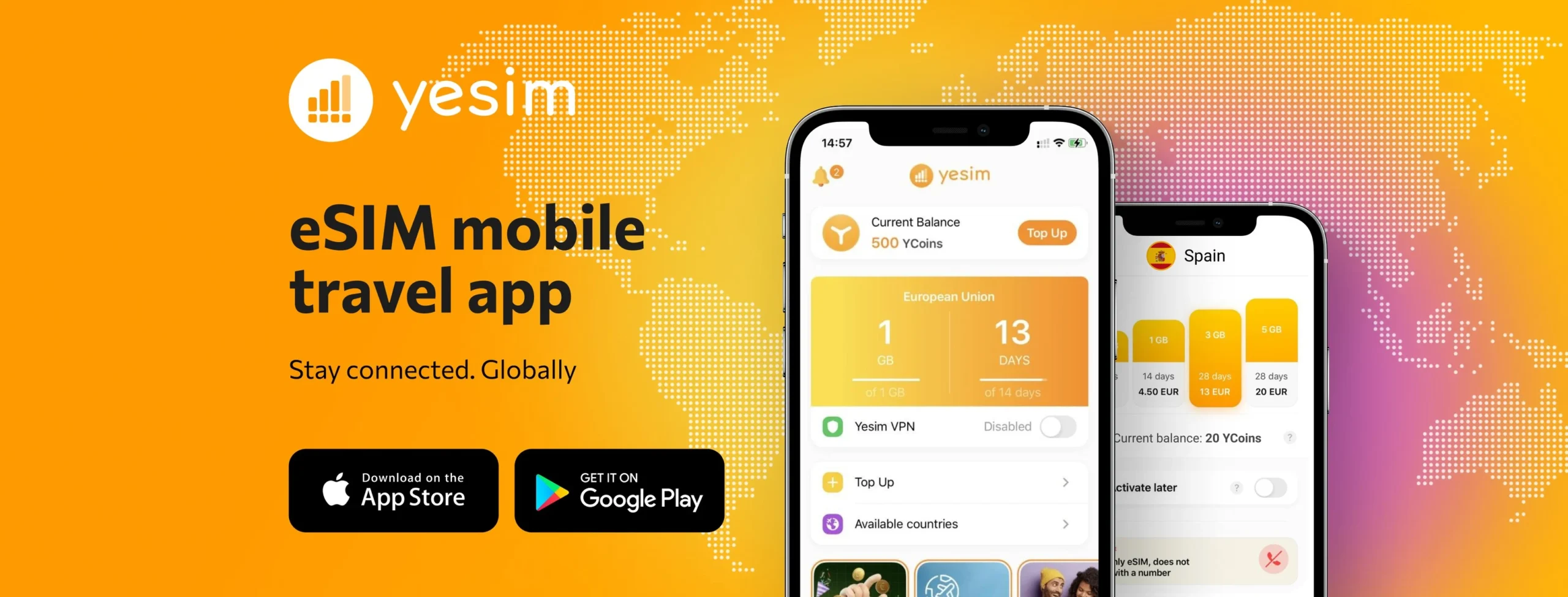
Most Yesim plans support hotspot/tethering by default.
Not as an upgrade.
Not as an extra fee.
Not as a hidden feature buried in app menus.
By default.
Yesim enables hotspot on your account automatically, so you don’t need to unlock anything or request access. And Yesim tells you exactly how to turn it on:
For both iOS and Android:
Go to Settings → Mobile Data → Personal Hotspot
or Settings → Personal Hotspot
Toggle “Allow Others to Join”
That’s it. No secret menus. No complicated steps. No “call us for hotspot permissions.”
And importantly:
You won’t be charged extra for using it.
Whatever you tether simply counts toward your data plan.
That transparency matters. Travelers don’t mind paying for data. They just don’t want surprise limitations that suddenly make their phone feel half-functional.
The disclaimer — and why it actually builds trust
Here’s where Yesim goes even further: they admit the one thing most providers try to hide.
The availability of a hotspot ultimately depends on the local network operator.
This is true across the entire telecom world. All eSIMs depend on partner networks, and if a carrier in a specific country restricts tethering, no eSIM provider — not even the giant ones — can override it.
But Yesim is one of the few who say this clearly instead of pretending everything is universally guaranteed. Their position is honest and realistic:
Hotspot should work on all Yesim plans in all regions.
In rare cases, local network rules may restrict it.
They cannot promise global perfection — no one can.
This candor is one reason Yesim continues to earn trust in a market where trust is rare.
Why do other eSIM providers stay silent about the hotspot
If you’ve used other eSIM providers, you may have noticed something: they rarely mention hotspot at all. And there’s a reason.
Silence is easier than explanation.
If you don’t mention the hotspot, you can’t be held responsible for it not working.
If you don’t promise anything, you don’t have to support it.
If you hide the limitation in fine print, you reduce support volume.
But the result is predictable: travelers feel misled, annoyed, sometimes outright scammed. Because for most people, tethering is not optional.
This is why Yesim’s openness stands out. Clarity is a differentiator.
A real-world scenario: the traveler test
Imagine two travelers landing in Lisbon.
Traveler A uses a budget eSIM.
Everything looks fine — data works, signal works — until they try to connect their laptop.
Hotspot toggle: grey.
Support: slow.
Result: frustration.
Traveler B uses Yesim.
They install the eSIM, turn on the hotspot, connect their laptop, and start working in five minutes.
Same country. Same airport.
Different experience entirely.
Not because the data is faster.
Not because one brand is magically better.
But because one provider understands how people actually use their phones.
Final Thoughts
Hotspot isn’t a feature. It’s a lifeline — especially for today’s travelers, who move between phones, laptops, tablets and partners who “forgot to buy an eSIM again.”
The real surprise isn’t that some providers block tethering.
It’s that they rarely tell you until you’ve already landed, unpacked, and tried to connect your laptop to read your hotel reservation.
Yesim’s approach — enable hotspot by default, explain how to activate it, and be upfront about network-dependent exceptions — is the direction the entire eSIM industry needs to move toward. Travelers don’t need more features; they need fewer surprises.
In a market full of providers who hide hotspot restrictions behind vague FAQs, Yesim chooses transparency and usability. And for travelers who depend on tethering to work, navigate, communicate, or simply keep the peace, that clarity makes all the difference.
If the future of travel connectivity is eSIM (and it is), then the future belongs to providers who make the essentials work exactly as expected. Hotspot included.