Digi Unveils New SGP.32 eSIM Accessory for Smarter IoT
Digi International is stepping into 2026 with a move that feels less like a product update and more like a signal to the entire IoT ecosystem. The company has announced a new SGP.32-compatible eSIM accessory designed to bring full-scale SIM lifecycle management to its connected device portfolio — and it arrives at a moment when enterprises are struggling to keep up with the operational complexity of global IoT deployments. Digi SGP.32 eSIM
At the heart of this release is something deceptively simple: a pre-loaded bootstrap profile that delivers instant out-of-box connectivity. But in practice, it unlocks the kind of flexibility, carrier choice, and remote governance that IoT deployments have been waiting for since eSIM first appeared on the roadmap.
And with Digi aligning its commercial rollout to the GSMA’s .32 standard, this is more than just a product. It’s an early blueprint for what interoperable, scalable IoT connectivity will look like in the next decade.
Why SGP.32 Matters More Than Ever
The industry has talked for years about “the promise of eSIM,” but Digi’s move lands at a very specific moment of inflection. Global eSIM adoption is accelerating fast: Juniper Research expects 4.9 billion connections to use eSIM by 2030 (up from just 1.2 billion in 2025). Meanwhile, GSMA Intelligence reports that 81% of enterprises consider eSIM essential to their IoT strategies — not a luxury, not a future nice-to-have, but essential.
But enthusiasm alone doesn’t solve the real-world problem: enterprises have devices scattered across regions, carriers, and regulatory environments, and they need a way to orchestrate all of it under one operational umbrella. That’s the gap SGP.32 is designed to close. And Digi’s early adoption positions it as one of the first IoT vendors to actually bring the standard into commercial deployments.
What Digi’s eSIM Accessory Actually Solves
If you’ve ever deployed cellular hardware at scale — whether routers, sensors, or industrial gateways — you know the pain points. Truck rolls, manual SIM swaps, unpredictableroaming conditions, carrier outages, physical theft, and SIM port failures have all been constant thorns in the side of distributed networks.
Digi is directly targeting that operational frustration with a set of capabilities that feel tailored for IoT fleets rather than consumer smartphones. With the bootstrap plan pre-installed, customers can:
Instant field deployment
No staging labs, no manual SIM prep — devices wake up connected.
Remote carrier switching
Move between carriers or rate plans without sending a technician.
Reduced mechanical risk
No removable SIM means fewer failures, fewer theft incidents, and better physical security.
Rapid recovery during outages
If a carrier goes down or quality dips, switching is fast, remote, and policy-driven.
Cost and performance optimization
Having up to eight profiles gives enterprises real agility in dynamic cost environments.
It’s also clear that Digi is thinking about the ecosystem layer, not just connectivity. The accessory is fully integrated with Digi Remote Manager, turning EX, IX, and TX routers into zero-touch, remotely orchestrated endpoints — a critical piece for industries like retail, transportation, and critical infrastructure, where downtime and manual servicing are costly.
A Small Accessory With Big Operational Implications
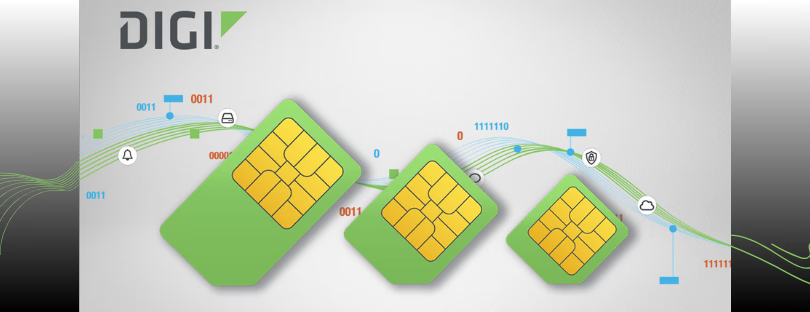
Packaged as a rugged 2FF 3-in-1 punchout card, Digi’s eSIM tool looks unassuming. But its role in distributed networking is substantial. The company is clearly aiming at the operational layer — where visibility, governance, and multi-carrier strategy intersect — and where most enterprises still rely on a patchwork of platforms.
The timing also hints at a bigger communications push: Digi plans to spotlight its eSIM orchestration strategy at Mobile World Congress 2026. With the IoT connectivity market entering its most competitive phase yet, showing an SGP.32-aligned solution this early gives Digi a strong narrative heading into Barcelona.
Where Digi Stands in the Broader eSIM Market
Digi vs. Other IoT Connectivity Players
Digi isn’t alone in chasing lifecycle eSIM management, but few players are aligning their offerings this closely with GSMA standards this early. Global IoT platforms like Telit Cinterion, Sierra Wireless (Semtech), and Eseye have taken strong positions on multi-carrier orchestration, but most still rely on hybrid systems that predate SGP.32 standardization. Meanwhile, connectivity-focused vendors like Soracom and 1NCE excel at cloud-native IoT SIM orchestration, yet their hardware integration layers differ significantly.
Digi has an advantage here: its routers are already widely deployed in transportation, retail, and infrastructure — meaning the company can push eSIM lifecycle capabilities into environments that typically lag behind in modernization. It’s a hardware-anchored path to eSIM adoption that many software-centric IoT providers can’t match.
Looking at market direction, the numbers reinforce Digi’s timing. Analysts like Juniper, Transforma Insights, and GSMA Intelligence all highlight the same trend line: eSIM is no longer a connectivity add-on but a foundational requirement for scaling IoT beyond regional footprints. Digi’s move mirrors where the market is going — toward unified orchestration, vendor-agnostic carrier selection, and touch-free device lifecycle governance.
The Conclusion: Digi Isn’t Just Releasing an Accessory — It’s Signaling the Next Phase of IoT
If you strip away the technical language, Digi’s new eSIM accessory is ultimately about removing friction — the operational friction that slows deployments, limits carrier choice, drives up connectivity costs, and makes global IoT unnecessarily complex.
What sets Digi apart is how tightly this solution fits into the realities of distributed networking. Unlike many eSIM offerings built with consumer devices in mind, this one understands that IoT environments are messy: remote, geographically diverse, difficult to access, and often mission-critical.
Competitors across the IoT landscape will no doubt match SGP.32 capabilities in the coming years, but Digi is helping set the pace — especially in the industrial and enterprise router space. And with reliable signals from Juniper and GSMA Intelligence showing eSIM adoption accelerating faster than previously forecast, Digi’s early alignment with standards-based lifecycle management puts it right where the industry is heading.
This isn’t just an accessory. It’s a stepping stone toward the next era of autonomous, policy-driven, carrier-agnostic IoT connectivity — and Digi is clearly positioning itself to be one of the companies defining that shift.
Driven by wanderlust and a passion for tech, Sandra is the creative force behind Alertify. Love for exploration and discovery is what sparked the idea for Alertify, a product that likely combines Sandra’s technological expertise with the desire to simplify or enhance travel experiences in some way.