Cuba Raises Roaming Prices to $3/Minute Starting Jan 29
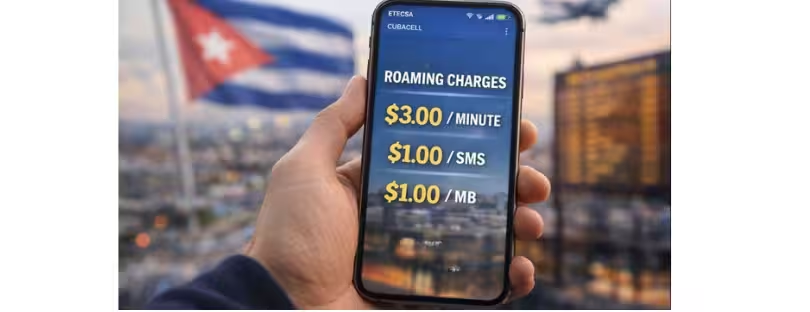
Starting January 29, making or receiving a phone call outside Cuba officially became far more expensive. Under a new regulation now in force, Cubans using international roaming can be charged up to three dollars per minute for calls, one dollar per SMS, and one dollar per megabyte of mobile data.
Cuba roaming charges
The decision did not arrive suddenly, even if it may feel that way for users. Resolution 48/2025 was signed at the end of October 2025 by the Minister of Communications, Mayra Arevich Marín. It remained largely unnoticed until its publication in Cuba’s Official Gazette on December 29. The legal text included a standard 30-day window before enforcement, which expired on January 29, the same day the Ministry publicly reiterated the measure.
For many Cubans, this was the first time the impact became real. Not when it was signed. Not when it was published. But when answering a call suddenly meant risking the equivalent of several days’ wages.
What the new roaming rates actually mean
With the regulation now active, users roaming abroad on Cuban mobile lines face the following maximum charges in prepaid mode, all denominated in U.S. dollars:
Calls: up to $3.00 per minute
SMS: $1.00 per message sent
Mobile data: $1.00 per megabyte
The prices apply to customers of ETECSA using international roaming services outside the country. The resolution allows the state-owned operator to offer lower rates, but only with explicit authorization from the Ministry of Communications.
In practice, this means that while the ceiling is now legally defined, users have no guarantee that more affordable alternatives will be available consistently or transparently. The burden of cost remains firmly on the customer.
A sensitive moment for a connected diaspora
The timing matters. Cuba is experiencing sustained emigration, frequent temporary travel, and a growing dependence on cross-border communication to maintain family ties. For many Cubans abroad, keeping a Cuban number active is not a convenience. It is often the only way to stay reachable by relatives at home, banks, government services, or employers.
In that context, a roaming call is not a luxury product. It is emotional infrastructure.
A single ten-minute call could cost $30. For perspective, that amount exceeds the monthly salary of many public-sector workers in Cuba. Even short, accidental connections can quickly become financially painful.
Transparency promised, safeguards unclear
The resolution states that ETECSA must inform users in advance about applicable rates based on the destination country and partner operator. On paper, that sounds reassuring.
In reality, there are no clearly defined safeguards against accidental roaming activation, network switching near borders, or background data usage. These are common issues globally, and they disproportionately affect prepaid users who lack real-time usage alerts or spending caps.
For Cuban users, this uncertainty adds stress. Not knowing whether your phone has silently connected to a foreign network is no small concern when every megabyte costs a dollar.
Mixed messages from authorities and operators
Adding to the confusion, the Ministry’s reminder of the new rates coincided with a separate announcement from ETECSA, published by Cubadebate.
That announcement focused on the future activation of international outgoing roaming for prepaid users. Starting March 1, 2026, Cubans abroad will be able to purchase dedicated roaming plans in dollars via international distributors and USD-based sales offices. The goal is to allow users to keep their Cuban line active while outside the country.
The issue is timing. While those plans remain a future promise, the high maximum rates are already in effect. For users skimming headlines or social posts, the overlap of messages risks creating the impression that affordable options are available now, when in fact they are not.

How does this compare globally
From a global roaming perspective, Cuba’s new ceiling places it at the extreme high end of the market.
In the European Union, retail roaming charges are capped and largely eliminated within the bloc. In Latin America, many operators offer roaming bundles that reduce per-minute costs to cents, not dollars. Even in traditionally expensive roaming regions, $3 per minute is considered punitive.
At the same time, the global trend is moving away from per-minute and per-megabyte billing entirely. Travelers increasingly rely on local SIM cards, Wi-Fi calling, or travel eSIMs that offer predictable pricing and flat data packages.
This shift is well documented by organizations such as the GSMA, which has repeatedly highlighted the decline of traditional roaming revenues and the rise of alternative connectivity models.
Communication as a controlled resource
Cuba stands apart not only in pricing but in structure. With a single state operator controlling mobile services, users lack competitive alternatives within the domestic system. That makes policy decisions feel heavier because there is no market pressure to soften their impact.
When communication becomes this expensive, it stops being neutral infrastructure and starts feeling like a gated service. One that users must ration carefully.
For families separated by borders, that reality is deeply personal.
Conclusion: where this leaves Cuban users
This is not just a story about roaming tariffs. It is a snapshot of how global connectivity trends clash with centralized telecom models.
Around the world, operators are lowering barriers, bundling access, and adapting to a mobile-first, borderless user base. Cuba is moving in the opposite direction, reinforcing per-use pricing at levels that most markets abandoned years ago.
Reliable data from GSMA reports, regional telecom regulators, and international travel connectivity providers all point in the same direction. Predictable, affordable mobile access is no longer optional. It is expected.
For Cuban users abroad, the message is clear. Until meaningful alternatives or safeguards appear, staying connected comes at a steep price. And every incoming call carries not just emotional weight, but financial risk too.
For Alertify readers, this is a reminder that roaming is never just technical. It is economic, political, and deeply human. Going to Cuba? Get a Cuba Nomad eSIM.