American Airlines Customer Service Enters App Era
American Airlines customer service used to mean one very familiar scene: a long line at the airport, tired passengers staring at screens, and one gate agent trying to fix 40 different travel problems at once.
That version has not disappeared. Anyone who flies often knows it still exists, especially during storms, missed connections, aircraft swaps, and full holiday flights. But American is clearly trying to move more of the customer service experience away from the counter and into the phone.
In March 2026, the airline announced a new digital experience designed to give passengers clearer explanations when flights are delayed or canceled. American Airlines says it operates nearly 7,000 flights a day and carries around 700,000 customers, so even small improvements in communication can affect a huge number of passengers. The key promise is not glamorous. It is basic: tell people what is happening, faster and more clearly. That matters. In aviation, silence is often what makes disruption feel worse.
The app is becoming the front desk
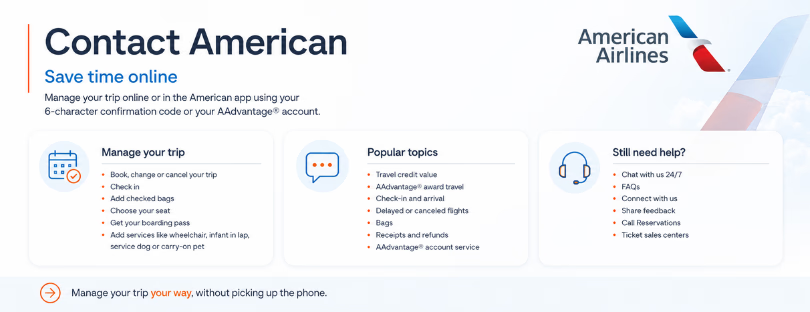
American’s customer service strategy is increasingly built around self-service. The airline’s own app already allows travelers to rebook when a flight is delayed or canceled, check boarding passes, track gate changes, and manage parts of the journey without waiting in line.
That sounds simple, but it reflects a bigger industry shift. Airlines no longer want customer service to begin only when something goes wrong. They want the app to act like a control panel before, during, and after the trip.
READ MORE: Why American Airlines Is Shifting Baggage Power to the App
In 2025, American also said it was testing a conversational AI assistant to help customers rebook during weather disruptions. That is the kind of tool that can be genuinely useful, but only if it works in real-life stress conditions. A chatbot that helps you grab the next available seat is a service. A chatbot that loops you through scripted answers while your connection disappears is just another delay wearing a digital costume.
This is where American’s challenge becomes interesting. It does not simply need more technology. It needs technology that feels calm, accurate, and accountable when passengers are already irritated.
Where passengers still lose patience
Customer service in airlines is rarely judged on an average day. It is judged on the worst day.
A smooth flight from Dallas to Miami does not make most travelers praise customer care. They expected that. But when a bag is missing, a flight is canceled, or a family is split across three rows, passengers suddenly measure every detail: how fast the airline communicates, whether the explanation sounds honest, whether the staff has the authority to solve the issue, and whether compensation is clear.
READ MORE: American Airlines and Mastercard Sign New Agreement to Enrich AAdvantage® Program
The U.S. Department of Transportation’s Air Travel Consumer Report exists exactly because these service issues are not soft complaints. They are measurable parts of airline quality, covering areas such as delays, baggage, oversales, and consumer complaints.
For American, this is especially important because it competes in the most unforgiving part of the market: huge network scale. More routes create more convenience, but also more operational complexity. When things go wrong, the customer does not care whether the cause was air traffic control, crew scheduling, weather, or maintenance. They care whether American helps them recover the trip.
The comparison with Delta, United and Southwest
American is not working in isolation. Delta has spent years turning operational reliability and premium service into brand equity. United has leaned hard into app functionality, real-time travel information, and a more confident product story. Southwest, even while changing parts of its historic model, still carries strong customer-service recognition in the economy segment.
J.D. Power’s 2026 North America Airline Satisfaction Study found that overall passenger satisfaction rose 8 points year over year, despite delays, cancellations, crowded airports, higher fares, and baggage fees. That tells us something important: passengers are not expecting perfection. They are rewarding airlines that make the journey feel more controlled.
READ MORE: American Airlines Uses AI to Predict Missed Flights
American’s opportunity is therefore not to pretend disruption can be eliminated. It cannot. The smarter goal is to make disruption less confusing. Clearer notifications, faster rebooking, better baggage visibility, more useful app tools, and empowered frontline staff are now part of the same customer service system.
There is also a premium angle. Reuters reported that American has been investing in a broader “customer reimagination” push, including premium upgrades, better in-flight products, faster Wi-Fi, and a renewed attempt to regain ground against Delta and United. That matters because customer service is no longer just a call center issue. It is the entire product, from seat comfort to connectivity to how easy it is to fix a bad travel day.
Final thoughts about American Airlines customer service
American Airlines customer service is moving in the right direction, but the bar has changed.
Passengers are no longer impressed by an app simply existing. They expect the app to solve problems. They do not want vague delay messages. They want plain language. They do not want to “contact customer support” five different ways. They want the airline to know the problem before they explain it.
That is the new contest between American, Delta, United, Southwest, JetBlue and the rest: not who sounds friendliest in marketing, but who removes the most anxiety when travel gets messy.
American has the network, the loyalty base, and now a visible digital-service push. But its customer service reputation will not be rebuilt by announcements. It will be rebuilt during the 11 p.m. cancellation, the missed connection, the missing suitcase, and the family trying to get home after a storm.
That is where airline trust is won now. Not in the slogan. In the recovery.