Apple AirTag Gets Smarter: Longer Range, Louder Sound, Same Price
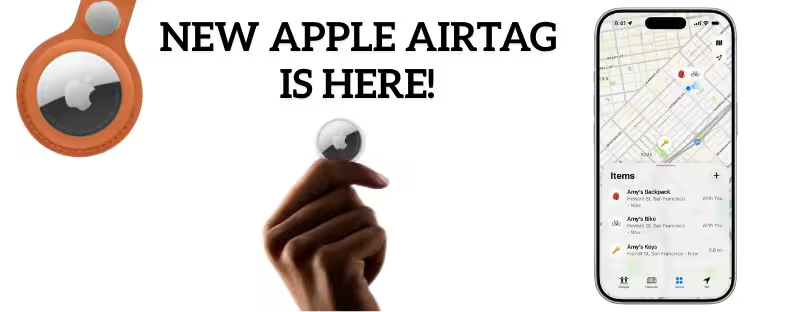
Apple is back with a familiar but meaningfully upgraded accessory. The new AirTag might look almost identical to the original, but under the hood, it is a much more capable tracker, clearly shaped by four years of real-world usage, user feedback, and a market that now fully understands how valuable item tracking has become. Apple AirTag new version
For frequent travelers, commuters, creatives, and frankly anyone who has ever muttered “where did I put that?”, this update lands at exactly the right moment.
A small product with very real stories behind it
Since its debut in 2021, AirTag has quietly become one of Apple’s most practical accessories. It is not flashy, but it is effective. Apple says users across the globe have been reunited with lost luggage, keys, bicycles, bags, and more thanks to the Find My network.
Some of the most compelling stories are deeply human. With the help of an AirTag placed inside an instrument case, a musician was able to locate their lost instrument and perform that evening, while another user was able to find lost luggage that contained a lifesaving medication.
Those stories explain why Apple has focused this update less on design changes and more on performance, reliability, and findability. The goal is simple. When something matters, you should be able to find it faster, from farther away, and with less friction.
Longer range, louder sound, less panic
The headline upgrade is range. The new AirTag is powered by Apple’s second-generation Ultra Wideband chip, the same one used in the iPhone 17 lineup, iPhone Air, Apple Watch Ultra 3, and Apple Watch Series 11. In practical terms, Precision Finding now works from up to 50 percent farther away than before.
That matters more than it sounds. If you have ever searched for keys buried deep in a backpack or a wallet lost somewhere in a hotel room, every extra meter counts. The combination of visual cues, haptic feedback, and directional audio makes the experience feel more confident and less frantic.
Apple has also upgraded Bluetooth performance, extending the range at which nearby devices can help locate an AirTag. And for the first time, Precision Finding works directly on Apple Watch Series 9 or later, or Apple Watch Ultra 2 or later. That wrist-based experience feels like a natural evolution, especially for travelers who rely on their watch as much as their phone.
Then there is the sound. The new AirTag is 50 percent louder than the previous generation and can be heard from up to twice the distance. The updated chime is sharper and more distinctive, which makes a difference in noisy environments like airports, train stations, or busy homes.

Find My is still the real superpower
Hardware improvements are important, but AirTag’s real advantage remains the Find My network. It is a crowdsourced system built on hundreds of millions of Apple devices worldwide, quietly and anonymously helping locate lost items via Bluetooth signals.
If your AirTag is out of range of your iPhone, nearby Apple devices can detect it and relay its approximate location back to you. All of this happens with end-to-end encryption, without revealing identities or locations to Apple or other users.
Apple has also doubled down on Share Item Location, a feature that has quietly become one of the most important developments in luggage recovery. Users can temporarily share the location of a misplaced item with trusted third parties, including airlines.
Apple now partners with more than 50 airlines that securely accept these location links. According to SITA, carriers report that using Share Item Location has reduced baggage delays by 26 percent and reduced incidences of truly lost or unrecoverable luggage by 90 percent.
For travelers, that is not a marketing stat. That is a tangible improvement in how lost luggage is handled. The shared access is time-limited, can be revoked at any moment, and automatically expires after seven days.
Built-in privacy, not bolted on later
AirTag continues to stand apart in how seriously Apple treats misuse prevention. It is designed exclusively for tracking objects, not people or pets, and includes industry-leading protections against unwanted tracking.
Location data is never stored on the device itself. All communication with the Find My network is encrypted. Bluetooth identifiers rotate frequently, and both iOS and Android users receive alerts if an unknown AirTag appears to be moving with them.
These safeguards matter more as trackers become more common. Apple’s approach has pushed the entire category forward and forced competitors to improve their own safety measures.
 Same design, greener materials, familiar accessories
 Same design, greener materials, familiar accessories
Visually, nothing has changed, and that is intentional. The new AirTag keeps the same form factor, meaning all existing accessories remain compatible. That includes Apple’s FineWoven Key Ring, available in five colors and made from 68 percent recycled content.
From an environmental standpoint, this update is quietly strong. The enclosure uses 85 percent recycled plastic. All magnets use 100 percent recycled rare earth elements. Apple-designed circuit boards use 100 percent recycled gold plating. Packaging is fully fiber-based and recyclable.
This aligns with Apple 2030, the company’s plan to become carbon neutral across its entire footprint by the end of the decade.
Pricing stays refreshingly unchanged
Despite the hardware upgrades, pricing remains exactly the same. AirTag costs $29 for a single unit or $99 for a four-pack, with free personalized engraving when ordered through Apple’s online channels.
The FineWoven Key Ring is priced at $35 and sold separately.
Availability starts immediately online, with in-store availability following shortly through Apple Stores and authorized resellers.
Conclusion: AirTag and the state of item tracking
The item tracker market is no longer niche. Players like Tile, Samsung SmartTag, and Chipolo all offer capable products, and competition has improved dramatically in recent years. Tile remains platform-agnostic and popular with Android users. Samsung’s SmartTag works well inside the Galaxy ecosystem. Chipolo has leaned into affordability and simplicity.
What Apple continues to do better is scale and integration. The sheer size of the Find My network remains unmatched, and features like Share Item Location with airlines show how tracking is evolving beyond personal convenience into operational recovery workflows.
Industry data from SITA, airline adoption trends, and growing traveler reliance on trackers all point to one thing. Item tracking is becoming an expected layer of modern travel, not a nice-to-have accessory.
With this update, Apple is not reinventing AirTag. It is reinforcing it. Better range, louder alerts, wrist-based finding, deeper airline integration, and unchanged pricing make the new AirTag a clear benchmark in the category.
For Alertify readers, especially frequent travelers and business users, the message is simple. Tracking is no longer about gadgets. It is about ecosystems, partnerships, and trust. And right now, Apple continues to set the pace.