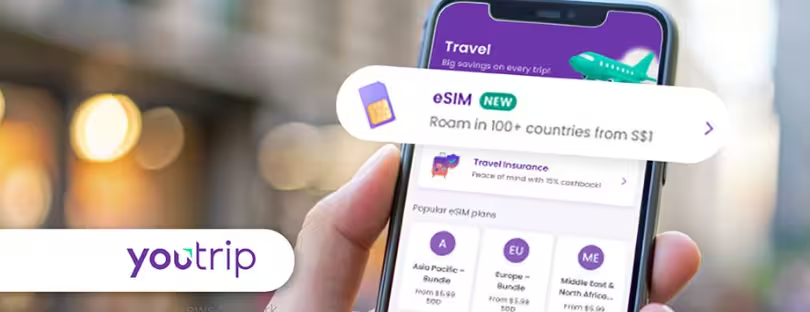
Affordable eSIM: The Hidden Travel Upgrade That Saves Real Money
Let’s be honest: roaming fees are the silent trip-ruiner nobody warns you about. You can book the perfect boutique hotel, hunt down cheap flights for weeks, pack like an absolute pro—and then one absent-minded swipe on Instagram abroad hits you with a €68 bill. All because your phone dared to load a Reel.

That’s exactly why “affordable eSIM” has turned into one of the hottest travel searches right now. Travelers are finally realizing that mobile data doesn’t need to cost more than lunch in a European capital. And if you’ve ever stood at an airport kiosk comparing overpriced tourist SIM cards with blurry eyes after a long-haul flight, you know the pain—and the promise of skipping all that.
So let’s talk about what affordable actually means in the eSIM world, how to spot real value vs. marketing fluff, and which strategies help you keep your phone connected without turning your travel budget into confetti.
Why Affordable eSIMs Matter More Than Ever
eSIMs didn’t just become popular because they’re convenient. They became popular because travelers started noticing how wildly overpriced traditional roaming is. A €2 per MB charge is not “premium service”; it’s daylight robbery dressed in telecom jargon.
Affordable eSIMs solve that problem in three really practical ways. First, you pay upfront, which means no surprise bill waiting for you at home like a horror movie jump scare. Second, plans are built around the way we actually travel now—weekend breaks, multi-country hops, remote work weeks — not some outdated “one size fits nobody” roaming package. Third, you can compare offers online, calmly, with coffee in hand, instead of panicking at an airport kiosk while your suitcase tries to roll away.
And the cherry on top? You don’t need to hunt for a physical SIM card, poke your phone with a paperclip, or stand in a queue
behind 40 jet-lagged people. You buy it, scan it, and you’re connected before the plane even touches down.

What “Affordable” Really Means (It’s Not Just the Lowest Price)
Here’s the trap a lot of people fall into: they think “affordable” equals “cheapest.” But the cheapest plan is not always the best deal. That €1 plan for 1 GB looks cute until Google Maps eats it in 40 minutes and you’re suddenly topping up like you’re feeding a slot machine.
Real affordability is more like a cocktail: price is one ingredient, but so are coverage, speed, validity, and flexibility. If you want a plan that actually feels budget-friendly in real life, look at:
- Price per GB: Compare plans on a per-gigabyte basis. A 10 GB plan for €18 is often a better value than a 5 GB plan for €12 — if you’re going to use the data.
- Validity period: Some low-price plans last only 3–5 days. Great for a city break, terrible for a two-week trip.
- Network quality: Saving money is pointless if your data crawls at the speed of sadness.
- Top-up options: Good providers let you add more data without forcing you to buy a brand-new plan.
If a plan nails those four things, it’s genuinely affordable — not just cheap-looking on the surface.
Why Travelers Love Budget-Friendly eSIMs (Even Non-Techies)
Most travelers want two things: a phone that works abroad, and not getting ripped off. Affordable eSIMs hit both of these beautifully. Even people who were loyal to the “I’ll just use hotel Wi-Fi” lifestyle are switching because eSIMs have become accessible and easy.
The most common reactions I hear from travelers are surprisingly simple:
“I love that I can activate it during the flight.”
“It just works.”
“It’s finally cheap enough that I’m not scared to use my phone.”
And honestly, that last one matters more than we admit. Travel is already full of decisions. You shouldn’t be rationing data like it’s water in the desert.

Where Affordable eSIMs Make the Biggest Difference
Not every destination has the same mobile data vibe. Some countries are naturally cheap; others make you feel like every MB is a luxury item. Affordable eSIMs are a game-changer in places where traditional roaming or tourist SIM pricing is famously high.
Think destinations like Switzerland, the USA, Japan, Turkey, or island regions where local options can be weirdly expensive
or a hassle to buy on arrival. In those spots, an affordable eSIM often costs a fraction of what your home operator would charge for roaming.
They’re also brilliant if you’re jumping across borders. A regional eSIM for Europe or Southeast Asia can save you from swapping SIMs every time you cross into a new country. No more collecting tiny plastic cards like confused Pokémon.
How to Find the Best Affordable eSIM for Your Trip
Good news: this doesn’t require secret industry knowledge or a telecom degree. You just need a simple process.
- Start with the destination. Prices vary by country. A plan for Thailand can be dirt cheap; Iceland might cost more.
- Be honest about your data habits. If you’re doing Maps, WhatsApp, and a few photos, you’re probably fine on 3–5 GB.
If you’re uploading content, working remotely, or streaming, go bigger. - Compare price per GB, not just the headline price. That’s where real value hides.
- Check validity. A “cheap” 7-day plan is not cheap if your trip is 14 days.
- Make sure the provider uses strong local networks. The plan is only as good as the network behind it.
- Look at traveler reviews. Especially for speed, reliability, and how easy top-ups are.
If a provider checks most of those boxes, you’re in safe, affordable territory.


Affordable Doesn’t Mean Low Quality Anymore
This is one of the biggest shifts in the eSIM market lately: affordable options aren’t automatically “budget” in a bad way.
The market has become competitive. Providers are constantly adjusting prices, improving apps, adding better coverage, and basically, fighting for travelers’ loyalty.
That means a plan that costs €6 today might have been €12 a year ago. Travelers are winning, and it shows. Better prices, better transparency, and fewer creepy surprises.
So yeah, “affordable” in 2025 doesn’t mean you’re settling. It means you’re being smart.
Airhub eSIM: One of the Most Affordable Ways to Stay Connected While Traveling
If you’re hunting for a truly affordable eSIM option, I’d recommend checking out Airhub eSIM—it’s one of the best value choices on the market right now. It offers coverage in over 190 countries, making it ideal for globetrotters and business travelers alike. You’ll find flexible prepaid plans—daily, weekly, and monthly—and many of them include data, voice & SMS, so you’re not only online but fully connected.
The setup is painless: buy online, scan the QR code, activate, and you’re good to go—no SIM swap, no airport kiosk runs. And best of all: the pricing is competitive—you’ll often pay far less per GB than traditional roaming or local tourist SIMs.
Final Thoughts: Affordable eSIMs Are a Smart Traveler’s Secret Weapon
Travel is already stressful enough. Delayed flights, confusing train platforms, that moment you realize your “sea view” is actually a suspiciously blue parking lot reflection… You don’t need mobile data to join the chaos.
Affordable eSIMs give you what every traveler really wants: control.
Control over your budget.
Control over your connectivity.
Control over your data use without fear of a post-trip bill slap.
So if you’re planning your next trip—whether it’s a weekend city break, a multi-country adventure, a business sprint, or a digital nomad month—an affordable eSIM is probably the easiest upgrade you can make.
Once you try one, the idea of paying old-school roaming fees feels… kind of wild.