Volkswagen Picks Qualcomm to Power Its Software-Defined Cars
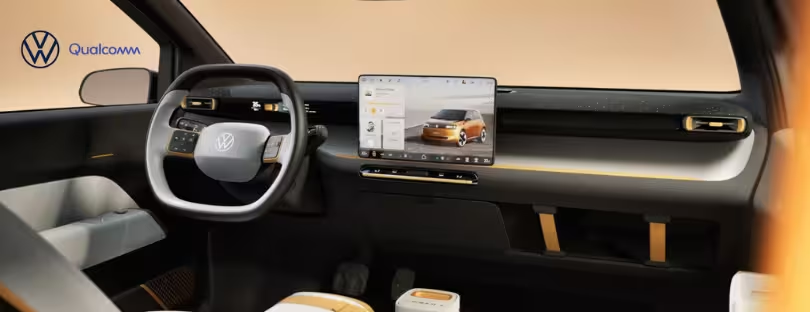
Volkswagen Group and Qualcomm Technologies have quietly made one of the most strategically important moves in automotive tech this year. The two companies announced a Letter of Intent for a long-term supply agreement that will put Qualcomm at the heart of Volkswagen’s next-generation infotainment, connectivity, and automated driving stack. Volkswagen infotainment system
This is not just another chip supply deal. It is a signal that Volkswagen is committing fully to the software-defined vehicle era, with a consolidated technology backbone designed to scale across brands, markets, and price segments.
For readers following the evolution of SDVs, this announcement confirms something the industry has been hinting at for a while. Legacy automakers are no longer experimenting. They are locking in partners and architectures for the next decade.
Qualcomm becomes core to Volkswagen’s zonal architecture
At the center of the agreement is Volkswagen’s new zonal SDV architecture, developed for the Western hemisphere through its joint venture with Rivian Automotive under Rivian and Volkswagen Group Technologies, often referred to as RV Tech.
Under the intended agreement, Qualcomm would act as Volkswagen Group’s primary technology provider for high-performance system-on-chip powering infotainment systems, starting from 2027. These SoCs will be based on Snapdragon Digital Chassis solutions and are designed to manage increasingly complex in-vehicle workloads.
Zonal architecture is a major shift away from today’s fragmented ECU based setups. Instead of dozens or even hundreds of individual controllers, a few powerful central computers manage vehicle functions across zones. This reduces complexity, improves updateability, and lowers long-term costs.
Volkswagen plans to integrate this SDV architecture into the ID.EVERY1 and all future electric vehicles built on the Scalable Systems Platform. In other words, this is not limited to premium models. It is meant to be the foundation across the portfolio.

Infotainment as a competitive battleground
Infotainment is no longer just about screens and navigation. It has become one of the main ways automakers differentiate themselves, especially as electric platforms level the playing field on performance.
Volkswagen intends to leverage the Snapdragon Cockpit Platform to deliver immersive digital experiences that can evolve over time via over-the-air updates. Think adaptive user interfaces, deeper personalization, and continuous feature expansion long after the car leaves the showroom.
Vehicles built on this platform can support agentic AI driven experiences that anticipate driver needs in real time. That includes everything from adjusting climate and seating preferences to optimizing routes and enabling multimodal voice and gesture controls.
This matters because consumers increasingly compare in-car experiences to smartphones and connected devices. Brands that fail to meet those expectations risk losing relevance, especially among younger and tech-savvy buyers.
Automated driving moves closer to scale
The collaboration with Qualcomm does not stop at infotainment. Volkswagen’s Automated Driving Alliance, formed by CARIAD and Bosch, is already working with Qualcomm Technologies to accelerate highly automated driving development.
The alliance plans to use Snapdragon Ride Elite, Qualcomm’s most powerful automotive compute platform, to build an AI based system for highly automated driving that can scale across brands and model lines. Crucially, this system is designed to be fully compatible with Volkswagen’s SDV architecture.
Snapdragon Ride Elite is built around an end-to-end AI architecture that prioritizes ultra-low latency. That is essential for sensor fusion, real-time decision making, and safety-critical driving functions.
For Volkswagen, this approach solves a problem many automakers face. How to develop advanced driver assistance and automated driving systems once, and then deploy them consistently across a diverse brand portfolio.
Next-Gen infotainment solutions and driver assistance systems are becoming increasingly important for differentiating our products and now account for a significantly higher share of vehicle value. With Qualcomm Technologies as one partner for the future, we are securing long-term access to the semiconductors that are essential for these technologies. Qualcomm Technologies is among the leading global suppliers of automotive semiconductors. Together, we are continuing a trusted collaboration to deliver a greater efficiency, stability, and predictability in our supply chain – while strengthening our capabilities in developing key technology fields.
said Karsten Schnake, Member of the Board of Management for Procurement, Volkswagen Passenger Cars brand.

Connectivity becomes foundational, not optional
Another key element of the intended agreement is connectivity. Volkswagen brands plan to integrate Snapdragon 5G Modem RF and V2X technologies into next-generation SDV-based vehicles.
This enables ultra-fast connectivity and real-time communication with other vehicles and infrastructure. The result is safer, smarter, and more connected driving, with applications ranging from hazard warnings to traffic optimization.
Connectivity also underpins everything else Volkswagen wants to do with software-defined vehicles. Over the air updates, feature subscriptions, fleet analytics, and AI-driven services all depend on reliable, high-bandwidth connections.
As vehicles become rolling computers, connectivity is no longer an add-on. It is part of the core architecture.
Why consolidation matters now
Volkswagen executives were unusually direct about why this partnership matters. Karsten Schnake, Board Member for Procurement at Volkswagen Passenger Cars, pointed out that next-generation infotainment and driver assistance systems now account for a significantly higher share of vehicle value.
By working with Qualcomm as a long-term partner, Volkswagen aims to secure access to critical semiconductors while improving supply chain stability and predictability. After years of chip shortages and fragmented sourcing, consolidation is a strategic necessity.
Volkswagen Group is advancing toward a fully software-defined future, and we are proud that Snapdragon Digital Chassis will serve as a core enabler of that transformation. This collaboration builds on the trust and momentum we’ve established over many years and reinforces Qualcomm Technologies’ commitment to delivering the high-performance compute, connectivity, and AI capabilities modern vehicle architectures demand. Together, we are advancing a modern vehicle architecture that is software-defined, AI-ready, and globally scalable – supporting updatable infotainment and accelerating the development of highly automated driving.
said Enrico Salvatori, SVP and President, Qualcomm Europe.
Werner Tietz, Head of Volkswagen Group Research and Development, framed it even more clearly. High-performance semiconductors are the foundation for aligning software and hardware. Without that alignment, software-defined ambitions remain theoretical. Volkswagen infotainment system

Qualcomm strengthens its automotive position
For Qualcomm, this agreement further cements its role as one of the most influential technology suppliers in the automotive sector. The company has spent years repositioning itself from a mobile-focused chipmaker to a full-stack automotive platform provider.
Executives at Qualcomm emphasized that Snapdragon Digital Chassis is designed specifically for software-defined architectures. It combines compute, connectivity, and AI in a way that supports scalability across global markets.
Enrico Salvatori, President of Qualcomm Europe, highlighted that this collaboration builds on years of trust and momentum. More importantly, it aligns Qualcomm with one of the world’s largest automakers at a time when platform decisions are becoming irreversible.
How does this compare to the wider market
Volkswagen’s move mirrors a broader industry trend. Tesla continues to rely heavily on in-house silicon and vertically integrated software. Mercedes-Benz has partnered closely with NVIDIA for its MB.OS and automated driving roadmap. BMW is combining Qualcomm and in house development for its Neue Klasse platform.
What sets Volkswagen apart is the sheer scale and brand diversity it is trying to support with a single SDV architecture. Few automakers operate across as many segments, price points, and regions.
By choosing Qualcomm as a primary partner, Volkswagen is betting on a supplier that can deliver consistency across that complexity. This contrasts with approaches that rely on multiple chip vendors and bespoke architectures per brand.
What this means for drivers and the industry
For consumers, the impact will not be immediate. The first vehicles using these platforms are expected from 2027 onwards. But the long-term implications are significant.
Cars will increasingly behave like updatable digital products rather than static machines. Features will improve over time. Interfaces will adapt. Driving assistance will evolve as software matures.
For the industry, this deal reinforces the idea that software-defined vehicles require deep, long-term partnerships between automakers and technology providers. Short-term sourcing strategies are no longer enough.
Conclusion: a decisive step in the SDV race
Volkswagen’s intended agreement with Qualcomm is best understood as a strategic alignment rather than a procurement announcement. It places the Group firmly alongside players like Tesla, Mercedes-Benz, and BMW in the race to define the software-first vehicle.
By consolidating infotainment, connectivity, and automated driving compute around Snapdragon platforms, Volkswagen is reducing fragmentation and increasing its chances of executing at scale. That is something many legacy automakers have struggled with.
Industry analysts from sources such as Automotive News, McKinsey, and S&P Global Mobility have consistently highlighted software complexity and semiconductor integration as the biggest risks to SDV success. Volkswagen appears to be addressing both head-on.
If executed well, this partnership could become a blueprint for how traditional automakers transition into software-led mobility companies. Not by trying to do everything alone, but by choosing the right long-term technology allies at the right moment.