There is a myth that still circulates in boardrooms. If you want to expand internationally, you need local infrastructure. Local entities. Local telecom contracts. Local phone lines.
The companies scaling fastest across borders today are not opening phone lines. They are deploying telecom infrastructure the same way they deploy cloud servers: digitally, instantly, and modularly.
And increasingly, they are doing it with virtual numbers.
Why local numbers still influence revenue
Before we dismiss traditional telecom thinking, let’s acknowledge something important.
Local numbers still convert better.
A UK customer is more likely to trust a +44 number. A US prospect is more inclined to answer a +1 call. In markets like the Netherlands, Canada, Israel, and Ukraine, the pattern repeats.
Local prefixes signal familiarity. Familiarity reduces friction. Friction impacts revenue.
The difference now is that you no longer need a physical presence in London or New York to create that signal.
Local trust has been decoupled from local real estate.
From telecom contracts to telecom layers
Telecom used to be static.
You signed a contract. Installed lines. Paid fixed fees. Accepted multi-year obligations.
Now it behaves more like software.
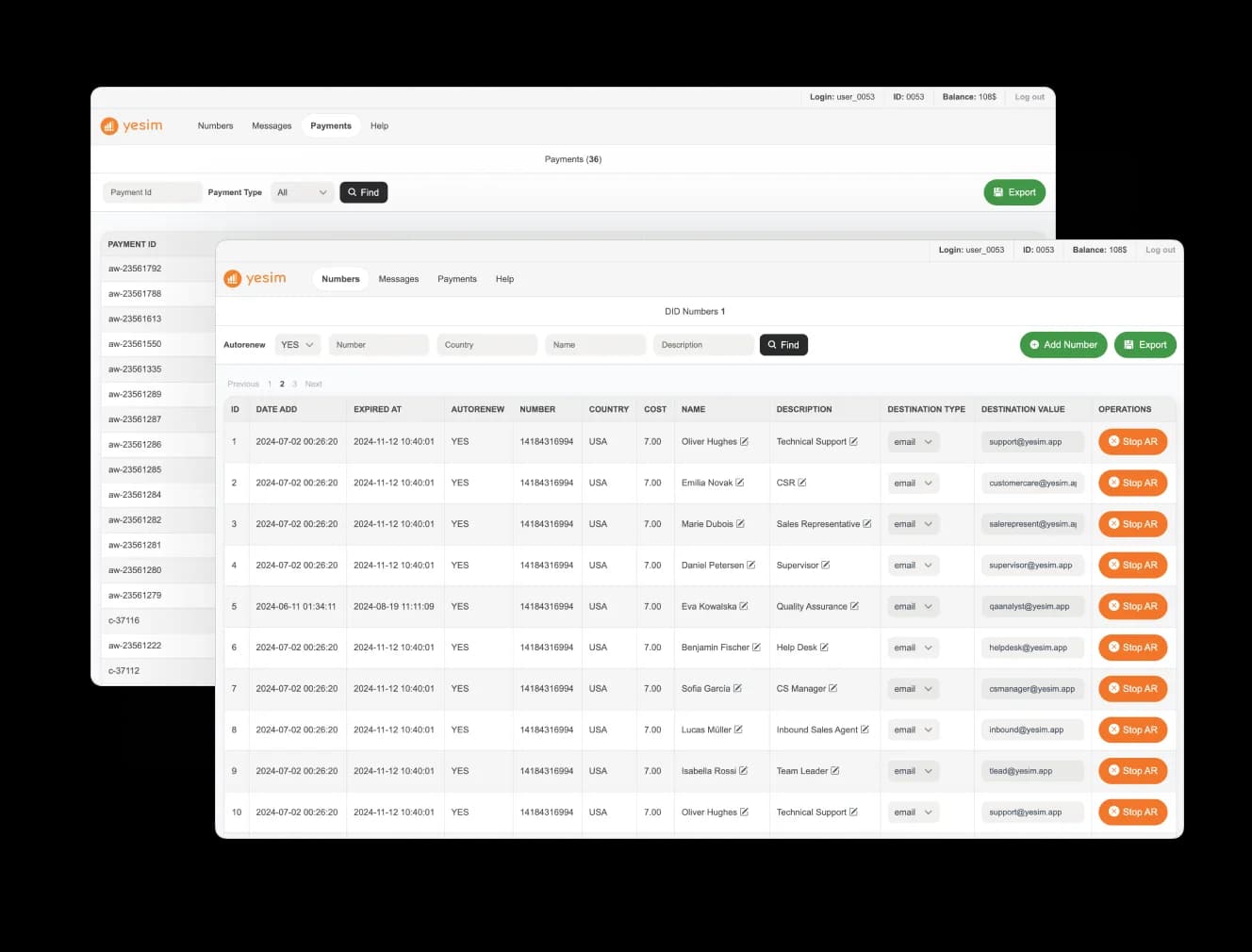
With structured virtual number platforms, companies can activate local numbers in the United Kingdom, the United States, the Netherlands, Canada, Israel, and Ukraine from €3 per month. No installation. No in-country technician. No waiting period.
This is not a workaround. It is infrastructure abstraction.
Providers such as Yesim, known for global eSIM connectivity, have extended their stack into business virtual numbers. That move is not cosmetic. It reflects a larger shift: connectivity and identity are converging into digital assets.
Numbers are no longer physical lines. They are programmable endpoints.
Expansion without capital lock-in
The real strategic advantage is not price. It is optionality.
Imagine you are launching in the US market.
Old model:
Incorporate locally. Open bank accounts. Secure telecom contracts. Deploy physical infrastructure. Commit capital.
New model:
Activate a US number online. Route inbound calls to your existing team. Run campaigns. Measure demand.
If traction appears, you scale operations. If it does not, you close the number.
The cost of testing a new geography drops to negligible levels.
This fundamentally changes international risk models. Market entry becomes iterative instead of binary.
The overlooked layer: digital platform identity
International expansion today is not only about customer calls.
It is about platform verification.
Businesses require phone numbers for WhatsApp Business accounts, Telegram communities, Google verification, Instagram campaigns, TikTok growth initiatives, Binance onboarding, OpenAI access, and dozens of other services.
Using employee personal numbers for these processes is operationally reckless. Using temporary prepaid SIM cards is unstable.
Dedicated virtual numbers for services, starting from €3 per month, create structural clarity.
Marketing gets its own WhatsApp line. Growth experiments get separate Telegram numbers. Verification flows are isolated.
Phone numbers become governance tools.
In an ecosystem where digital identity increasingly relies on phone verification, virtual numbers are part of the security architecture.
Telecom as strategic infrastructure
This is where the conversation becomes more serious.
Virtual numbers are not a convenience feature. They are strategic infrastructure.
The telecom industry itself is shifting toward software-defined models. Organizations like GSMA have repeatedly emphasized digital provisioning, virtualization, and network abstraction as central to modern telecom evolution.
eSIM replaced physical SIM logistics. Virtual numbers are replacing physical line dependency.
Both trends reduce friction. Both trends increase scalability.
And both reflect the same structural principle: infrastructure should not slow growth.
Compliance separates professionals from amateurs
There is a reason many businesses hesitate around virtual numbers.
The market is fragmented.
Serious providers are operating within regulatory frameworks. And there are grey-market SMS rental platforms that collapse under policy enforcement or platform bans.
Global numbering resources are regulated assets. They are overseen nationally and aligned internationally through bodies like the International Telecommunication Union.
Serious providers operate within these frameworks. That matters.
Because the cheapest solution often fails precisely when scale begins.
Professional expansion requires professional infrastructure.
Why this trend is accelerating
Several macro forces are converging:
Remote-first companies Distributed teams Global SaaS models Cross-border fintech Creator and influencer economies API-driven onboarding systems
Geography is becoming operationally irrelevant for digital-native companies.
But trust remains geographically coded.
Virtual numbers bridge that paradox.
They allow businesses to signal local credibility without committing physical capital.
That is not a marketing benefit. It is structural efficiency.
Where Yesim fits in the modern stack
Yesim’s positioning is particularly interesting because it sits at the intersection of connectivity and identity.
Known for global eSIM deployment, it now offers virtual numbers for countries including the UK, US, Netherlands, Canada, Israel, and Ukraine starting from €3 per month. It also provides service-based numbers for WhatsApp, Telegram, Google, Instagram, TikTok, Binance, OpenAI, and others at similar entry pricing.
The significance is not the country list.
The significance is integration.
A company can manage global data connectivity and local number identity inside a unified digital workflow. No hardware. No fragmentation.
For internationally active teams, that means fewer vendors, fewer contracts, fewer friction points.
It is modular telecom, aligned with modern operational logic.
What we are observing across markets
From Alertify’s perspective, analyzing travel tech, fintech, and remote-first businesses, the pattern is clear.
Companies expanding fastest are not overbuilding infrastructure.
They activate numbers before hiring locally. They use country-specific numbers to test campaign ROI. They isolate platform verification through dedicated service numbers. They scale only after signal confirmation.
Telecom becomes experimental infrastructure instead of fixed cost.
This is particularly powerful in volatile economic environments, where capital preservation and flexibility define resilience.
The bigger transformation
We are witnessing something deeper than cost optimization.
We are witnessing the dematerialization of telecom identity.
Phone numbers are becoming API-controlled assets. Provisioning is becoming instant. Geography is becoming configurable.
Compared to legacy fixed-line contracts, virtual number platforms represent a structural upgrade.
Compared to unstable SMS resellers, compliant providers represent risk mitigation.
Compared to physical expansion models, digital telecom layers represent strategic agility.
Conclusion: Global presence is no longer physical
The companies that will dominate cross-border commerce over the next decade will not be those with the most offices.
They will be those with the most adaptable infrastructure.
Virtual numbers allow businesses to separate presence from property, credibility from capital lock-in, and identity from geography.
That separation changes everything.
International expansion no longer begins with leasing space. It begins with provisioning endpoints.
And increasingly, the first signal of global ambition is not a new office.
Driven by wanderlust and a passion for tech, Sandra is the creative force behind Alertify. Love for exploration and discovery is what sparked the idea for Alertify, a product that likely combines Sandra’s technological expertise with the desire to simplify or enhance travel experiences in some way.