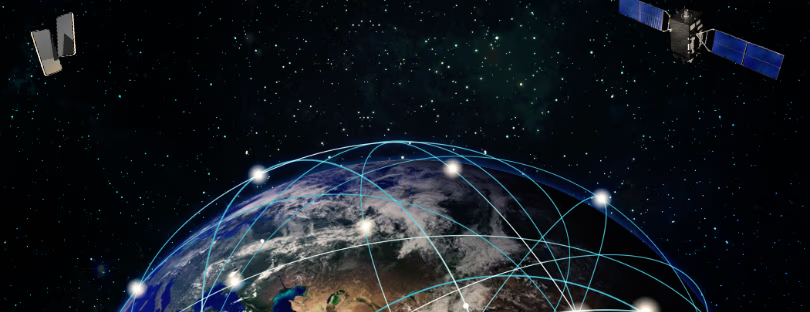
UK First in Europe to Approve Direct-to-Device Satellite Services for Smartphones
The UK is set to lead Europe in the rollout of satellite connectivity for standard smartphones, following Ofcom’s landmark decision to authorise Direct-to-Device (D2D) satellite services using existing mobile spectrum bands. This breakthrough means that, for the first time in Europe, ordinary smartphones will be able to connect directly to satellites — allowing users to make calls, send texts, and access the internet in places where terrestrial mobile masts have never reached.

The announcement comes amid a global race to integrate satellite and terrestrial networks. In the United States, companies such as SpaceX’s Starlink and AST SpaceMobile are testing satellite-to-phone services, while Apple has already launched satellite-enabled emergency messaging through its partnership with Globalstar. Amazon’s Project Kuiper is also eyeing direct-to-device connectivity. By moving early, the UK is positioning itself as a regulatory pioneer in Europe, setting the stage for wider adoption of hybrid mobile-satellite services.
For UK consumers, the change could be transformative. Rural communities in Scotland, Wales, and Northern Ireland, where mobile coverage gaps remain a persistent issue, stand to benefit from expanded connectivity. In emergencies — from storms to power outages — smartphones connected by satellite could provide a lifeline when terrestrial networks go dark. For businesses and public services, especially in transport, logistics, and utilities, the shift could unlock new opportunities for IoT innovation and operational resilience.
Ofcom’s Decision on Satellite Smartphone Connectivity
In a consultation earlier this year, Ofcom examined options for enabling D2D satellite services in spectrum bands below 3 GHz currently licensed to UK Mobile Network Operators (MNOs). After reviewing extensive stakeholder input, Ofcom has confirmed that it will move forward with a licensing framework allowing MNOs to integrate satellite services into their existing spectrum rights.
Specifically, Ofcom will:
- Introduce licence variations for MNOs, authorising them to support satellite-to-smartphone services.
- Create a new exemption regulation so that ordinary smartphone users can connect to satellites without requiring individual licences.
This approach ensures compliance with the Wireless Telegraphy Act 2006, under which the use of radio equipment in the UK would otherwise require specific licences.

Benefits of Direct-to-Device Satellite Services in the UK
By implementing this framework, the UK will become the first European nation to authorize mass-market smartphone connectivity with satellites. The potential benefits are wide-ranging:
- Improved rural coverage: Extending reliable service to the UK’s most remote and underserved communities.
- Resilience in emergencies: Offering backup communications when terrestrial networks experience outages.
- Support for IoT expansion: Enabling new applications where connected devices can rely on satellite links.
- Optimised spectrum use: Allowing MNOs to maximise the efficiency and reach of their existing holdings.
Consultation on Technical Safeguards
Although Ofcom has given the green light to D2D authorisation, it has also launched a new consultation focusing on technical and operational safeguards. Among the key areas under review are:
- Protecting Air Traffic Control (ATC) radars from potential interference in the 2.6 GHz band.
- Defining technical standards and operational rules for MNOs and satellite providers.
The consultation remains open until 10 October 2025, inviting input from telecom operators, satellite firms, and technology stakeholders before a final decision is published in December 2025.

Conclusion about Satellite Connectivity for Smartphones
Ofcom’s strategic move to authorize satellite Direct-to-Device (D2D) services using existing mobile spectrum not only positions the UK as a European pioneer but places it within the vanguard of a global transformation in mobile connectivity. While the policy underscores regulatory agility, its broader significance emerges when contrasted with parallel developments and emerging market trends worldwide.
Competitive Landscape & Global Trajectory
- Apple & Globalstar: In the U.S., Apple’s deep investment—$1.1 billion in infrastructure and an additional $400 million for a 20% equity stake—cements Globalstar’s role as a backbone for satellite-enabled emergency services across iPhones. This underscores a business model that combines consumer hardware ubiquity with satellite infrastructure expansion.
- SpaceX Starlink & T-Mobile: T-Mobile’s partnership with SpaceX leverages Starlink’s LEO capabilities to offer direct satellite-to-phone connectivity via existing midband LTE spectrum. It exemplifies a growing trend: terrestrial players collaborating with space-based platforms to fill coverage gaps.
- AST SpaceMobile: In Europe, Vodafone has co-invested with AST to form a SatCo aiming to deliver D2D services—though their fleet remains nascent, making the UK’s push ahead even more timely.
The UK’s regulatory framework thus stands in contrast as proactive and inclusive—enabling rather than merely reacting—as competition intensifies between Big Tech, telecom operators, and satellite providers.
Market & Technical Trends
The D2D market is shifting from niche emergency-use cases to mainstream, everyday utility—driven by mass-market devices rather than specialized satellite phones. Qualcomm’s Snapdragon Satellite and Iridium’s Project Stardust, aiming at NB-IoT 5G integration, signal a technical evolution toward embedded, low-latency satellite access across consumer devices.
In parallel, regulatory bodies across Europe—including CEPT, BEREC, and RSPG—are beginning to coordinate strategy on spectrum sharing and authorization models, reflecting a shared recognition of satellite-based mobile services’ future importance.
Strategic Implications for the UK
By opening license variations and handset exemptions, Ofcom effectively reduces barriers for market entry and innovation. This approach contrasts with heavier-handed models that impose new licensing regimes. It also aligns with the global shift toward hybrid network models, blending terrestrial rollout with satellite augmentation to deliver resilience, rural inclusion, and service continuity.
Moreover, by embedding technical and regulatory safeguards—especially around interference protection for aviation and terrestrial networks—the UK sets a high-standard blueprint for balancing innovation with safety and coexistence.