Samsung and Turkish Airlines Team Up to Make Lost Baggage a Little Less Stressful
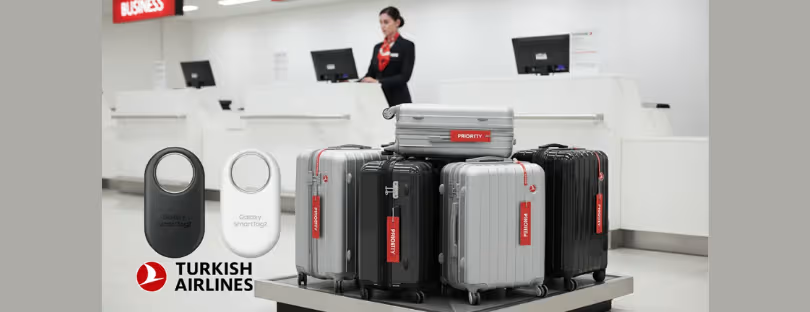
If you’ve ever stood at a luggage carousel wondering whether your bag decided to take its own holiday, Samsung and Turkish Airlines may have just delivered a small miracle. The two companies have officially launched the Smart Tagged Baggage Service, a first-of-its-kind partnership that brings Samsung’s SmartThings Find technology straight into the heart of the airline travel experience.

Rolled out on December 1, the new service allows Turkish Airlines passengers to locate lost or delayed bags more quickly by using Galaxy SmartTag2 and Samsung’s global device-tracking network. For travelers—especially those connecting through massive hubs like Istanbul Airport—this is a very big deal.
So what exactly changes now? Quite a lot.
How SmartThings Find Actually Helps Travelers
Samsung’s SmartThings Find is already one of the most powerful consumer tracking ecosystems on the market. It works by combining Bluetooth Low Energy (BLE) and ultra-wideband (UWB) technology to pinpoint the location of registered Galaxy devices. What makes it especially reliable is the sheer scale of the network behind it — more than 700 million Galaxy devices worldwide silently assist in anonymously locating lost items.
SmartTag2 sits right on top of this ecosystem. It’s a compact accessory that attaches to luggage, keys, backpacks, camera bags — pretty much anything without built-in connectivity. Once registered, the SmartTag pings its location through the SmartThings Find network, giving users near real-time visibility.
With the new partnership, Turkish Airlines is going a step further:
Travelers who lose a checked bag can now include a SmartThings Find link in their lost baggage report, giving the airline access to location information. In other words, instead of airport staff searching endlessly through warehouses of unclaimed bags, they get a map.
That alone already reduces recovery time dramatically.
Passengers also get a handy visual upgrade: they can use the “Change Device Image” feature to upload a photo of their actual bag inside the SmartThings Find app. Considering how many black suitcases look identical, this is one of those small-but-smart improvements that actually saves headaches.
 Why Turkish Airlines Is the First to Roll This Out
 Why Turkish Airlines Is the First to Roll This Out
Turkish Airlines has been leaning hard into digital transformation, and this initiative reinforces that direction. The airline says it not only wants to modernize baggage tracking but also wants to extend SmartThings Find into other customer touchpoints where location-based services could improve the traveler journey.
As Türkiye’s national carrier—and one of the world’s largest by destination count—the airline sits at a strategic intersection for tech partnerships. Istanbul is a major global hub, and improving baggage handling at scale is not just a branding benefit; it’s an operational necessity.
Samsung, for its part, is signaling something bigger: it wants SmartThings Find to become a cross-industry platform, not just a consumer feature. As Jaeyeon Jung, EVP and Head of SmartThings, puts it, the goal is to help customers “stay connected and at ease wherever they are.” That message only gets more powerful when airlines start adopting the system.

Industry Context and How This Compares to Other Players
This move arrives at a moment when airlines globally are doubling down on digital baggage tracking solutions. The International Air Transport Association (IATA) has been pushing for end-to-end baggage tracking through RFID and digital tags for years, citing promising reductions in lost luggage incidents (source: IATA Annual Baggage Report). Several carriers — including Delta Air Lines and Alaska Airlines — already use RFID chips built into bag tags to monitor checked luggage more closely.
But Samsung and Turkish Airlines are doing something slightly different.
Instead of relying solely on aviation infrastructure, they are tapping into an existing consumer device network, which is far larger and more distributed than typical airport systems. Apple AirTag users have been quietly doing this for years, often locating bags faster than airlines themselves. But this is one of the first times an airline is formally integrating a consumer tracker ecosystem into its own baggage recovery workflow.
That’s the interesting shift: airlines aren’t ignoring third-party trackers anymore — they’re embracing them.
Compared to Apple’s AirTag ecosystem, SmartThings Find has a distinct advantage in regions where Samsung dominates market share, including Türkiye, the Middle East, and many parts of Europe and Asia. The size of the Galaxy network makes the location data particularly robust in these markets.
We’re also seeing a trend where travel tech, consumer electronics, and airline operations begin overlapping more tightly — something analysts have flagged as a major direction for aviation digitalization. Passengers now expect the same visibility for baggage that they get for food deliveries or ride-hailing apps. Airlines that adapt quickly will shape expectations for the rest of the industry.
What This Means for Travelers and What Comes Next
The Samsung–Turkish Airlines collaboration moves us one step closer to a world where losing luggage is less of a nightmare and more of a solvable inconvenience. By merging consumer tech with airline systems, the partnership addresses a long-standing pain point with a surprisingly elegant solution.
We can expect more airlines to follow—not just because the technology works, but because passengers are already using trackers whether airlines support them or not. By integrating SmartThings Find, Turkish Airlines positions itself as a leader in customer-centric innovation, similar to Delta’s early adoption of RFID and Air France–KLM’s experiments with digital bag tags.
The bigger picture? Travel is becoming more transparent, more data-driven, and more personalized. Smart trackers are now part of mainstream travel behavior, not just a gadget-lover accessory. Airlines that lean into this—rather than resisting it—will define the next era of passenger experience.
Samsung’s expansion plans suggest this is only the beginning, and if the industry momentum continues, we may soon see SmartThings Find (and competing platforms) embedded across airports, lounge services, and even multi-modal travel.
For now, though, if your bag ever wanders off in Istanbul, you might just find it faster than your coffee order—and that’s a travel upgrade worth celebrating.