
Pittsburgh Airport Taps Mappedin for Smarter Travel
Pittsburgh International Airport (PIT) is deep into a $1.7 billion Terminal Modernization Program—a huge investment designed to reshape how nearly 10 million annual passengers move from curb to gate. And now, the airport has added another layer to that vision: a partnership with indoor-mapping leader Mappedin, whose platform will serve as the digital backbone of the new terminal experience.
For an airport positioning itself as a “gateway built by Pittsburghers for Pittsburghers,” this move signals a clear ambition: make every part of the journey easier, more intuitive, and more connected.
A Digital Layer That Connects the Entire Terminal
Mappedin’s indoor mapping technology will weave together real-time data, passenger navigation, and operational insights into a single digital foundation for PIT. Think of it as a live, constantly updated map that understands where travelers are, what they need, and how they move through the terminal.
Deepak Nayyar, Executive Vice President and CIO at Pittsburgh International Airport, described the modernization as a rethinking of how the airport serves its community.
“The transformed Pittsburgh International Airport is designed to deliver a more intuitive, cohesive journey—from curb to gate and back again,” he said. “Mappedin’s platform helps travelers navigate, discover amenities, and enjoy a more connected experience with the new airport.”
The vision is not just about maps. It’s about making sure every airport decision—operational, commercial, or passenger-facing—is strengthened by live spatial intelligence.
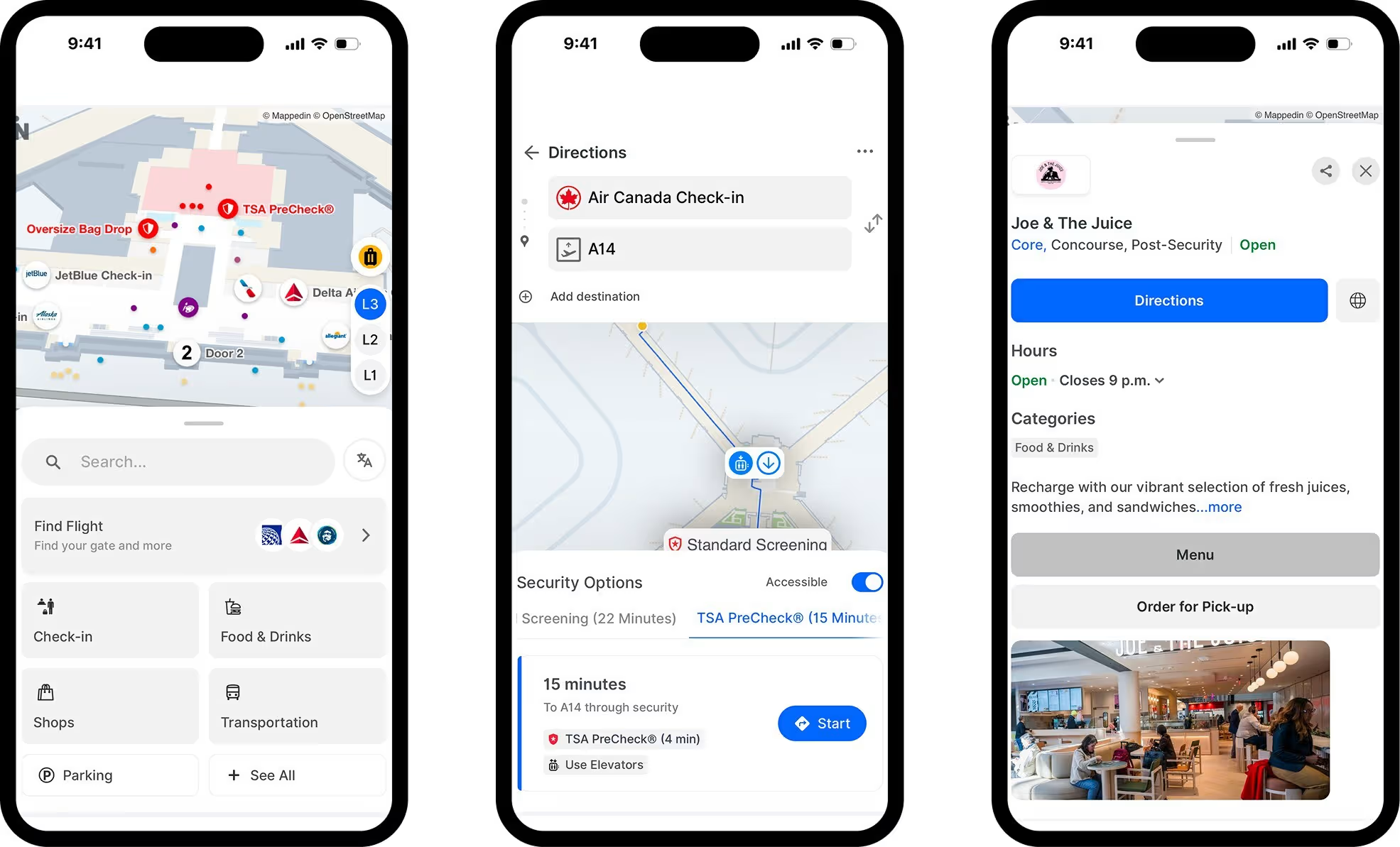
What Mappedin Brings to PIT
Mappedin’s platform supports three strategic goals: a more modern and accessible passenger experience, smarter commercial engagement, and unified data coordination across the airport.
Modernized Passenger Experience
Mappedin will integrate real-time flight information, parking availability, and security wait times directly into the map. Travelers can check updates and see the fastest route to where they need to go—on their phone, a kiosk, digital display, or airport website.
Accessibility is also central. The platform offers barrier-free routing, screen-reader support, visual optimization for color and font settings, and intuitive icon design. QR code positioning adds a simple, “start here” option for instant wayfinding.
Optimized Airport Discovery
Airports increasingly depend on non-aeronautical revenue, and PIT is no exception. Mappedin boosts engagement by surfacing nearby shops and services right on the flight card, highlighting deals and events, and enabling “click-and-pay” options for food ordering or parking.
For the airport, the analytics dashboard delivers valuable insights into passenger movement, behavior, and campaign performance—data many airports still struggle to gather in one place.
Unified Data Aggregation
Mappedin’s system combines flight data, parking feeds, security metrics, and other operational inputs into one central dashboard. That centralized feed can power chatbots, mobile apps, airport websites, and even internal operations platforms—ensuring consistency across every digital and physical touchpoint.
This creates a flexible digital foundation that informs staff decisions, reduces friction for travelers, and helps PIT plan for future expansion and innovation.

A Partnership Focused on the Future of Airport Experience
Yuval Kossovsky, Managing Director of Transportation at Mappedin, frames the collaboration as an investment in long-term growth rather than just a navigation upgrade.
“Our all-in-one platform enables the airport to continuously connect with travelers, guiding them to destinations and services that matter most while providing data-driven insights that optimize operations and unlock non-aeronautical revenue.”
In other words, the map is not the product—the intelligence behind it is.
How Mappedin Fits Into the Broader Airport Tech Landscape
Indoor mapping and wayfinding have quietly become one of the most competitive categories in airport digital transformation. Giants like Cisco, Here Technologies, and Google Maps Indoor Live View offer mapping layers or location services, while airport-focused innovators such as LocusLabs (acquired by Acuity Brands) continue to shape what connected terminals can look like.
Mappedin’s differentiator is its combination of flexible mapping, real-time data ingestion, and its strong analytics layer—features that airports increasingly demand as they chase both operational efficiency and higher concession revenue. According to research from SITA and ACI, more than 80% of airports worldwide plan to increase their investment in self-service, navigation, and passenger-flow-management technologies through 2027. This partnership positions PIT squarely within that global trend.
At the same time, airports are under pressure to personalize the experience—something traditional static maps can’t do. With PIT adopting an adaptive, data-rich digital map, it’s signaling that the next era of airport experience will be less about infrastructure alone and more about real-time intelligence layered over that infrastructure.
For travelers, this means fewer uncertainties. For airports, it means better flow and higher revenue opportunities. And for Mappedin, it cements another major step in becoming the go-to spatial data platform inside some of the world’s most ambitious terminals.