How Mobile and Biometric Tech Are Redefining the Way We Travel
The world of air travel is changing fast—and if you’ve flown recently, you’ve probably felt it. The latest IATA Global Passenger Survey (GPS) confirms two massive shifts shaping the passenger experience: travelers’ growing reliance on smartphones and the rapid rise of biometric technology. Together, these trends are rewriting how we book, check in, pass through airports, and even board planes—all with a few taps or a simple face scan.

As Nick Careen, IATA’s Senior VP for Operations, Safety, and Security, puts it:
“Passengers want to manage their travel the same way they manage many other aspects of their lives: on their smartphones and using digital ID.”
It’s clear—travelers are saying yes to digital convenience. But as Careen also warned, there’s a caveat: cybersecurity and trust are non-negotiable in this new, hyper-connected travel world.
Mobile: The New Passport to Everything
Let’s start with what’s already in your hand—your smartphone. Mobile has become the central nervous system of the travel experience.
According to IATA’s 2025 findings, passengers are doing just about everything on their phones: from booking and payment to loyalty tracking, check-in, immigration, boarding, and baggage tracking. And enthusiasm for these mobile-driven journeys is only growing.
Here’s what’s changing:
- Mobile-first booking is here to stay. Over half of travelers now prefer dealing directly with airlines—increasingly through mobile apps. Airline websites are still the top choice (31%), but that’s down from 37% in 2024. Meanwhile, app bookings jumped from 16% to 19%, driven largely by younger travelers.
- Digital wallets are taking off. Credit and debit cards still dominate, but not by the same margin. The use of digital wallets and instant payment tools like IATA Pay rose sharply—from 6% in 2024 to 8% in 2025.
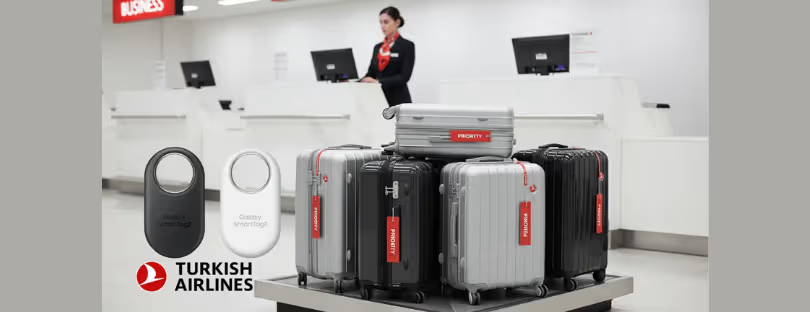
- Smartphones are becoming digital travel companions. Nearly 8 in 10 passengers want a single mobile app to manage everything—from tickets to digital passports and loyalty cards. Even electronic bag tags are catching on, climbing from 28% to 35% year-over-year.
In short, travelers expect their phones to do the heavy lifting. And airlines are listening—integrating more real-time updates, biometric check-ins, and AI-driven travel assistants into their mobile ecosystems.

The Biometric Boom: Seamless Travel Gets a Face
While mobile gets the headlines, biometrics are quietly reshaping the physical airport experience. Facial recognition, fingerprint scanning, and digital identity verification are increasingly replacing boarding passes and passports at major hubs around the world.
Half of travelers have now used biometrics somewhere in their airport journey — up from 46% last year and nearly 20 points higher than in 2022. The most common uses? Security, border control, and boarding.
And the satisfaction levels are sky-high:
- 85% of travelers who used biometrics say they were happy with the experience.
- 74% would willingly share biometric data if it meant skipping traditional passport and boarding pass checks.
- Even among skeptics, 42% said they’d reconsider if privacy was properly guaranteed.
As Careen emphasizes, the next frontier will depend on governments issuing digital passports and harmonizing systems across borders. Only then can we unlock fully digital journeys—secure, seamless, and globally recognized.
Regional Realities: One Trend, Many Journeys
Tech adoption in travel isn’t uniform—it reflects local habits, infrastructure, and trust levels.
- Africa: Passengers still value the human touch, often booking through offices or call centers. Despite facing visa and border complexities, they rank second in global satisfaction—suggesting that personalized service still wins hearts.
- Asia-Pacific: The region leads the digital charge. Travelers here are the most mobile and wallet-driven, the least dependent on credit cards, and frequent biometric users. Yet satisfaction with biometric experiences is surprisingly lower — likely due to patchy consistency across airports.
- Europe: The continent remains the cautious adopter. Europeans prefer booking directly via websites and paying with cards. They’re also the least likely to have used biometrics in the past year, showing clear hesitation about data sharing.
- North America: Convenience is king. Passengers prioritize speed and direct routes, rely heavily on airline websites, and widely use biometrics. But paradoxically, they’re among the least satisfied globally—with privacy concerns running deepest here.
- Latin America & the Caribbean: Personal service is prized. Travelers favor in-person bookings and card payments but are increasingly open to biometrics once they try them. Satisfaction is high post-adoption, suggesting a readiness to leapfrog once trust is built.
- Middle East: This region blends loyalty with digital enthusiasm. Travelers here are highly engaged with mobile wallets and smartphone-based credentials—ranking third globally in satisfaction. Loyalty programs and airport service quality remain strong motivators.

Where We’re Headed Next
Air travel is entering its most digital decade yet. Smartphones are now as essential as passports, and biometric identity is quickly becoming the golden key to frictionless movement. What’s happening at airports today echoes what Apple Wallet and Google Pay did to payments—replacing clutter and cards with a unified, trusted experience.
However, as the IATA survey and similar reports from SITA, Amadeus, and Skyscanner show, the challenge isn’t technology—it’s trust. Passengers are willing to share data, but only if transparency and cybersecurity keep pace. Airlines, airports, and governments must align standards and communicate clearly about how data is stored, shared, and deleted.
There’s also a competitive dimension. While Asia-Pacific carriers lead in digital adoption, European and North American airlines risk lagging unless they accelerate innovation and regulatory adaptation. The success of initiatives like Star Alliance’s biometric boarding, Delta’s Digital ID, and Singapore Changi’s automated immigration gates hints at what the global norm might soon look like.
In the end, passengers are telling the industry exactly what they want: control, simplicity, and trust—all powered by the devices and identities they already hold. The airlines that deliver that seamlessly will not only earn loyalty but also redefine what “connected travel” truly means in 2025 and beyond.