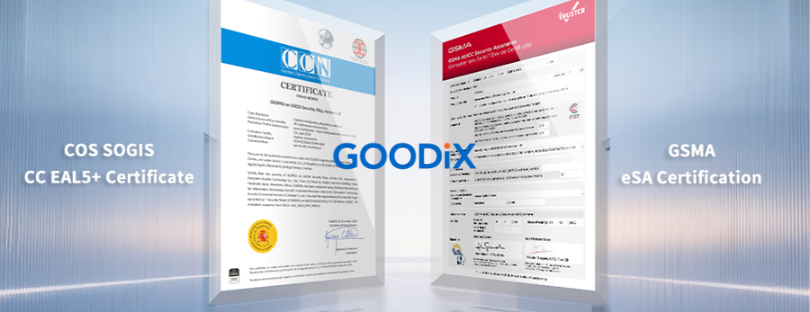
Goodix Raises the Security Bar With Dual eSIM Certifications
In a market where “secure” is often used loosely, Goodix has just done something that actually deserves attention. The company announced that its embedded SIM solution has been awarded two of the most demanding international security certifications in the industry: GSMA eUICC Security Assurance (eSA) and COS SOGIS CC EAL5+.

That combination matters. Not because certifications look good in a press release, but because they define whether an eSIM solution is truly ready for large-scale, real-world deployment across consumer, enterprise, and regulated environments.
For an industry that is moving fast and sometimes skipping steps, this is a signal worth slowing down for.
eSIM is no longer a side feature
A few years ago, eSIM was still framed as a convenience feature. No plastic SIM card. No shop visit. Easier activation. Nice to have.
That framing no longer holds.
According to GSMA, global eSIM connections are expected to reach 6.9 billion by 2030, representing 76 percent of all smartphone connections. And smartphones are only part of the story. eSIM now underpins connectivity for laptops, wearables, vehicles, payment devices, industrial hardware, and an expanding range of IoT endpoints.
At that scale, eSIM stops being a UX feature and becomes infrastructure. Infrastructure demands a different level of security discipline.
That’s where Goodix is clearly positioning itself.
Why these certifications actually matter
Security certifications are often misunderstood. Not all of them are equal, and not all of them test the same things.
The GSMA eUICC Security Assurance (eSA) focuses specifically on the embedded UICC environment. It evaluates how securely profiles are provisioned, stored, managed, and protected throughout their lifecycle. In practical terms, it answers a critical question for operators and OEMs: can this eSIM be trusted as part of a global mobile network?
The COS SOGIS CC EAL5+ certification goes even deeper. It is rooted in Common Criteria evaluation and is widely used in high-assurance environments, including government and regulated industries. Achieving EAL5+ is not trivial. It requires formal design verification, resistance to advanced attack vectors, and robust isolation between system components.
Taken together, these two certifications place Goodix’s eSIM solution well above the baseline compliance level seen across much of the market.

Security built from the silicon up
What stands out in Goodix’s announcement is not just the certificates, but the architecture behind them.
The company has been building toward this moment for several years. In 2024, its embedded Secure Element (eSE) chip achieved IC SOGIS CC EAL6+, one of the highest assurance levels available for secure hardware. That earlier milestone matters because eSIM security is only as strong as the secure element beneath it.
Goodix’s current eSIM solution integrates eSIM and eSE functionality into a single product, rather than treating them as loosely connected components. From a security perspective, this is significant. It reduces attack surfaces, simplifies trust boundaries, and allows tighter control over data flows between connectivity, identity, and authentication layers.
The solution uses dual protection mechanisms: a hardware-level firewall combined with software-based dual virtual machine isolation. This means security enforcement happens both at the physical level and within the operating environment, extending protection from silicon architecture all the way up to user data.
This is the kind of design that anticipates modern threat models, not yesterday’s.
Built for real-world interoperability
Security alone is not enough. An eSIM solution that cannot interoperate smoothly with mobile networks becomes a bottleneck instead of an enabler.
Goodix’s eSIM is fully compliant with the latest GSMA SGP.22 V3.1 standard and has already completed interoperability testing with more than 300 mobile network operators worldwide. That number is not cosmetic. It directly affects time-to-market for device makers and service providers.
The solution supports dual-profile activation, dual-network operation, and a flexible Local Profile Assistant (LPA) compatible with multiple operating systems. For OEMs, this means fewer custom builds, fewer integration surprises, and lower long-term maintenance costs.
In a market where device lifecycles are shortening and regional SKUs are multiplying, that kind of interoperability is becoming a competitive requirement rather than a bonus.
Integration without compromise
Another notable aspect of Goodix’s approach is its highly integrated combo design. The solution is built on an eSIM + eSE + NFC hybrid architecture, aligning with the broader industry push toward thinner, more capable, and more secure devices.
Integration often raises concerns about performance or isolation. Goodix addresses this through a dual-core virtual machine architecture, enabling concurrent processing across multiple physical channels while maintaining strict resource separation.
This allows for multi-tasking use cases such as secure payments, identity verification, and network authentication to run in parallel without compromising security boundaries.
The solution also supports over-the-air operating system updates, with independent upgrade paths for the eSE and eSIM modules. That detail matters. It ensures long-term scalability and adaptability as standards evolve, without forcing full system replacements.
How does this compare to the wider market?
Goodix is not alone in pursuing high-assurance eSIM solutions. Players like NXP, STMicroelectronics, Infineon, and Thales have long operated in this space, particularly at the secure element and eUICC level.
What differentiates Goodix is its combination of deep silicon control, integrated architecture, and focus on next-generation device categories rather than legacy deployments. While some incumbents are still optimizing for traditional SIM replacement models, Goodix appears to be designing for a world where connectivity, identity, and authentication are tightly interwoven across consumer and enterprise devices.
This aligns with broader market trends: convergence of eSIM and secure elements, increased regulatory scrutiny, and growing demand for hardware-rooted trust in connected ecosystems.
What does this signal for the eSIM industry?
The bigger story here is not just about one company or two certificates.
It is about where the eSIM market is heading.
As eSIM becomes the default rather than the exception, security expectations are rising. Operators, OEMs, enterprises, and regulators are no longer satisfied with basic compliance. They want demonstrable assurance, architectural transparency, and long-term upgradeability.
Goodix’s announcement fits squarely into that shift. It reflects a market moving from rapid adoption to mature infrastructure thinking.
Conclusion
Goodix achieving dual GSMA eSA and COS SOGIS CC EAL5+ certifications is not a symbolic win. It is a concrete indicator of how seriously parts of the industry are now treating eSIM as critical infrastructure rather than a convenience layer.
Compared to many eSIM solutions that still prioritize speed and cost over long-term trust, Goodix’s approach feels deliberately engineered for the next phase of the market: large-scale deployment, tighter regulation, and deeper integration with identity and security frameworks.
As GSMA projections continue to point toward near-universal eSIM adoption, the winners will not be those who move fastest, but those who build systems that can withstand scrutiny over time. Based on publicly available certification data and industry standards from GSMA and Common Criteria bodies, Goodix is clearly positioning itself in that camp.
For device makers and connectivity stakeholders watching where the market is truly going, that distinction matters.