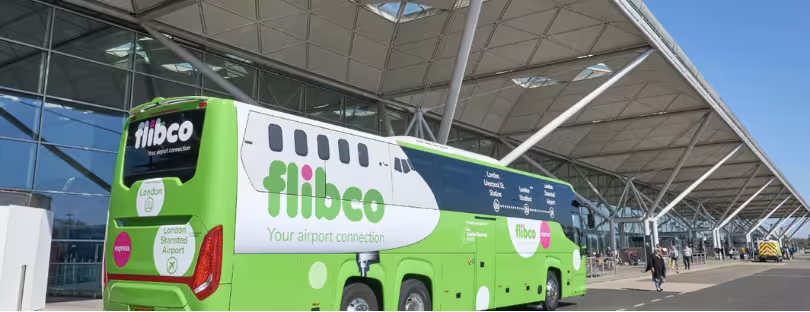
Flix Acquires Flibco to Scale Airport Shuttle Services
Rail and coach giant Flix has taken another decisive step in building a door-to-door travel ecosystem by acquiring a majority stake in Flibco, a well established airport transfer specialist. The financial terms of the deal have not been disclosed, but the strategic intent is clear. Flix is no longer thinking only about city-to-city transport. It wants to own the full journey, including the often-overlooked airport connection.
For travellers, airport transfers are one of the most stressful parts of a trip. They are expensive, fragmented, poorly integrated with long-distance transport and often poorly digitised. This is exactly the kind of inefficiency Flix has made its business model out of fixing.
A familiar expansion playbook
If this move feels familiar, it should. Flix has spent the last decade quietly assembling one of the most extensive ground transport networks in the world. Starting in Germany, the company expanded aggressively across Europe, later acquiring Greyhound to enter the North American market. Today, Flix operates across Brazil, Chile and Mexico in South America, as well as Turkey and India in Asia.
What ties all these expansions together is not ownership of vehicles or infrastructure, but platform control. Flix runs an asset light model, relying on local operating partners while owning the technology, brand, demand generation and pricing logic. Airport transfers fit this model almost perfectly.
Flix has already experimented with airport focused routes and shuttle services in markets such as Sweden. Acquiring Flibco turns those experiments into a scalable business unit.
Why Flibco matters
Flibco may not be a household name, but within airport ground transport it has quietly built a strong position. The company focuses exclusively on connecting airports with city centres and regional hubs, offering fixed-price, scheduled bus services with digital booking at the core.
Crucially, Flibco operates in a market that is highly fragmented. In most European countries, airport transfers are handled by a mix of local bus companies, municipal operators, private shuttle services and taxis. Few players operate cross-border, and even fewer offer a consistent digital experience.
That fragmentation is exactly what Flix knows how to consolidate.

Deal structure and strategic continuity
The transaction was advised by Ennea Capital Partners and will see SLG, a public transport specialist and Flibco’s previous owner, retain a minority stake while acting as a strategic partner. This structure suggests long term collaboration rather than a full absorption.
Operationally, nothing changes in the short term. Flibco will continue to operate under its own brand, led by CEO Tobias Stüber, with the existing management team and employees staying in place. This is another familiar Flix move: keep what works, scale what can be multiplied.
What Flix actually wants to fix
Speaking about the acquisition, Flix CEO André Schwämmlein was direct about the motivation. Travellers do not just need reliable transport between cities. They need reliable ways to get to and from airports. Anyone who has missed a flight because of an unreliable local bus or paid a premium taxi fare for a short airport ride understands the problem immediately.
Flibco brings a ready made solution, while Flix brings scale, data and reach. Combined, the two companies can integrate airport transfers into long distance booking flows, optimise schedules based on real demand data and potentially bundle tickets in ways traditional operators cannot.
Digital first, not bus first
One of the most important aspects of this deal is not the buses themselves, but the technology behind them. Flibco’s model is fully digital, from booking to ticketing to operational optimisation. Routes and schedules are adjusted using data, not legacy timetables.
This mirrors Flix’s own DNA. Neither company positions itself as a transport operator in the traditional sense. They are mobility platforms that happen to move people physically.
That distinction matters when looking at future competition.
A market ripe for consolidation
Airport ground transport is one of the last major travel segments still dominated by local players. While airlines, hotels and car rental have globalised, airport transfers remain stubbornly regional.
There are exceptions. Ride-hailing platforms like Uber and Bolt have captured some of the market, but they are expensive for longer distances and face regulatory pushback in many cities. Train operators often serve major airports well, but leave secondary airports poorly connected. Dedicated shuttle brands exist, but lack scale.
By combining Flix’s long-distance network with Flibco’s airport expertise, the group positions itself between public transport and ride hailing, offering a predictable, affordable and scalable alternative.

Media attention and cultural signalling
An interesting side note is that the transaction will feature in the upcoming Amazon Prime documentary SELFMADE, offering a behind-the-scenes look at Flibco’s growth and the partnership with Flix. This kind of visibility is not accidental.
Mobility platforms increasingly compete not just on price or coverage, but on brand trust. Being positioned as a transparent, founder-driven growth story helps attract both customers and local operating partners.
What this means for travellers
For travellers, especially frequent flyers and business travellers, the implications are practical. Expect more airport routes, more predictable pricing and deeper integration into existing booking journeys. Over time, it is easy to imagine a single Flix booking covering city to city travel plus airport transfer, something traditional transport operators have struggled to offer.
For secondary airports and regional cities, this could be even more impactful. Improved airport connectivity often determines whether an airport can grow new routes or remain competitive.
What this means for the industry
For the wider travel and mobility industry, this deal reinforces a broader trend. Ground transport is no longer a standalone category. It is becoming part of an integrated travel stack alongside flights, accommodation and digital services.
Companies that control demand, data and distribution are increasingly more powerful than those that own physical assets. This is a lesson airlines learned through online travel agencies. Bus and rail operators are learning it now.
Conclusion: a quiet but strategic shift
Flix’s acquisition of Flibco may not generate the same headlines as airline mergers or hotel acquisitions, but strategically, it is just as significant. By moving into airport transfers at scale, Flix is positioning itself closer to becoming a true end-to-end mobility platform.
Comparable players like BlaBlaCar Bus or regional rail operators have flirted with airport connectivity, but none have combined platform scale, data driven optimisation and brand consistency in the way Flix now can. At the same time, ride-hailing platforms face rising regulatory and cost pressures, creating space for fixed-route, scheduled alternatives.
Industry analyses from sources such as McKinsey, the International Transport Forum and European Commission mobility reports consistently point to integrated, sustainable ground transport as a key growth area over the next decade. This deal fits that narrative almost perfectly.
If Flix succeeds in scaling Flibco’s model across its global footprint, airport transfers may finally stop feeling like an afterthought in the travel journey. And that, quietly, would be a meaningful shift for how people move.