Ericsson Backs LotusFlare to Build the New Network API Economy
When telecom giants make strategic moves, it’s rarely subtle. Today, Ericsson announced a partnership that has the industry talking—and for good reason. The Swedish vendor has entered into a strategic collaboration with Silicon Valley–based LotusFlare, a software company that has been quietly powering digital customer experiences for telcos and enterprises since 2014. On top of that, Ericsson has taken a minority stake in the company, signaling real commitment rather than a symbolic handshake.

If you haven’t followed LotusFlare before, here’s the quick snapshot: founded in Santa Clara, now with around 500 employees worldwide, and known for its DNO Cloud platform—a digital engine that simplifies consent management, API access, and digital commerce for operators. In short: it’s one of the companies making the “network API economy” actually usable.
But what’s exciting about this partnership isn’t just the investment—it’s the ambition behind it.
What Ericsson Actually Gains From LotusFlare
Ericsson didn’t invest just to tick an innovation box. LotusFlare brings something that has been missing for many communication service providers (CSPs): a clean, modular way to expose advanced network capabilities through APIs while handling all the messy bits like consent, access control, identity, and digital transaction flows.
That’s basically the “missing middle” between programmable networks and enterprise developers who want to build things with them.
LotusFlare’s DNO Cloud platform acts as the exposure layer—a place where CSPs can package, present, and monetize advanced capabilities such as quality-on-demand, slicing, authentication, or location verification. This aligns almost perfectly with Ericsson’s long-term direction: building an ecosystem where CSPs can turn network assets into digital products that enterprises are actually willing to pay for.
Ericsson also confirmed that the two companies will create joint solution blueprints—essentially ready-made integration templates—covering API access models, consent flows, and typical deployment patterns. For operators stuck in lengthy internal IT cycles, this could significantly speed up go-to-market timelines.
Why Ericsson’s Vonage Unit Is Central to This Deal
The quote from Niklas Heuveldop, Head of Ericsson’s Global Communications Platform and CEO of Vonage, lays out the company’s big picture: combine Ericsson’s programmable networks, LotusFlare’s abstraction layer, Aduna’s global API aggregation engine, and Vonage’s enterprise developer ecosystem.
Think of it as building a complete pipeline:
- Network side (Ericsson) — 5G, slicing, quality tiers, authentication
- Abstraction layer (LotusFlare) — how CSPs manage, expose, and package these capabilities
- Aggregation layer (Aduna) — unify APIs across multiple operators
- Enterprise/developer consumption (Vonage) — tools, SDKs, and ready-made integrations
If this works as intended, developers could access advanced network features the same way they access cloud APIs today—simply, fast, global.
And this is exactly what Ericsson needs in order to compete with hyperscalers who are already moving into telco territory. AWS, Google Cloud, and Microsoft are all investing heavily in telecom APIs, edge computing, and developer ecosystems. Ericsson wants CSPs to stay in control of their most valuable asset: the network itself.
LotusFlare’s Perspective: Validation and Acceleration
LotusFlare’s CEO and co-founder, Sam Gadodia, didn’t hide his excitement. For a company that has spent a decade simplifying telco customer experiences—through its DNO Cloud and the increasingly popular Nomad eSIM business—having Ericsson step in as an investor is a huge validation.
He said the partnership will “accelerate the development of critical network asset monetization capabilities for CSPs globally.” In practical terms, LotusFlare now gains the scale, reach, and operator relationships that only a company like Ericsson can provide.
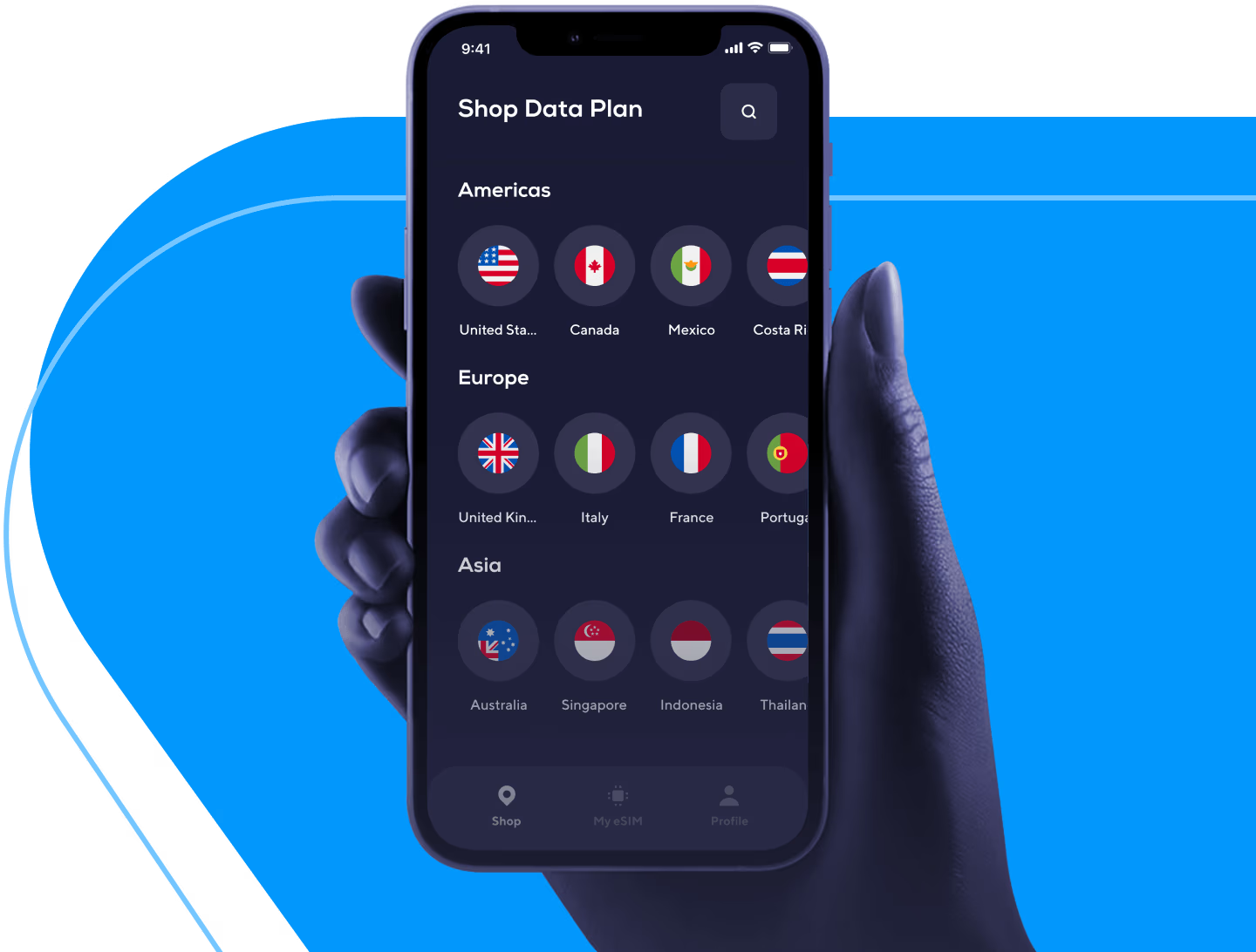
And yes—if you’re covering the eSIM angle, this is particularly interesting. LotusFlare’s Nomad eSIM brand has been expanding rapidly (Alertify readers might remember our recent piece on Nomad’s rare 12-month eSIM validity option, which is a standout offering in the travel eSIM market. With Ericsson now partially in its corner, Nomad’s visibility in the global connectivity space is likely to grow even faster.
What This Means for Operators
This isn’t just another vendor partnership—it’s a direct attempt to solve one of telecom’s biggest problems: operators have powerful networks but weak monetization models.
CSPs have struggled to commercialize 5G capabilities beyond consumer data plans. Enterprises want more control, speed, and performance, but operators rarely offer these capabilities in a way that’s easy to understand—or even easy to buy.
This Ericsson–LotusFlare collaboration gives operators:
- Faster integration paths
- Ready-made API exposure frameworks
- Consent-compliant digital commerce flows
- Developer-grade packaging of network capabilities
Most importantly, it gives CSPs the chance to offer advanced network features at “cloud speed” rather than “telco speed.”
Vonage will then help turn those APIs into enterprise-grade use cases—security, authentication, mobility automation, IoT connectivity, real-time communications, and more.

Where This Places Ericsson in the Market
By partnering with LotusFlare and officially buying into the company, Ericsson is aligning itself with a clear competitive front: the emerging Network API economy. And the competition is getting intense.
On one side, you have GSMA’s Open Gateway initiative, which now includes more than 50 operators working on standardized APIs.
On another, Cisco, Nokia, and Huawei are each building their own stacks around network programmability, slicing orchestration, and edge capabilities.
Then there are the hyperscalers—AWS (with Wavelength), Google Distributed Cloud, and Azure MEC—all vying for control of the developer relationship.
Ericsson’s move positions it as the company building both ends of the bridge: network infrastructure and the enterprise-facing API layer.
If this ecosystem gains momentum, the value creation shift could be massive—comparable to when cloud computing moved from raw infrastructure (IaaS) to curated developer services (PaaS).
Conclusion: A Clear Signal That the API Economy Is Real
Ericsson’s partnership with LotusFlare isn’t a footnote—it’s a strategic marker. It tells us that the telecom industry finally accepts a reality that cloud players figured out years ago: developers, not networks, determine who wins the next decade of digital innovation.
Other major telecom players are moving in the same direction, but few have built such a complete stack—from the physical network layer to the developer marketplace. LotusFlare gives Ericsson a much-needed abstraction layer, and Vonage gives it a massive developer funnel. Compared with Nokia’s network API framework or AWS’s operator partnerships, Ericsson now has a more vertically integrated approach—and arguably a faster one.
For CSPs, this could be the turning point where network differentiation becomes business differentiation again. For enterprises, it could mean real access to programmable connectivity. And for the eSIM world—where brands like Nomad are already innovating with long-validity products—this ecosystem could drive entirely new consumer and enterprise experiences.
The financials aren’t public, but the industry implications are unmistakable: the network API monetization race is officially accelerating.