Crypto IBANs Arrive: Mt Pelerin Merges Wallets and Banking
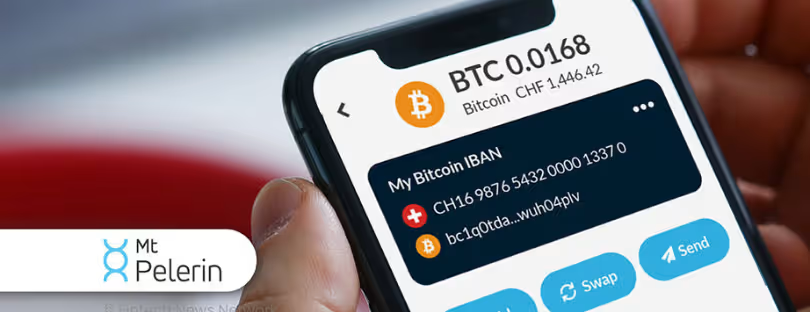
Mt Pelerin just dropped one of the most interesting updates we’ve seen in the digital finance space this year: personal crypto IBANs. And yes—it’s exactly what it sounds like. Your self-custodial wallet can now function like a universal account that sends and receives money across both blockchain rails and traditional banking networks.

For anyone who’s ever tried to live fully self-custodial, this is big. Because while Bitcoin and crypto promise freedom, ownership, and independence from financial gatekeepers, the reality has always been a bit more complicated. Total control often comes with a price: friction with the “real world” that still runs—overwhelmingly—on bank accounts and IBAN numbers.
Mt Pelerin’s new crypto IBAN feature is designed to remove that friction. No custodial middlemen. No need to move funds through exchanges. No compromised sovereignty. Just a wallet with an IBAN.
Let’s unpack what they’ve built.
Self-Custody Meets Everyday Payments
In Mt Pelerin’s vision, self-custody shouldn’t mean isolation. You should be able to receive a bank transfer from your employer, your customers, or your family—and have it show up straight in your crypto wallet. Likewise, you should be able to pay an invoice or send money to a bank account using crypto you already own.
With the new crypto IBAN, that’s exactly what happens.
Users can create a personal EUR or CHF IBAN—in their own name—and link it directly to any self-custodial crypto wallet. Once activated, the IBAN allows you to:
Receive money from any bank account
Incoming bank transfers are automatically converted into crypto and deposited into your self-custodial wallet.
Send bank transfers to anyone
Your crypto gets converted on the fly, and the recipient receives a standard bank transfer from an IBAN carrying your name.
From the outside, these payments behave like any normal transfer. Under the hood, settlement happens on-chain. For crypto-native users who still need to interact with the traditional economy, this feels like the missing puzzle piece.

Why This Matters: A Practical Alternative to a Bank Account
This release is more than a product update—it’s a milestone in Mt Pelerin’s long-running mission to make self-custody not only possible but practical.
The idea of “opting out” of traditional banking has been around since Bitcoin’s white paper. But for most people, that opt-out has never been fully realistic. Rent still needs to be paid. Clients still send wires. Governments still issue refunds via bank transfer.
By equipping a crypto wallet with an IBAN, Mt Pelerin effectively offers a hybrid model: the independence of self-custody with the usability of a bank account.
It’s not a bank account legally—and doesn’t need to be declared as one—but functionally, it’s close enough to replace many aspects of one.
Key Details About the New IBAN Feature
Here are the essentials you need to know:
EUR and CHF IBANs are based in Switzerland
Switzerland is part of the SEPA zone, so Euro transfers work like you’d expect.
Available to individuals and organizations
This isn’t only for retail users; businesses can benefit as well.
Open to almost every country
As long as you’re not on Mt Pelerin’s excluded jurisdiction list.
Free IBAN, free fiat–ZCHF conversions
The ZCHF stablecoin — their Swiss franc on-chain asset — can be swapped with fiat at zero cost.
Works with 30+ cryptocurrencies on 15 blockchains
A genuinely multi-chain experience, not a single-token ecosystem.
Compatible with any self-custodial wallet
There’s no lock-in to Mt Pelerin’s app, although the feature is accessible through it.
Available now on app.mtpelerin.com and on Mt Pelerin’s mobile wallet.
Conclusion: A Sign of Where Crypto Finance Is Moving
Mt Pelerin isn’t the first company to blend crypto and banking, but the self-custody-first approach sets it apart. Players like Revolut, N26, and even Coinbase offer fiat-to-crypto flows, but always through custodial accounts. Others — such as Monerium or Bank Frick — issue on-chain IBAN-like identifiers, but typically with institutional or compliance-heavy setups.
What Mt Pelerin introduces is closer to a “user-owned neobank account,” where settlement happens on-chain and custody never leaves the user’s hands. That’s a fundamentally different direction from the industry’s big custodial hybrids.
The timing also aligns with broader trends highlighted by Chainalysis, Messari, and Swiss National Bank research: stablecoin adoption is rising, cross-border payments are one of crypto’s strongest real-world use cases, and users increasingly want tools that bridge — not replace — existing financial systems.
If mainstream crypto is going to become truly interoperable with everyday life, solutions like crypto IBANs may be what carry it there.
Mt Pelerin’s move is bold, timely, and aligned with where digital finance is heading: self-custody first, interoperability second, but both equally essential.