Buy NTC eSIM on Khalti App: Easy Digital Activation
Nepal’s journey toward fully digital telecom services has taken an important step forward. With the launch of Nepal Telecom eSIM purchases directly inside the Khalti wallet app, getting a virtual SIM has finally become something you can do entirely from your phone, without paperwork, queues, or office visits. For a country where mobile connectivity is central to daily life, this move signals a wider shift toward app-based, user-first telecom services.
Below is a complete, improved, and practical guide that explains how the service works, why it matters, and what it means for the future of eSIM adoption in Nepal.
Buying NTC eSIM digitally through Khalti
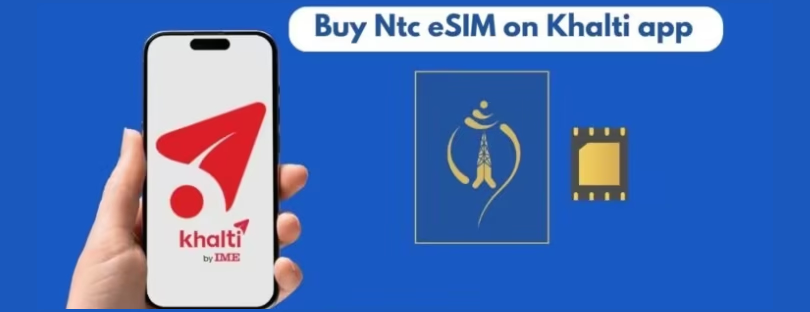
Nepal Telecom, widely known as NTC, has officially partnered with Khalti to enable prepaid eSIM purchases inside the Khalti app. The agreement between NTC and IME Khalti Limited allows users to apply for a new eSIM remotely, submit their documents digitally, and complete payment without visiting any telecom office.
Until now, getting an NTC eSIM required physical presence at an NTC customer service center, printed forms, and manual verification. That process often discouraged users, especially professionals, students, and travelers who could not easily take time off during office hours. By moving eSIM onboarding into a digital wallet, NTC is aligning itself with how people already pay bills, recharge phones, and manage services in Nepal.
Why this matters for Nepal’s mobile users
eSIM adoption in Nepal has been steadily rising, driven mainly by newer smartphones that no longer rely exclusively on physical SIM cards. As of Shrawan 2082, Nepal has already crossed more than 400,000 eSIM users. This number is expected to grow quickly as flagship Android phones and iPhones become more common.
Despite this growth, accessibility remained a bottleneck. Requiring in-person verification limited adoption, particularly outside major cities. Khalti’s integration removes that friction. The entire process is now smartphone-based, which matches how modern telecom services are expected to work.
For users working standard office hours, living outside Kathmandu Valley, or frequently traveling, this is a meaningful improvement rather than a cosmetic upgrade.

What you need before buying an NTC eSIM
Before starting the purchase, users should make sure a few basics are covered. The system is simple, but preparation avoids delays.
Device and document requirements
Your smartphone must support eSIM functionality. Most recent iPhones, Samsung Galaxy S and Z series, Google Pixel devices, and some flagship Xiaomi models support eSIM.
You will also need one valid identification document. Accepted options include citizenship certificate, driving license, national ID card, or voter ID. Clear photos of both front and back are mandatory, along with a live selfie.
An active Khalti wallet with sufficient balance is required since the eSIM fee is deducted directly from the app.
Step by step process to buy NTC eSIM on Khalti
The actual purchase flow is designed to be beginner-friendly. Even users with limited experience using digital wallets should be able to complete it without assistance.
Step by step application flow
- Open the Khalti app on your smartphone
- Scroll down to Popular Services and tap on NTC Prepaid eSIM
- Alternatively, use the search bar and type eSIM, then select NTC Prepaid eSIM
- Confirm that your phone supports eSIM by following the on-screen instructions
- Fill in personal details such as name, father’s name, grandfather’s name, and date of birth
- Upload front and back images of your ID document and take a live photo
- Enter contact details, email address, and document issue date
- Tick the confirmation box acknowledging eSIM compatibility
- Tap Purchase to submit your request
The eSIM fee of NPR 90 is deducted instantly from your Khalti balance. Once submitted, the request goes through a verification process handled jointly by Khalti and NTC.
Verification and eSIM delivery timeline
After submission, a Khalti representative will contact you for verification. This step ensures compliance with national SIM registration rules and helps prevent misuse.
Once verified, your eSIM QR code is typically delivered within 24 hours. You can then scan the QR code on your device to install the eSIM profile and activate your new NTC number.
In practical terms, this is significantly faster than visiting a telecom office, waiting in line, and returning home to activate the SIM manually.

Using NTC eSIM in everyday life
From a user perspective, an eSIM functions exactly like a physical SIM card. Calls, SMS, mobile data, VoLTE, and VoWiFi services work the same way once activated.
The main difference is convenience. There is no physical card to damage, lose, or replace. Switching devices, managing dual SIM setups, or traveling becomes easier, especially for users who rely on one number for work and another for personal use.
This also opens the door for smoother dual SIM usage. Many users in Nepal operate both NTC and Ncell numbers. eSIM allows one operator to live digitally while keeping a physical SIM slot free.
How does this compare with other markets
Globally, telecom operators are moving eSIM onboarding into apps and partner platforms. In markets like India, Singapore, and parts of Europe, eSIM activation through operator apps or digital wallets has become standard rather than experimental.
In India, for example, major operators allow eSIM conversion and activation through their official apps with OTP based verification. In Europe, many carriers and MVNOs deliver eSIMs instantly via email or app dashboards. Against that backdrop, Nepal’s move through Khalti is not late, but it is timely.
What makes the Khalti integration notable is that it leverages an already trusted fintech app rather than forcing users into a separate telecom-specific platform. This mirrors successful models seen in Southeast Asia, where super apps bundle payments, telecom, and government services together.
What could improve next
While this launch is a strong first step, there is room to evolve. Currently, only NTC prepaid eSIMs are available. Many users would welcome postpaid eSIM onboarding and SIM-to-eSIM conversion through the app.
Another widely anticipated development is the inclusion of Ncell eSIM purchases. Nepal has a large base of dual network users, and enabling both major operators inside one wallet would significantly improve the user experience.
Instant eSIM delivery without manual phone verification is another likely future step, especially as digital ID systems mature.
Conclusion
The availability of Nepal Telecom eSIM purchases through the Khalti app is more than a convenience update. It reflects a broader shift in Nepal’s telecom landscape toward app-driven, paperless, and user-centric services. Compared with regional and global trends, this move places Nepal on a similar trajectory as markets where eSIM adoption is accelerating fastest.
By partnering with a trusted digital wallet instead of building a closed system, NTC has chosen a scalable and familiar channel that aligns with how people already manage payments and services. As smartphone penetration increases and physical SIM dependency declines, app-based eSIM onboarding will likely become the default rather than the exception.
Reliable indicators from GSMA reports, regional telecom regulators, and operator data consistently show that eSIM growth is strongest where activation friction is lowest. Khalti’s integration directly addresses that friction. If expanded thoughtfully to include other operators and faster activation flows, this model could become a reference point for digital telecom services in Nepal.
For users, the message is simple. Mobile connectivity is becoming something you activate, manage, and switch as easily as any other digital service on your phone. And this launch is a clear signal that Nepal’s telecom ecosystem is moving in that direction.