



Here’s the thing about travel connectivity in 2026: it’s no longer just about buying data. It’s about how seamlessly that data fits into everything else you’re doing. And that’s exactly where Airhub starts to feel different.
If you’ve ever bought an eSIM before, you probably know the drill. Pick a country, choose a plan, install, and hope it works when you land. It’s functional. It gets the job done. But it’s also… fragmented.
Airhub isn’t trying to win by being just another eSIM provider in that crowded list. It’s quietly positioning itself as something bigger. Not just a place where you buy data, but a platform that connects travel, distribution, and even business use cases in one layer.
And once you start looking at it that way, it becomes a lot more interesting.
What Airhub actually is (and what it isn’t)
Let’s start simple.
Airhub is an eSIM platform that gives you mobile data in multiple countries. You download a plan, install it on your phone, and you’re connected when you travel. That’s the baseline.
But that description alone misses the point.
Because Airhub is not trying to compete only on “cheapest data per GB.” It’s building around flexibility, distribution, and partnerships. In other words, it’s less about the product itself and more about how that product can be used, sold, and integrated.
That distinction matters more than most people realize.
The travel use case feels familiar… but smoother
From a traveler’s perspective, Airhub feels easy.
You land, your phone connects, and you don’t think about roaming charges anymore. That’s the promise every eSIM provider makes. Airhub delivers on it, but what stands out is how it tries to reduce friction across the entire journey.
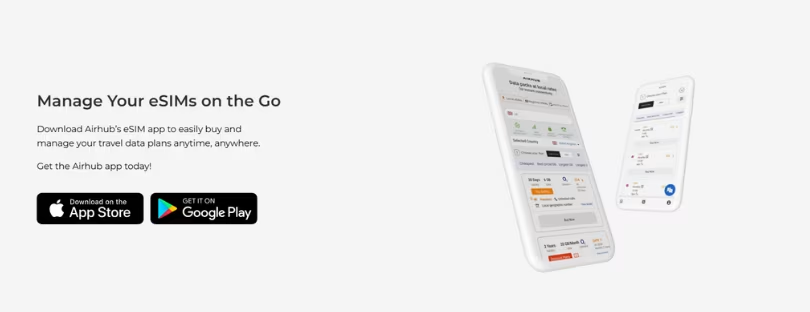
Instead of constantly switching providers or juggling multiple profiles, you can manage your connectivity in one place. Plans are available across a wide range of destinations, and the setup process is straightforward.
There’s no overcomplication here. And that’s a good thing.
But again, if that was the whole story, Airhub would just be another name in a very crowded space.
|
MORE ABOUT AIRHUB
News, insights & platform updates
Features · partnerships · what’s evolving
|
AIRHUB REVIEW
How good is Airhub really?
Performance · coverage · real-world use
|
GET AIRHUB
Ready to stay connected?
Flexible plans · global coverage · easy setup
|
Where things get interesting: distribution and partnerships
This is where Airhub starts to play a different game.
Most eSIM providers focus on selling directly to consumers. Airhub does that too, but it also builds tools for others to sell eSIMs.
Think about travel agencies, airlines, booking platforms, or even fintech apps. All of them have one thing in common: they already have travelers.
What they don’t have is connectivity built into their offering.
Airhub steps into that gap.
Instead of forcing users to go out and find an eSIM provider, Airhub enables businesses to embed eSIMs directly into their own customer journeys. That could mean offering data plans at checkout, bundling connectivity with travel packages, or selling eSIM vouchers as an upsell.
From a business perspective, this is powerful.
From a user perspective, it’s invisible.
And that’s exactly why it works.
The “lifetime eSIM” idea is more important than it sounds
One of the more underrated things Airhub offers is the concept of a lifetime eSIM.
At first glance, it sounds simple. You install one eSIM once, and instead of replacing it every trip, you just top it up depending on where you’re going.
But if you think about it, this solves one of the biggest annoyances in the entire eSIM experience.
No more deleting profiles.
No more reinstalling.
No more confusion about which eSIM is active.
You just keep one digital SIM and reuse it.
For frequent travelers, this is a huge quality-of-life improvement. And for businesses managing multiple employees or customers, it’s even more valuable.
It turns connectivity from a repeated purchase into a persistent layer.
That’s a subtle shift, but an important one.
Airhub is quietly moving toward infrastructure
Here’s the part most people miss.
Airhub is not just a product. It’s increasingly becoming infrastructure.
When you look at its API, partner programs, and white-label capabilities, you start to see a different picture. Airhub is positioning itself as a backend layer that other companies can build on top of.
And this is where things get strategic.
Because the future of travel connectivity is not necessarily about brands that consumers recognize. It’s about who controls the distribution.
If an airline offers you data during booking, you don’t really care which provider powers it.
If your bank app includes global data, you’re not asking which MVNO is behind it.
You just use it.
Airhub is betting on that future.
What this means for the eSIM market
The eSIM market is going through a shift right now.
On one side, you have consumer-focused brands competing on pricing, UX, and marketing. This is where most of the noise is.
On the other side, you have enablement players building the infrastructure that powers those experiences.
Airhub sits somewhere in between, but it’s clearly leaning toward the second group.
And that’s a smart move.
Because competing on price is a race to the bottom. Competing on infrastructure is a race to relevance.
Where Airhub still needs to improve
No platform is perfect, and Airhub is no exception.
The biggest challenge right now is clarity.
When you visit the platform, it’s not always immediately obvious what Airhub wants to be. Is it a consumer app? A partner platform? A B2B solution?
The answer is “all of the above,” but that can create confusion.
For a traveler, simplicity is key.
For a business, clarity is even more important.
Airhub has the building blocks. Now it’s about telling the story in a way that matches its ambition.
Another area is brand awareness.
Compared to some of the big names in the eSIM space, Airhub is still relatively under the radar. That’s not necessarily a problem today, especially if the focus is on partnerships. But long-term, visibility matters.
Because even in an infrastructure-driven world, trust still plays a role.
How does this compare with other approaches in the market
If you zoom out, you’ll notice three main directions in travel eSIM right now.
Some providers focus on simplicity and unlimited plans.
Others focus on flexibility and regional coverage.
And then there are players like Airhub focusing on distribution and integration.
Airhub is not trying to win the “best travel eSIM” title in the traditional sense.
It’s trying to become the layer that powers multiple “best eSIM” experiences across different platforms.
That’s a very different strategy.
And arguably, a more scalable one.

What this means for you as a traveler (or business)
If you’re a traveler, Airhub gives you a reliable, flexible way to stay connected without overthinking it. The lifetime eSIM concept alone is worth paying attention to if you travel often.
If you’re running a business in travel, fintech, or mobility, Airhub becomes much more interesting.
It’s not just a product you use. It’s something you can build into your own offering.
And that’s where the real opportunity lies.
Final thoughts about Airhub eSIM: eSIM for travel and business
Airhub is not the loudest player in the eSIM space.
It’s not trying to win with flashy campaigns or aggressive pricing.
Instead, it’s building quietly in the background, focusing on something that matters more in the long run: how connectivity is delivered, not just how it’s sold.
And if the market continues to move toward embedded, invisible connectivity, that positioning could turn out to be very smart.
Because the real question is no longer “Which eSIM should I buy?”
It’s “Why do I need to think about eSIM at all?”
Airhub is one of the companies trying to make that question disappear.
And that’s exactly why it’s worth watching.