Starlink Cost in 2026: Monthly Plans, Equipment and Hidden Fees
A satellite internet subscription advertised at $55 a month sounds straightforward. But for Starlink customers, the actual bill can depend on far more than the selected broadband plan. Equipment ownership, rental charges, location-specific pricing, and whether the connection will be used at home or while traveling can substantially change the final cost.
Starlink cost in 2026 also varies considerably between countries. A household in Germany may pay a different monthly rate from one in the United Kingdom or United States, even when choosing a comparable service tier.
SpaceX has expanded its pricing structure beyond a single residential subscription, introducing multiple speed tiers, portable plans, and equipment offers. That gives customers greater choice, but makes headline prices less useful without context.
Here is what Starlink actually costs, how the plans compare, and which expenses deserve attention before ordering.
How Much Does Starlink Cost Per Month in 2026?
Starlink residential internet currently starts at $55 per month in the United States, £40 in the United Kingdom, and €35 in Germany, according to official service-plan pages checked in October 2026.
These are advertised entry-level rates. Availability may differ by address, and additional equipment charges or other checkout fees can apply.
Starlink monthly cost by country
| Plan | United States | United Kingdom | Germany |
|---|---|---|---|
| Residential 100 Mbps | $55 | £40 | €35 |
| Residential 200 Mbps | $85 | £60 | €55 |
| Residential Max | $130 | £80 | €75 |
| Roam 100GB | $55 | £55 | €45 |
| Roam 300GB | $80 | Not listed | Not listed |
| Roam Unlimited | $175 | £100 | €95 |
The differences reveal an important feature of Starlink’s commercial strategy: its prices are increasingly determined by local market conditions rather than a single global tariff.
The entry-level 100 Mbps plan is suitable for lighter household needs, while the 200 Mbps tier targets customers who regularly stream, work from home, or share the connection across multiple devices. Residential Max offers higher network priority and maximum available performance, although actual speeds still depend on congestion and local conditions.
Unlike conventional mobile data plans, Starlink Residential subscriptions advertise unlimited data. However, unlimited usage does not mean every service tier receives equal performance at all times.
The cheapest plan is therefore not automatically the best value. Customers should compare the performance they need with the price difference between available tiers.
READ MORE: Starlink Launches €29 Plan in Europe: What Changed
Starlink Equipment Cost: Buying vs Renting the Hardware
The monthly subscription is only one part of the purchase decision.
Conventional Starlink broadband requires a dedicated satellite terminal, commonly called a dish, plus compatible networking equipment and power. Customers cannot simply activate a Starlink Residential subscription on an ordinary smartphone without this hardware.
SpaceX has moved beyond its original purchase-only model. Depending on the market and promotion, customers may be able to purchase equipment outright, rent it, or receive hardware with no upfront payment under specified conditions.
Starlink advertises no upfront hardware cost for residential service in selected US and UK locations, but this should not be confused with guaranteed free ownership. The terms of the equipment offer matter.
In June 2026, Starlink introduced a $10 monthly equipment rental charge on certain US residential orders, according to Ars Technica’s reporting on the equipment-fee change. That charge is separate from the broadband subscription.
There are three practical differences between purchasing and renting:
- Buying: Higher initial expense, but potentially lower recurring costs over a longer ownership period.
- Renting: Lower initial commitment, but rental charges can accumulate and equipment generally must be returned.
- Promotional equipment: An attractive initial offer that may carry eligibility, cancellation, or return conditions.
Starlink’s equipment rental documentation also confirms that rental availability and conditions differ by market.
Customers should inspect the order summary for shipping, installation, mounting equipment, activation charges, and any capacity-related fees. These costs should never be assumed to be included in the advertised monthly rate.
The Real Starlink Cost Over 12 Months
Comparing satellite broadband solely by its monthly subscription can produce a misleading picture.
Illustrative first-year cost
— US Residential 100 Mbps
Consider a hypothetical US household choosing the $55 monthly Residential 100 Mbps plan.
| Service for 12 months | $660 |
| Equipment rental at $10/month | $120 |
| Illustrative annual total | $780 |
An outright equipment purchase could change the comparison. If a kit costs $349, for example, the same $55 monthly service would produce an illustrative first-year cost of $1,009 before additional charges. Unlike the rental scenario, the customer would own the equipment.
The difference becomes more relevant over two or three years.
A rental may suit someone who wants to minimize initial expenditure, while purchasing may be more economical for a long-term subscriber, depending on the actual offer, equipment lifespan, and return conditions.
The most useful comparison is therefore total cost of ownership, not merely the first month’s payment.

How Much Does Starlink Cost for Travel and Roaming?
Starlink Roam is designed for customers who need connectivity away from a fixed service address. That includes motorhome owners, campers, remote workers, and travelers spending time in places where conventional mobile coverage is unreliable.
In the United States, Roam starts at $55 monthly for 100GB of high-speed data. A 300GB option costs $80, while Roam Unlimited is advertised at $175. In the UK, the corresponding listed options are £55 for 100GB and £100 for unlimited service.
Once a limited plan’s high-speed allowance is exhausted, Starlink currently provides unlimited lower-speed data under the applicable plan terms.
This creates a different cost calculation from residential service. A traveler who spends only a few weekends each year outside cellular coverage may find the equipment investment difficult to justify. Someone working regularly from remote locations could place substantially more value on reliable broadband access.
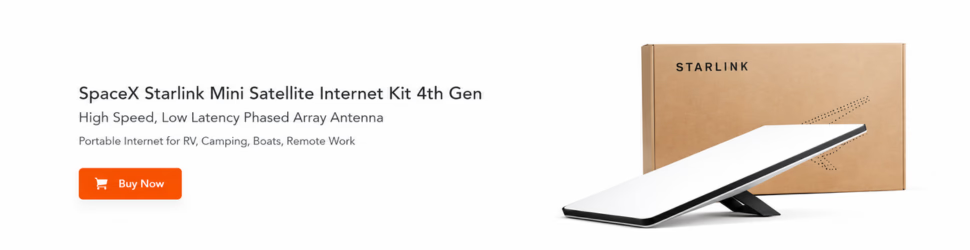
Starlink Mini, a compact portable terminal with integrated Wi-Fi, addresses this second market. However, the terminal is still separate from an ordinary smartphone or travel eSIM and requires suitable power and satellite visibility.
The official Starlink Roam information describes international use, selected in-motion functionality, and a Standby option for temporarily reducing service costs. Restrictions depend on the plan, registered country, and destination.
READ MORE: Starlink Mini Antenna and EU Roaming Rates Available in Europe
An important practical distinction concerns international travel. A Starlink terminal may receive satellite signals in a destination without being authorized for unrestricted commercial use there. Customers should check local service availability and Roam restrictions before crossing borders.
For normal international travel, a local SIM or travel eSIM will usually be cheaper and more convenient wherever terrestrial mobile networks are reliable. Starlink becomes more compelling when those networks are unavailable or when several people need to share one broadband connection.
Is Starlink Cheaper Than Fiber, 5G or Traditional Satellite Internet?
Starlink’s competitiveness depends heavily on geography.
Where modern fiber is available, it will often provide better value through high download and upload speeds, low latency, and predictable performance. Fixed wireless access over 4G or 5G can also be cheaper, provided coverage and network capacity are adequate.
Starlink is most competitive where those alternatives are poor or nonexistent.
A rural business facing a costly fiber extension may find that satellite broadband avoids major construction expenses. For a remote household, paying more each month can be reasonable if the alternative is an unreliable copper connection.
Businesses should also consider the cost of losing connectivity, not simply the cost of buying it. A separate satellite connection may support operational resilience when terrestrial infrastructure fails, although proper backup power and automatic failover remain essential.
This explains why Starlink also sells Priority services for commercial customers. Its business offerings separate network priority and data allowances from ordinary household pricing. Official US business-plan listings include Local Priority and Global Priority categories, with different intended applications and service costs.
The competitive pressure on telecom operators is increasingly concentrated in underserved areas and business-continuity applications. Starlink does not need to undercut every fiber subscription to win customers; it needs to make connectivity economically practical where traditional network investment is difficult.
Is Starlink Worth the Monthly Cost?
For customers comparing broadband providers, the decision comes down to three questions: what alternatives are available, how reliable those alternatives are, and how much the equipment and service will cost over the period of ownership.
A $55 monthly subscription can be attractive for a remote property with limited broadband options. The same subscription may be considerably less compelling in an urban apartment already served by affordable gigabit fiber.
Similarly, Roam Unlimited may be valuable to a full-time traveler working beyond mobile-network coverage, but excessive for someone whose trips are normally covered by a low-cost international eSIM.
Starlink’s shift toward multiple residential speeds, rental equipment, and differentiated roaming packages is commercially significant. SpaceX is no longer selling satellite connectivity under a simple premium-price model. It is segmenting customers according to usage, performance expectations, geography, and willingness to pay.
That allows the company to compete on entry-level affordability in selected regions while reserving higher-priced plans for customers who value network priority or mobility.
The real question is no longer whether satellite broadband is expensive. It is whether Starlink delivers enough additional connectivity value to justify its total cost in a particular location.
For customers without credible terrestrial alternatives, the answer may be straightforward. For everyone else, careful comparison remains essential.