


Saily Adds Coverage Maps, Raising the Bar for Travel eSIM Transparency
Travel eSIM shopping has become remarkably predictable. Choose a destination, compare gigabytes and validity, check the price, and hope the connection works when you arrive.
Saily wants travelers to know a little more before paying.
On October 23, Saily announced coverage maps across its 200-plus destinations and a new in-app breakdown of mobile data consumption. The tools are available now, according to the company.
Neither feature changes the basic promise of travel eSIM. But together, they tackle two questions that pricing tables rarely answer: Where will my connection actually work, and what is eating through my data?
From country coverage to local coverage
A provider saying it covers Japan tells you very little about connectivity in rural Hokkaido. The same applies to a United States plan used outside major cities, or an island itinerary with unpredictable reception.
Saily’s maps allow customers to zoom into a destination and inspect areas where mobile signal may be weaker or unavailable before buying.
“With a traditional SIM card, you’re stuck with one network – if it has poor coverage where you’re traveling, that’s your problem. Saily eSIMs can switch between several local networks, so you’re far less likely to hit a dead zone. Now we’re going one step further: our new coverage maps let users zoom in on their destination and see the connection quality on the ground before they travel,” says Matas Cenys, head of product at Saily.
The broader point is compelling. Travel eSIM providers have spent years promoting destination counts, package sizes, unlimited-data labels and discounts. Yet the network behind a package can be more important than another gigabyte.
READ MORE: Travel eSIM Latency: What Really Determines Speed?
Saily’s announcement outlines three features:
- Coverage maps: Destination-level views indicating stronger, weaker and potentially unavailable signal areas before purchase.
- Usage by category: A breakdown showing how much data activities such as streaming and social media consume.
- Privacy controls: Saily says it identifies traffic categories rather than content, and users can delete their usage history.
The maps are the most consequential addition, provided their information reflects the service customers can actually use.


The question a coverage map cannot answer alone
There is a technical catch. A mobile operator’s coverage footprint and a roaming eSIM’s accessible coverage are not necessarily identical.
A host operator may advertise extensive 5G coverage, but an international roaming agreement can limit which networks, technologies or services a particular eSIM can access. Network switching can also depend on the plan and selection settings.
That leaves a crucial unanswered question: Do Saily’s maps show the networks available to each purchased package, or more general modeled coverage in the destination?
The announcement does not explain the maps’ data sources, update frequency, or how coverage is matched to individual plans. That is not proof the maps are inaccurate. It means travelers should treat them as planning guidance, not a connectivity guarantee.
READ MORE: The eSIM Trust Index
There is also a difference between finding signal and getting a usable connection. Opensignal distinguishes geographic coverage from real-world experience, including where users actually receive service. Congestion, indoor reception and roaming arrangements can all affect the result.
For a city-break traveler, this nuance may barely matter. For someone driving through remote regions, working from a rural property or depending on connectivity for business calls, it matters enormously.
 Why the data breakdown matters
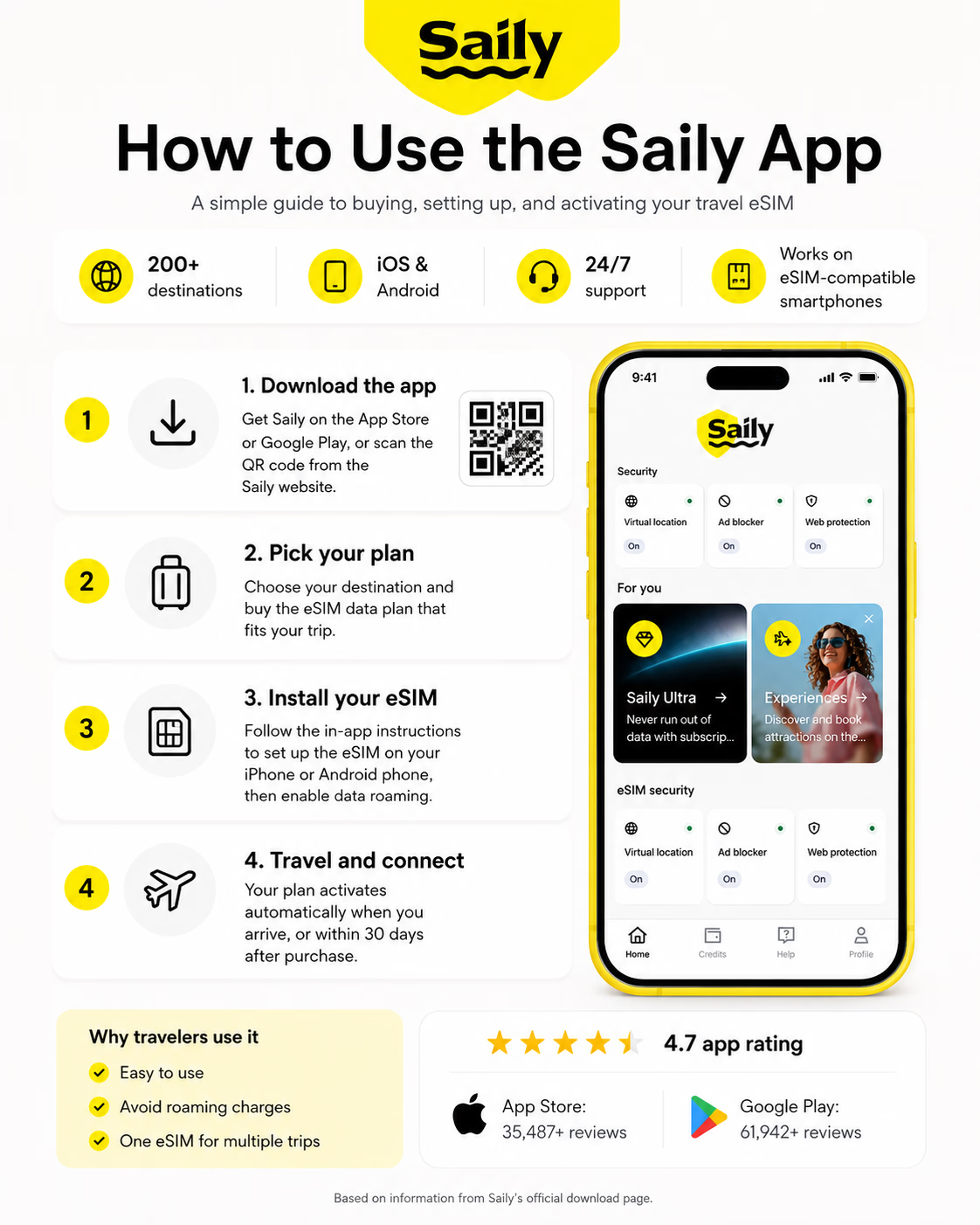
The second update tackles a different frustration: buying 5 GB for a week and discovering that most of it vanished after a few days.
Knowing that streaming consumes more data than messaging is obvious in theory. Seeing the actual category breakdown inside the eSIM app is far more actionable.
Travelers can identify expensive habits, adjust background activity or decide whether their next trip requires a larger allowance. Saily says the feature reports traffic categories without reading content, with an option to erase usage history.
That privacy distinction matters, although the announcement does not provide enough technical detail for an independent assessment of its traffic-classification method.
READ MORE: Bcengi Study Finds Median Usage of Just 2GB
There is a commercial opportunity here, too. Over time, category-level usage could support more relevant plan suggestions: a light messaging user probably needs something different from a traveler uploading video every evening.
Saily has not announced personalized package recommendations with this release, however. That remains a potential direction, not an existing feature.
The company has also been adding travel utilities beyond connectivity, including a flight tracker that stores multiple flights and alerts users to status changes. It suggests Saily wants its app opened during the trip, not only during checkout.
A more useful kind of competition
Saily is not the first provider to make network information part of its sales proposition. Ubigi, for example, publishes a destination-by-destination list of partner mobile operators and available network technologies. That offers another form of transparency: naming the networks rather than only visualizing their footprint.
Travelers comparing Saily with Ubigi, Airalo or Holafly should still examine price, plan-specific networks, 5G access, hotspot rules and fair-use conditions. A polished map cannot compensate for an unsuitable package.
Conclusion: The next eSIM battle is about proof
The travel eSIM market has become crowded enough that adding another destination is no longer a convincing headline by itself. The more interesting competition is about reducing uncertainty before a customer spends money.
Saily’s maps move in the right direction, but the industry should aim higher: show which networks each plan genuinely accesses, how recent the underlying coverage data is, and where expected signal differs from measured performance.
GSMA Intelligence already provides operator-sourced coverage mapping, while Opensignal measures aspects of actual network experience. Those are different evidence layers, and travel eSIM brands could become much more useful by explaining the distinction.
The winner will not necessarily be the provider with the prettiest map. It may be the one willing to make a verifiable promise about the connection travelers can expect once they leave the airport.


