EU Roaming Explained: What’s Free, What’s Limited, What Still Costs
EU roaming is one of those quiet policy wins that travellers now take for granted. You land in Spain, Italy, France, Croatia or Germany, your phone connects, and nothing dramatic happens. No panic. No €80 bill for checking Google Maps. No turning mobile data off, like it is radioactive.
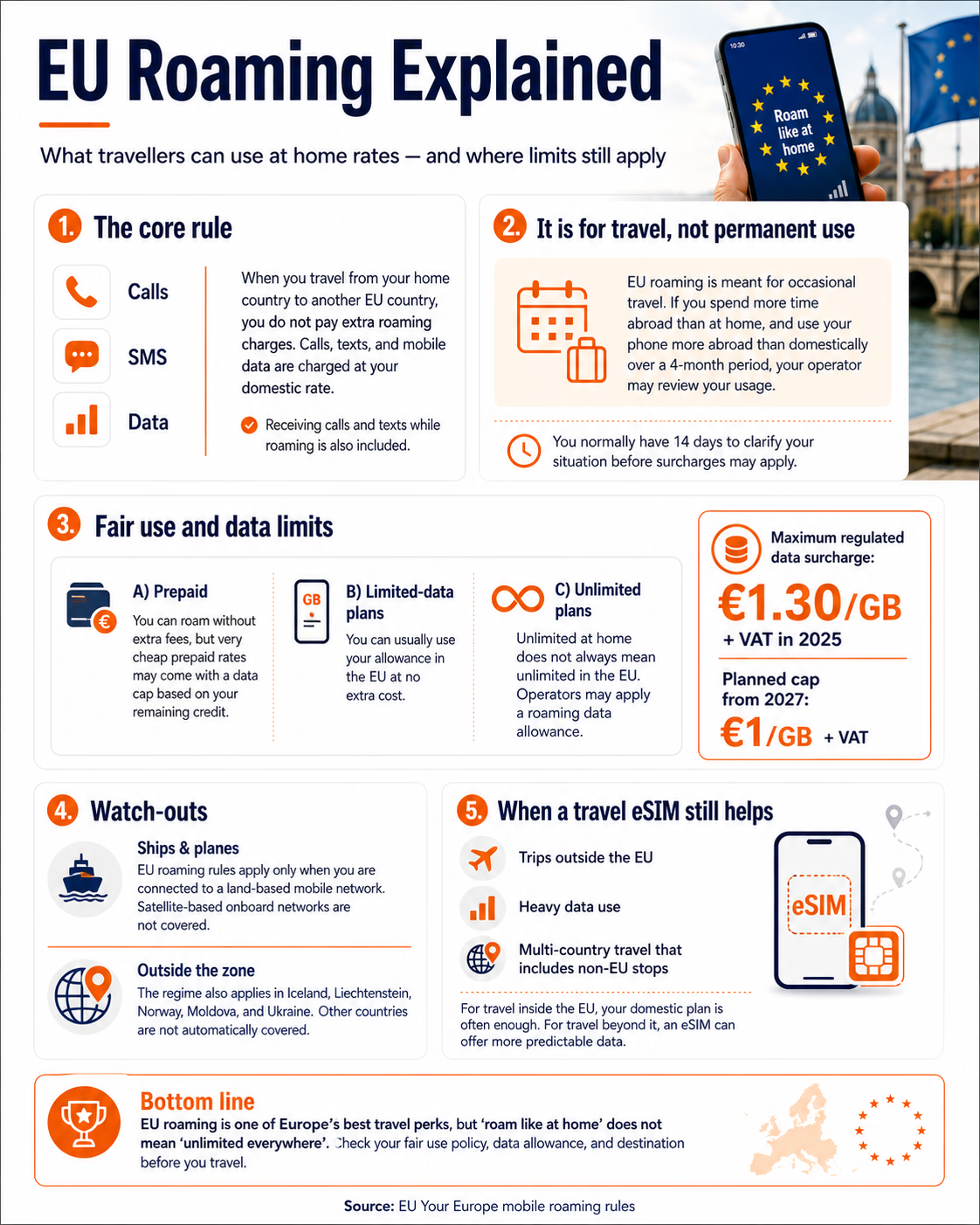
That is the whole point of “Roam like at home”. When you travel from your home country to another EU country, your calls, SMS and mobile data are charged at the same domestic rate you pay at home. The same applies when you receive calls or texts while roaming. You do not pay extra just because you crossed a border.
For European travellers, this has changed behaviour. People now use mobile data abroad almost as casually as they do at home. They check hotel bookings, call an Uber, stream music, translate menus, send work emails and use maps without thinking about roaming charges every five minutes.
That is a big cultural shift. But it is not the same as saying roaming in Europe is completely unlimited, borderless or risk-free.
What EU roaming actually covers
The official EU rule is simple on the surface: if you are occasionally travelling in another EU country, your mobile operator should treat your usage like domestic usage. This applies to calls, texts and data, as long as you have a stable link to your home country and are not using a SIM permanently abroad.
That word “occasionally” matters.
EU roaming was designed for travel, not for replacing a local mobile subscription. If you live in one country and keep using a cheaper SIM from another country full-time, your operator can apply fair use rules. This is where many misunderstandings start. The EU removed abusive roaming fees for normal travellers, but it did not create an unlimited arbitrage system for people to permanently shop around Europe for the cheapest SIM.
Operators can monitor roaming behaviour over four months. If you spend more time abroad than at home and use your phone more abroad than domestically, your provider may ask you to clarify your situation. If the pattern continues, extra charges can be applied, although those charges are capped.
That is not a loophole. It is the compromise that made the system commercially survivable.
The data catch
The most common problem with EU roaming is not calls or SMS. It is data.
If your plan has a fixed data allowance, you can usually use that allowance while travelling in the EU. But if your domestic plan is very cheap, or if it includes unlimited data, your operator may set a fair use roaming data limit. The EU allows this, as long as the operator informs you in advance and follows the regulated formula.
For 2025, the wholesale data cap is €1.30 per GB plus VAT, and from 2027 it will fall to €1 per GB plus VAT. This figure matters because it helps define the maximum surcharge and the minimum roaming allowance in certain types of plans.
Here is the practical translation: “unlimited data” at home does not always mean unlimited data while roaming. A user paying a low monthly fee for unlimited domestic data may receive a smaller roaming allowance when travelling. Once that allowance is used, extra charges can apply, but they must stay within the EU cap.
This is where telecom language gets messy. Consumers hear “roam like at home” and assume perfect symmetry. Operators read the regulation and apply fair use limits. Both sides think they are right. In many cases, they are.
Planes, ships and border traps
There is another detail travellers often miss: EU roaming rules apply when you are connected to a terrestrial mobile network. If you are on a ship or plane and your phone connects through a satellite-based onboard network, EU roaming protections do not apply. Those charges can be much higher. The EU explicitly warns travellers to deactivate roaming or use flight mode onboard if they want to avoid unexpected costs.
This is especially relevant in ferry-heavy markets like Greece, Croatia, Italy and Scandinavia. A traveller can be physically inside Europe and still connect to a non-regulated maritime network. The phone does not care that you are on holiday. It connects to what is available.
The same caution applies near borders. Most of the time, EU roaming works smoothly. But phones can occasionally attach to a network in a neighbouring non-EU country, especially in border regions or coastal areas. For Alertify readers, the lesson is simple: when travelling near Switzerland, the Western Balkans, Turkey, North Africa or at sea, check the network name before assuming EU rules apply.
Outside the EU is a different world
EU roaming also extends to the European Economic Area countries Iceland, Liechtenstein and Norway, and the EU page notes that the “roam like at home” regime is also available in Moldova and Ukraine. Other countries are not automatically covered, although some operators choose to include them in their own offers.
This is where the eSIM market has found its strongest opening. Inside the EU, a domestic European SIM is usually enough for casual travel. Outside the EU, the story changes quickly. Roaming in Turkey, Switzerland, the United States, the UAE, Asia or Latin America can still become expensive if users do not check their operator’s rates before travelling.
That is why travel eSIM providers continue to grow, even in Europe where roaming has been largely solved. They are not competing only with EU roaming. They are competing with the anxiety that begins the moment a traveller leaves the regulated zone.
Where eSIMs fit
For intra-EU travel, many Europeans do not need a travel eSIM at all. That is the honest answer. If you have a solid domestic plan with a decent roaming allowance, EU roaming is usually the simplest option.
But eSIMs still matter in three cases.
First, non-EU visitors coming to Europe often need affordable regional data. A US, Canadian, Australian or Asian traveller may find a Europe eSIM easier than paying their home carrier’s roaming fees.
Second, heavy data users may want more predictable data than their fair use allowance provides. Remote workers, content creators and business travellers can burn through roaming data faster than they expect.
Third, multi-region trips are where eSIMs become genuinely useful. A traveller going from France to Switzerland, then Turkey, then the UAE is no longer living inside the neat EU roaming bubble.
This is where the market splits. Traditional European mobile operators are strongest for residents travelling within the EU. Travel eSIM brands are strongest for visitors, multi-country itineraries, and out-of-zone travel. Global operators and enterprise eSIM providers play a different game again, serving companies that need control, reporting, policy and cost visibility across employee devices.
Final thoughts
EU roaming remains one of the best consumer telecom policies in the world. It made mobile travel feel normal. That should not be underestimated.
But the next phase of travel connectivity is not about whether EU roaming works. It does. The real question is whether travellers understand where it stops.
For a weekend in Paris, Rome or Lisbon, your domestic European plan will usually beat any travel eSIM for simplicity. For a US tourist landing in Europe, a regional eSIM may be cleaner. For a business traveller moving between the EU, Switzerland, Turkey and the Gulf, the decision becomes more strategic. For enterprises, roaming is not just a price issue anymore. It is a visibility and control issue.
That is the market trend worth watching. EU roaming solved the most obvious consumer pain point inside Europe. eSIM providers are now building around everything the regulation does not fully cover: visitors, edge countries, heavy users, business travel, multi-region trips and predictable data control.
So yes, “roam like at home” is still a travel win. But smart travellers should read the small print before assuming Europe’s best telecom perk follows them everywhere.
Driven by wanderlust and a passion for tech, Sandra is the creative force behind Alertify. Love for exploration and discovery is what sparked the idea for Alertify, a product that likely combines Sandra’s technological expertise with the desire to simplify or enhance travel experiences in some way.