


Push-to-Talk Devices, eSIM Data and the New Shape of Team Connectivity
A walkie-talkie and a data plan used to sit in different budgets. Today they ship in the same box. IMARC projects the push-to-talk over cellular market to expand at a 7.52% CAGR through 2034, and the growth is being driven less by radio hardware than by the networks underneath it: carrier LTE, facility Wi-Fi and embedded SIMs that can be provisioned remotely under the SGP.32 eSIM framework.
That combination removes the old complaints about range, licensing and repeater costs. It also creates fresh ones, such as which carrier profile is active on a device parked abroad, or what happens to two hundred handsets when a contract ends.
The sections below work through those trade-offs, from coverage and fallback to profile control and pricing.
Why Teams Are Leaving Traditional Radio
Two-way radio still works, but its limits are structural. Range is tied to repeaters and line of sight, channels require licensing in many markets, and a crew that crosses a county line can drop off the net entirely.
PoC devices swap that model for IP transport: the handset sends voice packets to a cloud server over LTE, 5G or Wi-Fi, and the server routes them to a talk group, a dispatcher or a single user.
What teams tend to gain:
- Wide-area reach, since coverage follows the carrier map rather than a tower you own
- Faster rollout, because there is no frequency planning or repeater install
- Data on the side, such as GPS position, messaging and call recording
The catch is dependency. If the data link fails, the radio goes silent, so the connectivity layer deserves as much scrutiny as the hardware.
What eSIM Data Changes for PTT Devices
A PoC radio without a working data profile is a paperweight. Physical SIMs handle that job, but they lock a device to one carrier and one contract, and swapping them at scale is tedious. Embedded SIMs move that work into software.
Juniper Research expects the number of devices using eSIMs to grow by 30% in 2026, with connected logistics and oil and gas among the fastest-moving segments, which is close to the exact profile of a PTT customer.
For a fleet manager, that can mean:
- Activating profiles in bulk before devices leave the warehouse
- Switching carriers over the air if coverage or pricing changes
- Keeping one hardware SKU for several countries
Alertify has tracked how programmable connectivity turns the SIM into a policy object rather than a plastic card, and PTT is one of the clearest cases for it.
Coverage, Fallback and the Wi-Fi Question
Can a cellular radio be trusted inside a steel warehouse or a basement plant room? Often not on LTE alone, which is why most business PoC handsets also connect over Wi-Fi and hand off between the two.
Indoors, the facility network carries the call; outside, the carrier takes over. Some deployments add a satellite-backed Wi-Fi hotspot for remote sites, so the radio never has to know what sits behind the access point.
A practical coverage check before buying might include:
- Walking the site with a test unit on cellular only, then Wi-Fi only
- Mapping dead zones where lone workers spend time
- Confirming which carrier bands the handset supports
- Deciding what happens during a full outage, and telling staff
If both links vanish, the radio waits until one returns. That is acceptable for a retail floor and risky for a utility crew.
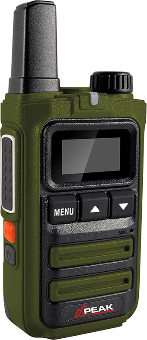
Peak PTT and Three Ways to Deploy It
Peak PTT is a useful reference point because it packages PoC the way most small and mid-sized teams buy it: pre-programmed radios, no FCC licence, flat monthly airtime and multi-carrier LTE service in the United States. Looking at the platform from three angles shows how flexible the category has become.
- Handhelds for crews. Rugged, glove-friendly units with SOS and GPS, aimed at construction, security and events.
- Vehicle-mounted units for fleets. Dash-installed radios wired to vehicle power with external antennas, so drivers stay on the same channels as the yard.
- Apps and PC dispatch for the office. Smartphone clients and a web console put supervisors on live maps with recording and alerting.
The platform can also bridge legacy radio through a RoIP gateway, which helps if a phased migration makes more sense than a rip-and-replace.
Public Safety Shows the Model in Action
Agencies with the strictest uptime needs have already tested this approach under stress. In Baltimore, an underground fire knocked out power and disabled radio communications downtown; the City Sheriff’s Office kept coordinating on FirstNet broadband devices, an incident that pushed the agency to adopt broadband for daily operations.
In Amherst, Massachusetts, the fire department has been moving from conventional radio to push-to-talk over FirstNet, drawn by the ability to share multimedia alongside voice.
These are outcomes from real incidents rather than vendor demos, and they illustrate a pattern private teams can copy:
- Priority data access for the people who need it most
- Talk groups created on the fly across agencies
- Location visible to command without a separate tracker
If an emergency network can rely on broadband PTT, a logistics or facilities team probably can too.
Cross-Border Teams and Permanent Roaming
Operators serving Europe or Latin America run into a problem U.S.-only PoC vendors rarely mention: permanent roaming. Several regulators limit how long a foreign SIM can camp on a domestic network, and devices that never leave a country can be cut off.
We covered how enterprise IoT eSIM offerings from carriers such as Ooredoo respond with access to hundreds of networks under one management view.
For a PTT rollout, the questions become practical:
- Does the eSIM provider hold local profiles where crews are based?
- Can a device switch profiles without a technician touching it?
- Who is accountable if a national carrier throttles VoIP-style traffic?
Vendors themselves warn that service outside their home market may be limited, so international buyers should test a pilot batch before committing.
Managing Profiles at Fleet Scale
The hard part of eSIM was never the chip. It is orchestration: who owns the profiles, how fast they can be switched and what happens when a carrier contract ends. Alertify’s look at IoT eSIM management platforms built on SGP.32 describes exactly that layer, with over-the-air provisioning, profile updates and lifecycle control for devices that may never be physically accessed again.
Translated to a PTT fleet, a mature setup could look like this:
- A connectivity dashboard listing every handset, its active profile and its data usage
- Rules that push a backup profile if a primary network degrades
- Bulk actions, so a thousand radios can move carriers in one job
Without this layer, eSIM simply relocates the SIM-swap headache from the parking lot to a spreadsheet.
Security and Control on the Data Layer
Because PoC voice travels as IP packets, it inherits IP-style risks along with IP-style controls. Encryption in transit, centralised user and talk-group management and least-privilege admin access are the baseline most business platforms now offer. Public safety adds mission-critical PTT standards from 3GPP, which define priority handling and reliability targets.
eSIM adds another dimension. Remote provisioning must itself be secured, and profile switching should never open a path for a rogue profile to land on a device. The G+D analysis we published on eSIM in IoT makes the case that cellular’s globally harmonised standards give it a security and manageability edge over Wi-Fi and Bluetooth for exactly this reason.
A short due-diligence list: ask for the encryption model, the admin audit trail, and who can trigger a profile change.
Costs, Contracts and the Buying Model
Is PoC cheaper than the radio system it replaces? Usually the hardware is, since a business LTE handset costs less than a licensed UHF radio plus repeater infrastructure. The real difference sits in the operating model. Instead of a capital project, teams pay per radio per month, often with no long-term contract, and the SIM data plan is bundled into that fee.
Things worth modelling before signing:
- Airtime per device, and what it includes (GPS, dispatch, recording)
- If eSIM profiles carry a separate data charge from the carrier
- Hardware lifecycle, since a lifetime warranty tied to active service changes the maths
- Exit terms, if the team later wants to move carriers or platforms
If a provider can quote a flat, all-in number, comparing it with a legacy radio budget becomes a simple exercise.
Where PoC Radios and eSIM Meet Next
Push-to-talk over cellular gave field teams the reach of a phone network with the discipline of a radio. eSIM data is now doing to the connection what PoC did to the handset: turning a fixed, physical dependency into something that can be provisioned, moved and retired from a dashboard.
The combination can shorten rollouts, simplify multi-country fleets and reduce carrier lock-in, if the orchestration layer is in place and the coverage has been tested on site rather than assumed from a map.
The buyers who get the most from it will treat connectivity as part of the device spec instead of an afterthought on the purchase order. Radios, profiles and policies will increasingly ship together, and the vendors who make that bundle easy to manage are the ones worth watching.


