Permanent Roaming: Why Your SIM Card Could Get Blocked Abroad
There’s a quiet tension running through the telecom industry right now, and it sits exactly at the intersection of two things that are genuinely colliding: the rise of long-term mobile travellers and the increasingly aggressive stance that operators — and regulators — are taking against people who roam indefinitely.
“Permanent roaming” sounds like a technical term buried in some GSMA specification, and for most of its history, it was. But it’s become something far more relevant to digital nomads, expats, and even everyday users who’ve moved abroad and kept their home SIM. The issue is finally surfacing because the number of people affected has grown large enough to matter commercially.
So what exactly is the problem — and who’s actually enforcing it?
What Permanent Roaming Actually Means
At its most basic, permanent roaming is what happens when a SIM card registered in one country is used continuously on a foreign network with no meaningful return to the home network. Roaming agreements between operators were designed to handle temporary displacement — a traveller spending two weeks in Thailand, a business trip to Berlin. They were never built for someone who moved to Lisbon and just kept their British O2 number running for eighteen months.
From a network economics standpoint, the problem is structural. Roaming agreements typically facilitate temporary roaming for business travellers or tourists visiting a country, and MNO partners may want to change the business dynamics to cover for this by creating bilateral revenue-sharing agreements or prohibiting permanent roaming altogether. The visited network carries the traffic. The home network collects the revenue. If that arrangement never ends, the visited operator is essentially subsidising someone else’s customer, indefinitely.
That’s a losing deal. And operators know it.
Where the Crackdowns Are Happening
The regulatory landscape on permanent roaming is, to put it plainly, a patchwork. In markets like Brazil, Turkey, and Nigeria, permanent roaming is banned outright by the regulator. In Australia, Canada, and the USA, there are no regulatory restrictions, but local MNOs are hostile to the practice. China, Egypt, India, Saudi Arabia, Singapore, and the UAE prohibit large deployments. In the EU, there are currently no restrictions.
In countries with permanent roaming restrictions, MNOs often implement time limits — typically 90 or 180 days per year. If this limit is exceeded, the SIM card is blocked and the device’s IMEI number may be blacklisted.
Turkey is the most aggressive case study right now. As a foreign visitor, you may roam in Turkey for up to 120 days. After that, the device is automatically classified as “permanently roaming,” which is prohibited, and is immediately removed from all Turkish networks — the device will still register to the network but can’t use data, and the device’s IMEI will be flagged. This isn’t theoretical. Travellers report it happening regularly.
Russia took a different approach in late 2025. Russian telecommunications authorities introduced a new restriction in October 2025: foreign subscribers in roaming would be left without mobile internet and SMS for the first 24 hours. After three days of inactivity, the blockade triggers again. Officially framed as a security measure, practically it’s part of a broader strategy of network control and data localisation.
The EU’s Uncomfortable Middle Ground
Europe presents its own brand of complexity. The Roam Like at Home framework, extended and reinforced under Regulation (EU) 2022/612, bans roaming charges within the EEA — but it was never designed to handle someone using a Romanian SIM as their permanent number while living in Amsterdam. If you use your mobile phone abroad permanently, for example, if you move abroad and keep using your SIM card from your home country, your mobile operator may charge you extra for roaming under the fair use policy.
The fair use clause is where it gets messy. Operators can legitimately throttle or surcharge users who show a pattern consistent with permanent roaming, and the wholesale data cap sits at €1.30 per GB in 2025, decreasing to €1.00 by 2027 — but the enforcement is operator-dependent and inconsistently applied. Some carriers look the other way. Others quietly throttle.
What makes the EU picture more interesting in the longer term is the M2M dimension. Under EU regulation, MNOs may prevent permanent roaming of regulated roaming services or anomalous or abusive use of wholesale roaming access. Agreements on permanent roaming continue to be possible, but will not automatically benefit from regulated wholesale access obligations and tariffs. What constitutes “permanent” is still being interpreted, especially for IoT, but the direction of travel is clearly toward tighter controls.
The eSIM Layer Makes Everything Messier
Here’s where the travel eSIM industry gets pulled directly into this debate. The entire value proposition of a travel eSIM — whether from Airalo, Holafly, Nomad, Ubigi, or Yesim — is essentially arbitrage roaming. The user stays on their home device, downloads a foreign data profile, and the provider manages a wholesale roaming arrangement behind the scenes. That model works brilliantly for short trips. For long stays, it starts running into exactly the same structural tensions that trouble traditional SIM cards.
Turkey now requires eSIM companies to work directly with local mobile operators, store all SIM profile data inside the country, and prevent long-term roaming on foreign networks. . That’s not just a consumer inconvenience — it’s a direct challenge to the business model of data-only eSIM providers who rely on not needing a local entity in every market.
As of 2025, Turkey’s BTK has restricted access to over 30 international eSIM providers, including Airalo, Holafly, Saily, Nomad, Instabridge, Mobimatter, Ubigi, Roamless, GigSky, and others. That list keeps growing, and the pattern is spreading. What Turkey formalised, India and the UAE have enforced through practical blocking rather than explicit law.
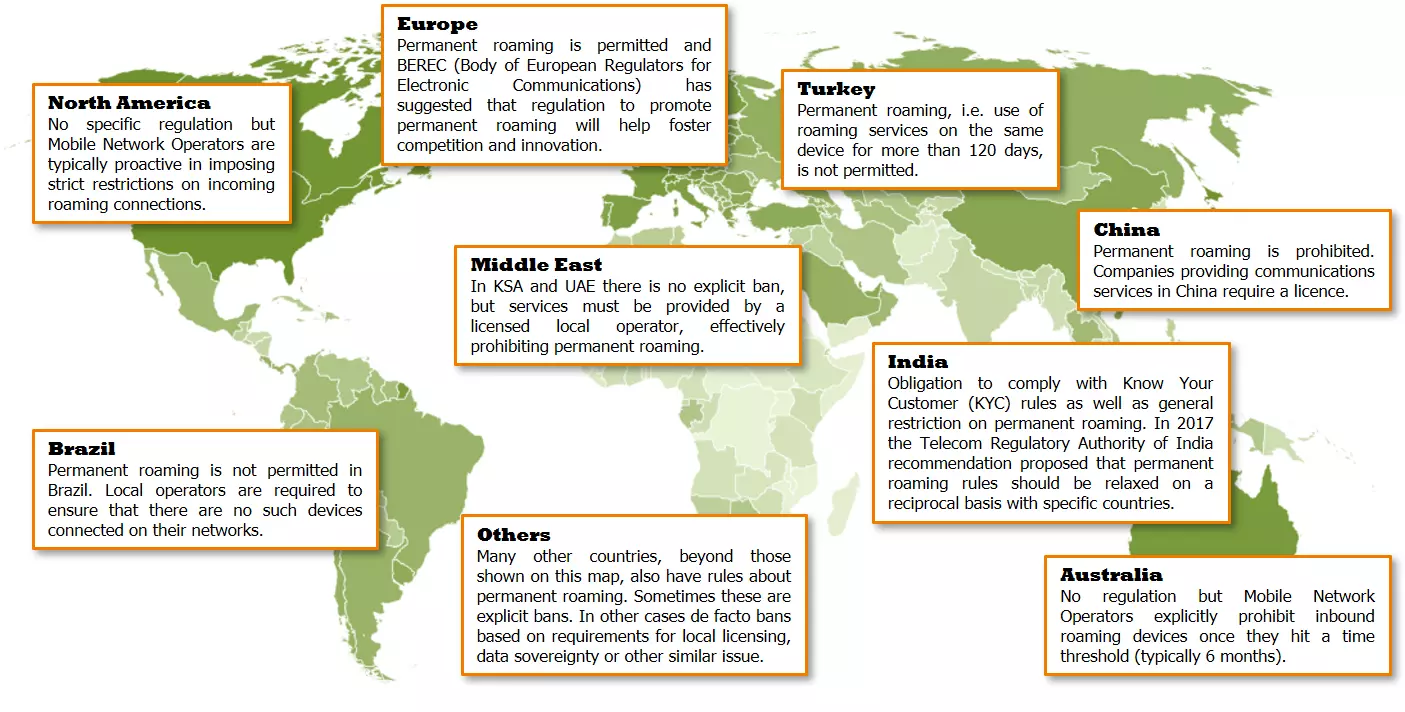
Source: Transforma Insights Permanent roaming, by Matt Hatton, 26 May 2021
The IoT Precedent Is Already Being Set
The consumer side of permanent roaming is getting attention now, but the IoT world has been dealing with it for years — and the solutions emerging there will likely influence what happens to travel connectivity next.
One fix for the permanent roaming issue is to choose an eUICC solution that lets you add multiple provider profiles to a SIM. Multi-IMSI approaches — where a single SIM carries multiple network identities and can present as a local subscriber depending on geography — are already standard practice in connected cars, smart meters, and logistics fleets. The technology exists. The question is whether travel eSIM providers will build toward it.
Some already are. Providers like Ubigi (owned by Transatel, now part of NTT) and Airalo’s B2B division are increasingly positioning toward longer-duration connectivity rather than pure short-trip data packs. The annual plans that Nomad, Yesim and others have been rolling out quietly — valid for 365 days across multiple countries — are a market signal. They’re not explicitly designed to solve permanent roaming, but they’re building the commercial relationship that makes compliance negotiations easier.
The Bottom Line
Permanent roaming is a regulatory time bomb that the travel connectivity industry has largely managed to avoid by staying in the tourist segment. That’s changing. As more people live internationally and as eSIM adoption deepens, the grey zone between “traveller” and “permanent roamer” is getting harder to ignore — and operators, from Vodafone to Turkcell, are investing in the analytics to detect it.
Providers like Holafly and Airalo built their business on simplicity — quick top-ups, short trips, no contracts. That model isn’t going away, but it has a ceiling. The providers that will scale past it are the ones investing in local network partnerships, localisation-ready infrastructure, and compliance frameworks that actually satisfy regulators in Turkey, Brazil, and wherever the next crackdown lands. Ubigi’s position as a Transatel-backed MVNO with real network agreements gives it structural advantages here that pure-play resellers don’t have. Yesim’s move toward subscription models is in the same direction.
The broader signal, if you follow organisations like GSMA and BEREC, is that the era of unconstrained global roaming arbitrage is closing. Not overnight — but the permanent roaming restrictions already baked into EU law, and the enforcement momentum building everywhere from São Paulo to Istanbul, point one way. The providers who treat compliance as a product feature, not a legal afterthought, will be the ones still standing when the window finally closes.