


Monty eSIM Promo Code: Discounts, Plans & Review
Monty eSIM has quietly become more interesting than its consumer storefront suggests. On the surface, it sells the familiar mix of prepaid country, regional and global data packages.
Behind that sits Monty Mobile, a telecom infrastructure company with its own eSIM provisioning stack, wholesale data business and B2B platform. And in September 2026, Monty added the piece that changes the consumer proposition: One eSIM, a persistent profile that can stay installed while new destinations and plans are added later. That matters more than another 1GB price cut. It turns Monty from a collection of disposable travel bundles into something closer to a reusable connectivity account. There are still gaps — particularly around refund visibility, network consistency and unlimited-plan fine print — but there is substantially more telecom underneath Monty eSIM than the average travel-data storefront.
What Monty eSIM actually is
Monty eSIM is the consumer travel-connectivity service of Monty Mobile. Its iOS application is published by MONTY UK GLOBAL LIMITED, headquartered in London, while Monty Mobile operates a much broader telecom business spanning eSIM infrastructure, wholesale data, CPaaS and operator services.
That distinction matters.
Many travel eSIM brands primarily aggregate connectivity bought from other platforms. Monty Mobile operates GSMA-accredited subscription-management infrastructure; its current certification page lists GSMA SAS-SM accreditation for its eSIM remote-provisioning systems. Its enterprise platform also supports APIs, SDKs, white-label stores, real-time provisioning and wholesale data distribution.
So the consumer eSIM is effectively the retail edge of a larger telecom platform.
Monty’s consumer website and app still advertise coverage in 190+ countries and regions, while newer One eSIM and Monty Mobile B2B materials refer to 200+. That appears to reflect newer infrastructure coverage expanding faster than the consumer marketing copy is being updated, but travellers should judge coverage by the specific plan they are buying rather than either headline number.
What you can actually buy
Monty’s core retail portfolio consists primarily of prepaid mobile-data plans: individual countries, regional bundles and global packages. Allowances and prices vary considerably by destination.
India illustrates the cheaper end. When checked, Monty listed 1GB for seven days at US$1.99, 10GB for 15 days at US$11.99, and 20GB for 30 days at US$24.50. Heavy users could go as high as 100GB for 30 days at US$94.50. The page identifies Airtel and Vodafone Idea among the available networks and advertises 5G where supported.
Andorra demonstrates why country-by-country comparison still matters. There, 1GB/7 days was US$5.50, while 20GB/30 days cost US$65.50. Andorra Telecom was the listed network.
Those were displayed prices when checked and were not labelled promotional. The plan pages reviewed did not make possible checkout taxes or other payment charges sufficiently clear to generalise, so the final checkout total remains the one that matters.
Hotspot and tethering are explicitly supported on the destination pages examined. That makes larger bundles more useful for laptop users rather than limiting the eSIM to the phone itself.
Monty’s mainstream consumer proposition remains data rather than traditional mobile service. Its App Store description directs customers to use internet-based services such as WhatsApp for calls and messaging rather than promising a local phone number, native minutes or SMS as part of the standard product.
One eSIM is the feature that actually matters
Traditional travel eSIM purchasing has a silly side effect: after enough trips, the SIM settings page starts looking like an archaeological site.
Monty’s One eSIM addresses that.
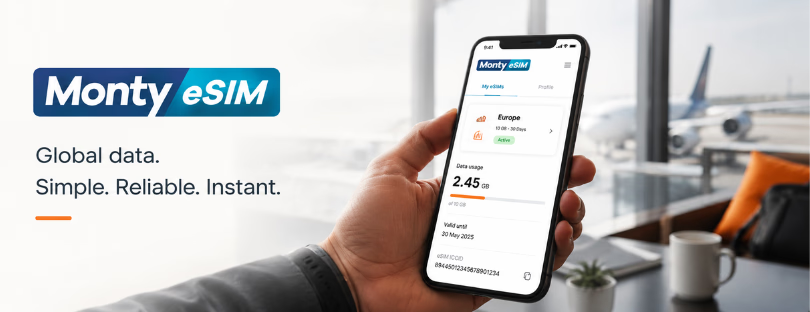
The customer installs one Monty profile initially. Future country or regional packages can then be added to that same profile through the app. Monty says customers can also top up or add another destination while travelling without installing another QR code or creating another profile.
Imagine flying Zagreb–Dubai–Singapore this month and London next month. The traditional workflow might involve three or four separate eSIM installations. One eSIM turns those into plan purchases attached to the profile already sitting on the phone.
This approach is not unique. Ubigi has long used a reusable profile, and Roamless similarly positions one global eSIM as a persistent connectivity layer. But it is still considerably more useful than treating every journey as a fresh installation.
And Monty’s infrastructure makes the move strategically logical: the company would rather keep a traveller attached to its connectivity platform than compete from zero for every trip.
What happens on the network?
The destination pages are better than many eSIM storefronts at naming network partners. India lists Airtel and Vodafone Idea; Andorra lists Andorra Telecom. Monty also advertises 5G with fallback to 4G/LTE where available. montyesim.com
The underlying platform is more interesting. Monty Mobile says its eSIM infrastructure uses carrier-direct data routes, automatic failover and local breakout designed to reduce latency. Its wholesale platform also gives partners real-time usage and routing controls.
That is meaningful infrastructure. It does not, however, guarantee identical performance everywhere.
Monty does not publish enough consumer-level routing detail to tell a traveller where traffic will break out for every destination, whether every plan provides multiple selectable networks, or what latency should be expected.
And customer feedback reflects that variability.
The U.S. App Store currently rates Monty eSIM 4.7/5 from about 1,300 ratings, while Google Play shows 4.0/5 from roughly 690 reviews and 100,000+ downloads. Positive reviewers repeatedly mention quick support and successful multi-country use. Negative reports include plans that failed to connect, manual configuration requirements and inconsistent network performance.
Those reviews do not prove a systemic problem. They do underline a basic reality of travel eSIMs: having roaming access to a network and delivering an excellent connection are not automatically the same thing.
Unlimited is destination-dependent
Monty currently markets both capped and unlimited bundles, but unlimited availability is not consistent across destinations. Its public consumer material also does not provide one clearly documented universal high-speed threshold applying to every unlimited package.
That is where Monty could be more transparent.
If an unlimited plan has a daily high-speed allowance followed by throttling, that number should sit directly beside the price. Until Monty publishes a universal rule — or explicit destination-level FUP details — heavy hotspot users should verify the exact package before purchasing.
For many travellers, a clearly defined 20GB or 50GB package may actually be easier to evaluate than an unlimited label with less-visible network management rules.
Monty eSIM promo code: what discount actually exists?
There is an important distinction between a public Monty eSIM promo code and Monty’s referral system.
The official website currently advertises US$3 off a new customer’s first eSIM purchase when they use an existing customer’s referral code. The person making the referral receives US$3 in Monty wallet credit after a successful referral. Monty also advertises 10% cashback after a customer’s third transaction.
In other words, there is no single permanent universal promo code advertised on Monty’s homepage at the time of checking. Referral codes are individual.
That matters because old coupon pages and codes shared in app reviews can remain indexed long after campaigns end. Check that the discount appears before completing payment rather than assuming an old Monty eSIM promo code still works.
The catch: transparency after something goes wrong
Monty’s strongest technical story sits behind the product. Its weaker area is consumer-policy visibility.
A detailed current refund policy is not prominently surfaced through the publicly indexed consumer pages we could verify. Secondary comparison sources describe refunds as available where activation fails because of a validated Monty technical issue, but Alertify could not independently confirm sufficiently detailed current official refund conditions to present that as a universal rule.
Monty does publish 24/7 support, a UK telephone number, email support and a contact form. Customer reviews also show WhatsApp being actively used for troubleshooting.
For something purchased specifically because you need internet immediately after landing, cancellation, replacement and failed-activation rules deserve to be easier to find.
Who should consider Monty eSIM?
Monty is increasingly attractive for repeat travellers rather than only someone hunting the cheapest gigabyte for a single weekend.
One eSIM removes repeated profile installation, large fixed-data bundles suit laptop and hotspot users, and the carrier infrastructure behind the service is stronger than the branding alone suggests.
Travellers requiring a local telephone number, native SMS or dependable OTP reception should look for a provider explicitly selling those capabilities. Someone whose priority is genuinely unrestricted unlimited data should also compare unlimited-focused providers and their published fair-use limits before choosing Monty.
Alertify Reality Check
Best for: Frequent travellers wanting a reusable eSIM with competitively priced prepaid data.
Less suitable for: Travellers who require native voice/SMS, a local number or extremely transparent unlimited-data rules.
Standout feature: One eSIM — install the profile once and add future destinations to it.
Watch out for: Destination-dependent network performance and insufficiently visible consumer refund/FUP details.
Alertify take: Monty’s real differentiator is not another cheap bundle; it is that a travel eSIM sits on top of a genuine telecom infrastructure business.
Conclusion
Monty eSIM becomes much easier to understand once you stop viewing it as an isolated travel app.
Cheap country packages are useful. Referral discounts are pleasant. Neither is particularly difficult for competitors to copy.
One eSIM plus Monty Mobile’s underlying provisioning, carrier and wholesale infrastructure is the more defensible proposition. Monty is moving from selling connectivity trip by trip toward keeping the traveller connected to one persistent telecom profile.
What holds it back is not technology. It is transparency at the retail edge: refund conditions, unlimited-plan limits and network behaviour should be as clear as the pricing.
That is an unusually fixable weakness. The infrastructure story is already there. Monty now needs the consumer information around it to be just as strong.


