Mobile Data Solved Connectivity. It Didn’t Solve Communication.
For years, the travel-connectivity problem looked simple: get the traveller online. Land in another country, avoid roaming shock and the SIM kiosk, activate an eSIM, open Maps, order a ride, send a message. Problem solved.
Except it wasn’t.
The travel eSIM industry became very good at delivering mobile data. What it often did not solve was the larger question of communication: who can reach you, what number you use, whether you can receive a normal call or SMS, and whether your mobile setup still makes sense once “I have internet” is no longer the whole job.
That distinction sounds small. It isn’t.
Connectivity was the easy win
The first wave of travel eSIM products was built around a clean proposition: data without roaming friction.
For many travellers, that is exactly enough. A few gigabytes can power WhatsApp, Maps, email, ride-hailing and hotel apps. If the services you rely on already sit on top of mobile data, why buy anything more complicated?
GSMA’s consumer eSIM architecture is fundamentally about remote provisioning: downloading and managing a mobile subscription without physically swapping a SIM card. The standard enables the mechanism. It does not require every commercial offer built on it to look the same.
“eSIM” describes how a mobile subscription is provisioned. It does not automatically mean “data-only travel plan.”
Being online is not being reachable
Picture a traveller who lands in Riyadh for a week of meetings.
The data eSIM connects within minutes. Email works. Teams works. WhatsApp works. From a connectivity perspective, everything is fine.
Then the less tidy parts begin.
A local contact asks for a number they can call. A courier phones rather than messages. A booking form expects a mobile number. A colleague wants to send a normal SMS. The traveller can keep the home SIM active, but now the experience depends on dual-SIM settings, roaming policy and the cost of conventional calls.
Together, they reveal the gap.
Mobile data gives a device internet access. Communication is about reachability.
That can involve apps, but also numbers, voice, SMS and continuity. Those layers matter more for some users than others: business travellers, expatriates, remote teams, people managing cross-border family relationships, entrepreneurs operating in several markets, or anyone staying long enough that “just use WhatsApp” starts feeling incomplete.
The number never disappeared
Messaging apps were supposed to make phone numbers irrelevant.
Instead, the phone number became less visible and more embedded.
It is still a way to call someone, but it can also be a contact credential, a business touchpoint, a verification route and a practical anchor between services. The value is not necessarily that people are making more traditional calls. It is that the number remains widely understood by people, apps and institutions.
This is one reason the next phase of travel connectivity may look less like a battle over gigabytes and more like a reassembly of telecom functions.
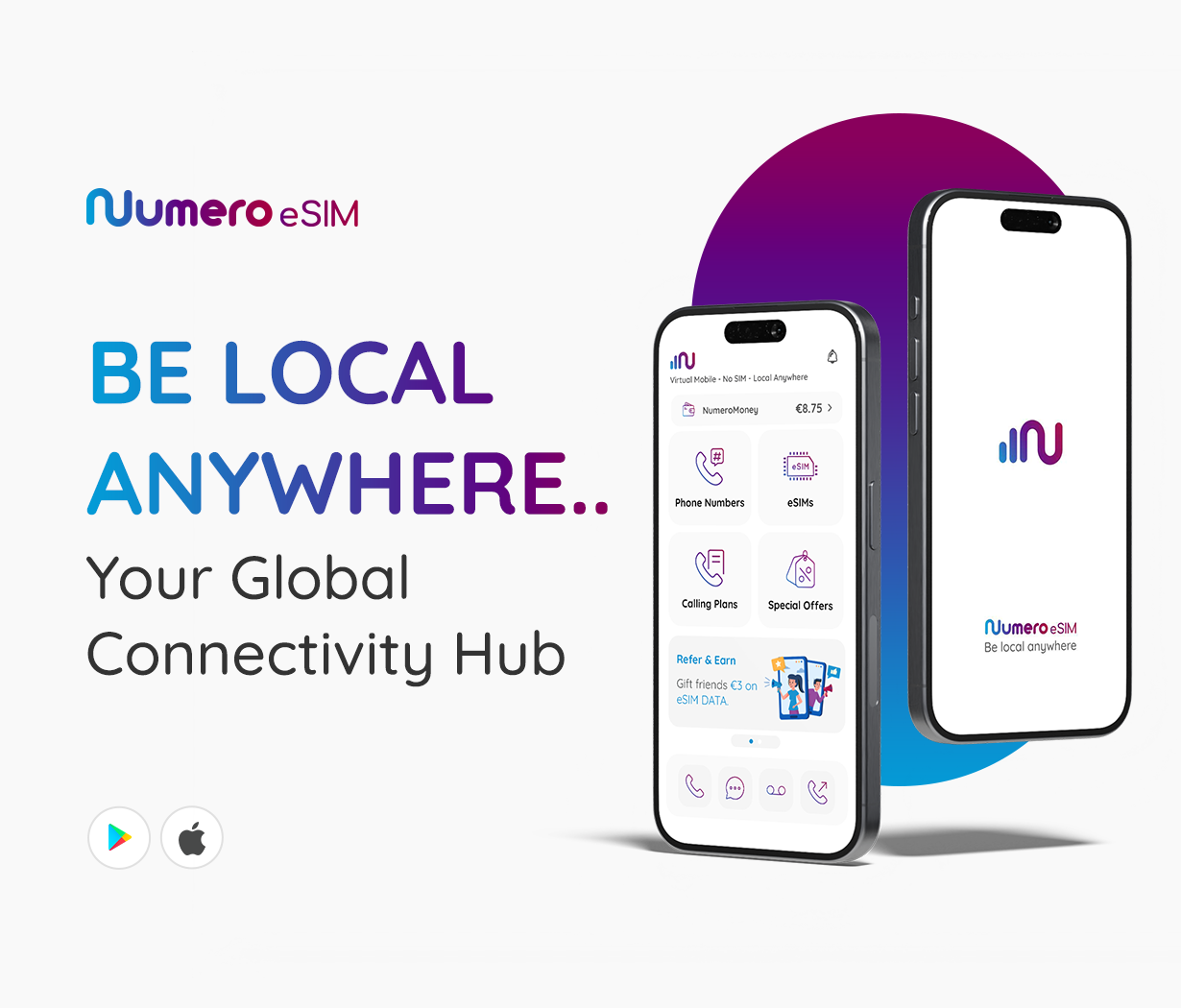
Numero eSIM is a useful example. Alongside conventional data eSIMs, it offers what it calls Full eSIMs: a single profile with mobile data, a real phone number, calling minutes and SMS. It also offers virtual numbers and app-based calling separately, allowing users to choose different pieces for different use cases.
The interesting part is not the label “Full eSIM.” It is the product logic underneath it.
Data is treated as one component of mobile communication, not the entire product.

The bundle is being rebuilt
Traditional mobile subscriptions bundled everything together. A SIM came with a number, voice, SMS and data.
Travel eSIMs broke that bundle apart. They proved that many users would happily buy only temporary data when abroad.
Now the pieces are being put back together selectively.
A weekend traveller may want nothing more than 5GB and WhatsApp. Giving that person a second number, voice allowance and more account complexity would solve a problem they do not have.
READ MORE: Numero eSIM App Download: Why This App Is Not Just Another Travel eSIM Button
A consultant spending two months across the Gulf may think differently. So might an expatriate who wants a number they can keep renewing, or a small business owner who needs presence in another market without maintaining another physical SIM.
Numero’s own catalogue makes the distinction visible. Its Full eSIM combines data, a number, calls and SMS, while its virtual-number service can be retained separately through renewal. The company also notes that the number attached to a Full eSIM is not always local to the destination—an important limitation for customers who specifically need local identity.
That detail matters. “Includes a number” can sound more universal than it really is.
Clarity is the next product feature
The travel-connectivity industry has become excellent at explaining coverage, data allowance and validity.
Communication features are less straightforward.
If a plan includes a number, is it local or foreign? Can it receive SMS? Can the number persist? Does it support app verification? Are calls native to the line or routed through an app? What happens when the data package expires?
Numero answers many of these questions across its Full eSIM and number pages, including calling, SMS and verification support on eligible products. But users still need to understand the difference between a Full eSIM number and a separately purchased virtual number.
That is where the broader market still has work to do.
The opportunity is not to make every eSIM plan bigger. It is to make the service model clearer.
Who does not need any of this?
Plenty of travellers.
If you are going to Lisbon for four days, already have WhatsApp tied to your home number and only need Maps, Instagram and ride-hailing, a simple data eSIM may still be the cleanest answer.
More features are not automatically more value.
READ MORE: Numero eSIM Pricing: Why This Is More Than Another Cheap Travel Data App
The stronger proposition appears when communication itself becomes part of the trip: when people need to be called, need SMS, want a number that persists, or want to separate personal, business and travel communication without juggling physical SIMs.
That is a narrower need than “everyone who travels,” but potentially a more valuable one.
Final thoughts about travel eSIM with phone number
The next phase of travel eSIM will probably not be a contest between data-only and full-line products. Both have obvious use cases.
The more important trend is modularity.
One part of the market will keep optimizing the data layer: easier activation, better coverage, sharper pricing and larger allowances. Another will build services around it: numbers, voice, SMS, account continuity and reasons for the customer to remain after the trip.
Numero sits closer to the second model. Its broader stack does not make data-only obsolete. It makes the industry’s original assumption look incomplete.
GSMA standardized the remote-provisioning layer that made consumer eSIM practical. Providers now get to compete over what the customer relationship should contain once that profile is installed.
That is a much more interesting market than another comparison of 10GB versus 20GB.
The first travel eSIM revolution asked: can we get the traveller online without the SIM-card ritual?
The second question is harder:
Once they are connected, are they actually reachable—and is there any reason for that telecom relationship to continue when the trip ends?