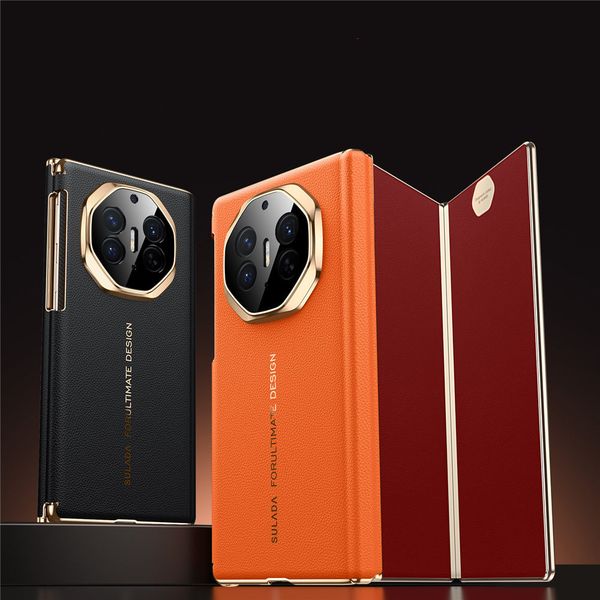
Huawei Mate 90 Pro eSIM and Satellite Messaging
Huawei has launched the Mate 90 and Mate 90 Pro in China, and this is more than another annual flagship refresh. Both phones bring new Kirin processors, upgraded XMAGE cameras, tougher bodies and larger batteries. Huawei also combines eSIM, BeiDou satellite messaging, Wi-Fi 7 and NearLink in the same premium device.
For travelers and connectivity watchers, that combination matters. Huawei is treating the smartphone less like a single-network handset and more like a flexible communications hub.
The Mate 90 Pro gets the bigger upgrades
The Mate 90 Pro keeps Huawei’s familiar circular camera module, but the hardware underneath moves forward.
It uses a 6.75-inch dual-layer LTPO OLED display with a 1-120Hz refresh rate and 2832 × 1280 resolution. Huawei quotes peak brightness of 12,000 nits in a limited 1% APL scenario. That figure should not be read as normal full-screen brightness.
Third-generation Kunlun Glass protects the display, while Huawei has also reinforced the chassis. The company says overall drop resistance improves by 50% versus the Mate 80 Pro. IP68 and IP69 ratings add protection against immersion and high-pressure hot water jets under laboratory conditions.
Inside, the Kirin 9035 pairs with 12GB or 16GB of RAM and up to 1TB of storage. There is no memory-card slot. Huawei also promotes hardware-accelerated ray tracing for gaming.
A 6,600mAh battery supports 100W wired and 50W wireless charging. Reverse charging works through both cable and wireless accessories. Huawei’s official specifications confirm those figures.
XMAGE remains a major selling point
Huawei has not abandoned the camera-first identity that helped define the Mate series.
The Mate 90 Pro includes:
- 50MP main camera with variable f/1.4-f/4.0 aperture and OIS;
- 40MP ultra-wide camera with an f/2.2 aperture;
- 50MP periscope telephoto camera with OIS and macro focusing;
- third-generation Red Maple multispectral camera for color analysis;
- 13MP front camera plus a separate 3D depth sensor.
Huawei lists roughly 4x optical zoom and 8x “optical-quality” zoom, with digital zoom reaching 100x. The system also supports 4K video, RAW capture, Log video and XMAGE computational photography.
READ MORE: Huawei unveils Mate 50 phones with satellite connectivity
The interesting part is not simply the megapixel count. Huawei continues to invest in color science, variable apertures and dedicated imaging hardware. That gives it a different emphasis from rivals leaning heavily on software-led image processing.
eSIM and satellite messaging deserve more attention
For Alertify readers, the connectivity setup may be the most interesting part of the launch.
Both phones support two nano-SIM cards plus eSIM. Huawei says each device can store up to two eSIM numbers. Users can keep four numbers across physical SIM and eSIM, with two active simultaneously.
That is unusually flexible as Apple pushes further toward eSIM-first hardware. Apple’s US iPhone 18 Pro specifications list dual eSIM with no physical SIM slot. European versions still combine nano-SIM and eSIM.
READ MORE: iPhone 18 Pro Keeps the SIM Tray — But eSIM Is Winning
Huawei also includes BeiDou satellite messaging. In mainland China, users can send texts and compressed images when terrestrial coverage disappears. The service requires prior activation while a normal network is available and remains China-specific.
This does not turn the Mate 90 into a universal satellite phone. It does show where premium connectivity is heading. Cellular, eSIM, Wi-Fi and satellite links increasingly sit inside one device experience.


The standard Mate 90 gives up surprisingly little
The regular Mate 90 keeps the same 6.75-inch size and 6,600mAh battery, but Huawei makes several sensible cuts.
It uses a single-layer LTPO OLED display and the Kirin 9030, with RAM fixed at 12GB. The camera system still includes a 50MP variable-aperture main camera, 40MP ultra-wide and 50MP telephoto lens. It loses the Pro’s telephoto macro capability.
Wired charging drops to 66W, while wireless charging remains at 50W. Huawei also keeps Wi-Fi 7, Bluetooth 6.0, NearLink E2.0, eSIM, BeiDou messaging and IP68/IP69 protection.
READ MORE: Chinese 5G Phones Are Changing the Mobile Race
Both phones run HarmonyOS 7. Huawei has expanded its Xiaoyi assistant with call handling, real-time translation, summaries and context-aware suggestions. Cross-device communication also plays a larger role.
This matters because Huawei now competes through a vertically integrated stack of chips, software, cameras and connectivity. Reuters also framed the launch around Huawei’s push for greater technological self-reliance amid U.S. trade restrictions. Counterpoint Research placed Huawei first in China in Q2 2026, with 23% shipment share versus Apple’s 18%.
Price and availability
Huawei started selling both phones in China on October 1.
Huawei’s official buying guide confirms the China prices and sales date. The company has not announced European pricing or a wider release schedule.
Conclusion
The Mate 90 series captures a wider change in the premium smartphone market. Cameras still matter, but connectivity has become part of the flagship identity.
Counterpoint says premium devices accounted for a record 29% of global smartphone sales in the first half of 2026. Apple, Samsung and Chinese brands now compete harder for those buyers.
Apple is moving further toward eSIM-first hardware, while Samsung offers broad eSIM support across the Galaxy S26 family. Huawei takes a different route. It keeps physical SIM flexibility while adding eSIM and China-focused satellite messaging.
That mix suits users who want multiple numbers, strong battery life and deep Huawei ecosystem integration. It makes less sense for buyers who need guaranteed international availability or a familiar Google-centric experience.
Huawei could strengthen the proposition by expanding satellite services beyond China and publishing clearer global eSIM compatibility details. Those gaps matter for travelers.
For buyers outside China, the iPhone 18 Pro and Galaxy S26 Ultra remain easier international choices today. Yet Huawei’s strategy deserves attention. The Mate 90 shows how the premium smartphone is evolving into a multi-network connectivity platform, not just a faster camera phone.