Can You Really Get Free Unlimited eSIM Data?
There’s a quiet shift happening in the eSIM market right now. And if you’ve been paying attention, you’ve probably seen the same promise popping up everywhere:
“Try unlimited data for free.”
At first glance, it feels like the ultimate hack. No SIM card. No payment. No commitment. Just install an eSIM and you’re instantly connected, often with “unlimited” data attached to it.
But here’s the thing. This trend is real, but it’s also misunderstood.
Because “free eSIM trial” and “unlimited data” rarely mean what travelers think they mean.
And once you understand how these offers actually work, you start to see a much bigger shift in the connectivity market.
What “free eSIM trial unlimited data” really means
Let’s break it down clearly.
There are two completely different worlds behind this idea:
Carrier network trials (the “real unlimited”)
These are the closest things to what people imagine.
Major telecom operators like T-Mobile, Verizon, and Google Fi now offer free eSIM trials with unlimited data.
- T-Mobile: 30-day trial with unlimited data (with high-speed caps like ~250GB before throttling)
- Verizon: 30-day free trial with full network access, no credit card
- Google Fi: 7-day trial with unlimited data, calls, and texts (with high-speed limits around 10GB)
These are not travel eSIMs. They are network acquisition tools.
The goal is simple:
Let you experience the network → convert you into a paying subscriber.
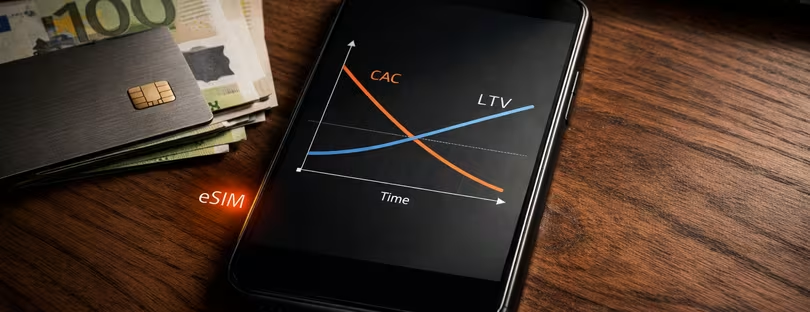
That’s why they can afford to give you “unlimited” access. It’s CAC strategy, not generosity.
But there’s a catch.
Most of these trials:
- Work only in specific countries (mainly the US)
- Require local eligibility or app setup
- Are not designed for international travelers
So yes, this is “real unlimited” — but it’s not built for travel.
Travel eSIM free trials (the “micro test”)
Now let’s look at what most travelers actually encounter.
Providers like GigSky or Nomad eSIM offer free eSIM trials, but they look very different:
- 100MB to 1 GB free data
- Short duration (24 hours to a few days)
- No payment required
Example: GigSky offers 100MB free (up to 500MB in Europe) just to test the service
This is not meant to replace your connectivity. It’s a product demo.
Think of it like:
- Testing speed
- Checking coverage
- Trying installation
That’s it.
No provider in the travel eSIM space is giving you truly unlimited data for free.
And economically, they can’t.
Why “free unlimited” is mostly a telecom strategy
Here’s where it gets interesting from a market perspective.
Unlimited data is expensive.
And in the travel eSIM world, margins are already tight:
- Wholesale data costs
- Roaming agreements
- Distribution fees
- Marketing spend
So offering unlimited data for free would be… irrational.
But for telecom operators, it’s different.
They’re playing a long-term game:
- Acquire user → lock into subscription
- Recover costs over months or years
- Upsell bundles, family plans, services
This is why free unlimited trials exist at the carrier level, not the travel level.
It’s a completely different business model.
And this is exactly where the eSIM market is splitting right now.

The illusion of “unlimited” in travel eSIMs
Even when you do see “unlimited” in travel eSIM offers, it usually comes with conditions:
- Speed throttling after a certain limit
- Fair usage policies
- Daily caps
- Network prioritization
And in free trials, that’s even more constrained.
In reality:
- Free = limited test
- Unlimited = marketing layer
These two rarely overlap.
This is why most “free unlimited eSIM” searches lead to confusion.
Because users are mixing:
- Carrier trials
- Travel eSIM offers
- Promotional bundles
And expecting them to behave the same way.
They don’t.
What travelers should actually use free eSIM trials for
If you approach it correctly, free eSIM trials are still incredibly valuable.
But not for what most people think.
They’re best used for:
Testing before you commit
Install the eSIM, check:
- Speed in your location
- Network stability
- App experience
This alone can save you from a bad purchase.
Emergency connectivity
That free 100MB?
It’s enough to:
- Call an Uber
- Open maps
- Send messages
In real travel scenarios, that’s often all you need in a pinch.
Comparing providers
Use multiple free trials to test:
- Different networks
- Different regions
- Different performance
This is where smart travelers win.

Where this trend is heading
Here’s the bigger picture.
Free eSIM trials are not just a feature. They’re a signal.
They show how the market is evolving:
- Connectivity is becoming software-first
- Onboarding is becoming frictionless
- Providers are competing on experience, not just price
And more importantly:
The market is splitting into two clear directions:
- Telecom-driven trials
Unlimited, aggressive, subscription-focused - Travel eSIM models
Flexible, prepaid, usage-based
And the gap between them is growing.
Why you won’t see true “free unlimited travel eSIMs” anytime soon
Let’s be blunt.
A real free unlimited travel eSIM would:
- Destroy margins
- Break wholesale agreements
- Attract heavy usage with zero revenue
It doesn’t scale.
That’s why even the most aggressive players avoid it.
Instead, they’re experimenting with:
- Free credits
- Cashback models
- Trial data
- Bundled partnerships
It’s controlled exposure, not full access.
And that’s unlikely to change.
Conclusion
The idea of a “free eSIM trial with unlimited data” sounds like the perfect travel hack.
But in reality, it’s a mix of two very different worlds.
Telecom operators use free unlimited trials as a conversion engine. They can afford it because they monetize you later.
Travel eSIM providers use free trials as a trust-building tool. They give you just enough to test, not enough to rely on.
And that distinction matters.
Because if you approach this trend expecting free unlimited global data, you’ll be disappointed.
But if you understand what’s really happening, you can use these trials strategically:
- Test networks before buying
- Avoid bad providers
- Stay connected in critical moments
Compared to the broader market, this trend also highlights something bigger.
Unlimited data is no longer the real differentiator.
Access, distribution, and user experience are.
And free trials are simply the entry point into that new competition layer.
So the real question isn’t:
“Where can I get unlimited data for free?”
It’s:
“Which provider gives me the best experience once I’m no longer free?”
That’s where the real decision starts.