T-Mobile eSIM QR Code: How Activation Really Works
The funny thing about eSIM is that the technology is supposed to make mobile activation feel invisible. No plastic SIM. No shop visit. No waiting for delivery. Just a digital profile downloaded to your phone and you are connected. Yet for many users, the most important moment still comes down to something very simple: scanning a QR code.
That is why “T-Mobile eSIM QR code” has become such a practical search term. People are not usually looking for telecom theory. They are standing with a new phone in one hand, Wi-Fi on, camera ready, and hoping the activation works the first time.
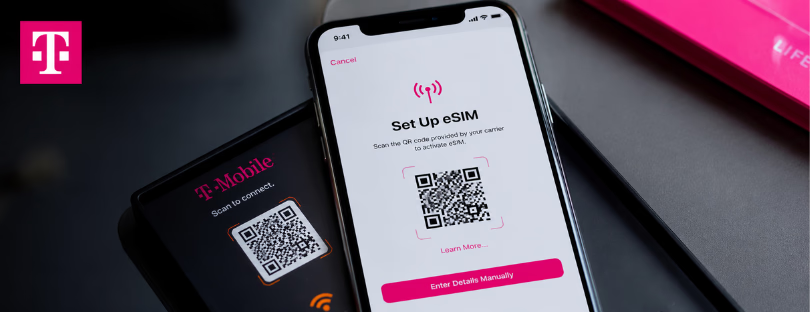
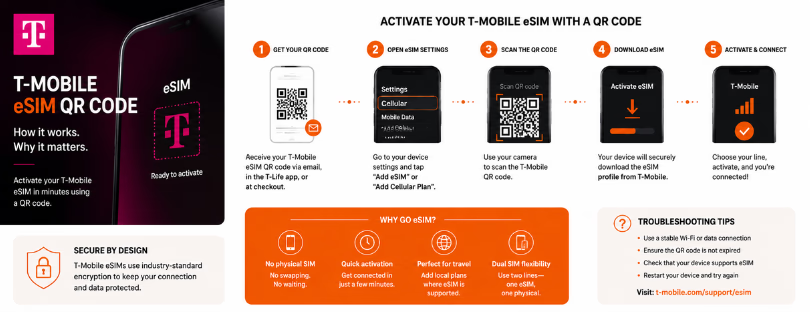
T-Mobile’s own support flow reflects this reality. Its tutorial hub lets customers choose their device and follow eSIM setup steps using a QR code, while device-specific pages show the same basic idea: scan the carrier QR code, download the eSIM profile, and confirm the mobile plan on the device.
The QR code is still the bridge
In the cleanest version of eSIM activation, the user never thinks about profiles, carrier servers, SM-DP+ addresses, or activation layers. They receive a QR code, scan it, and the phone knows where to fetch the eSIM profile.
On iPhone, Apple says users can set up an eSIM with a QR code during initial setup by choosing “Use QR Code” on the cellular setup screen, or after setup if the carrier provides one. On Android, Google’s Pixel guidance follows the same principle: users add a SIM, scan the QR code from the provider, and then choose how the SIM should be used for calls, texts, and mobile data.
T-Mobile’s role in this is carrier-side trust. The QR code is not just a barcode. It is the user-facing key to a carrier-issued eSIM profile. That matters because eSIM is not like downloading an app. It touches identity, billing, network access, number ownership, roaming, and device compatibility.
Where users still get stuck
The problem is not that QR-code activation is complicated. Most of the time, it is not. The problem is that it feels fragile when something goes wrong.
A user may not know whether the QR code has already been used, whether the device is locked, whether the phone supports eSIM, whether Wi-Fi is stable, or whether the activation is tied to a specific account or line. That uncertainty is what creates the frustration.
READ MORE: T-Mobile Launches U.S. Travel eSIM for Visitors
T-Mobile’s prepaid eSIM activation page, for example, says that after the order success screen appears, customers scan the QR code with their device to download and activate the T-Mobile eSIM profile. That sounds simple, and usually it is. But from the user’s perspective, the process depends on several invisible checks happening correctly in the background.
This is where carriers still have work to do. eSIM adoption is not only about offering digital SIMs. It is about making the activation journey feel boringly reliable.
Why this matters for travel and roaming
For Alertify readers, the T-Mobile eSIM QR code story is bigger than one U.S. operator. It shows where the whole connectivity market is heading.
Travelers are already used to buying eSIM plans from apps before a trip. They scan a QR code or install directly from an app, land abroad, and expect mobile data to work immediately. Apple also notes that travelers can activate eSIMs digitally through QR codes or carrier apps, depending on the carrier and local rules.
That expectation is now coming back to traditional operators. If a travel eSIM app can sell a plan in minutes, users will wonder why their main carrier cannot make activation, transfer, and recovery equally smooth.
READ MORE: T-Mobile Launches Network-Level AI Translation for Voice
T-Mobile, Verizon, AT&T, Vodafone, Orange, Deutsche Telekom, and other major operators are not only competing with each other anymore. They are also being compared against Airalo, Holafly, Ubigi, Nomad eSIM, Yesim, GigSky, and other travel eSIM brands that have trained customers to expect instant digital onboarding.
That does not mean travel eSIM providers are always better. They often lack voice, SMS, full local-number support, or deep account integration. But they have pushed the market psychologically. They made users comfortable with the idea that connectivity can be bought and installed like software.
The QR code may not be the final form
The interesting part is that QR codes may be a transitional layer. They are easy to understand, easy to issue, and work across many devices. But the industry is clearly moving toward more native activation flows.
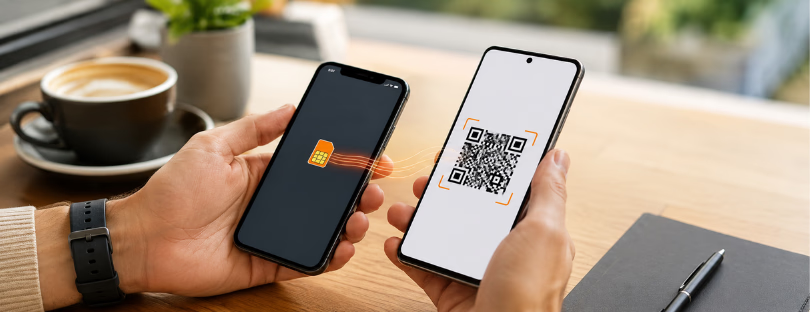
Apple already supports carrier-driven eSIM setup and eSIM transfer experiences beyond simple QR scanning. Google and Android device makers are also improving eSIM setup and transfer flows. T-Mobile’s own support pages include device-to-device transfer instructions, including flows where users scan from an old device to move a line to a new one.
That tells us something important: the QR code is not disappearing tomorrow, but it is no longer the most advanced version of eSIM activation. It is the practical middle ground between old SIM logistics and fully embedded, OS-native connectivity.
The real test is confidence
The T-Mobile eSIM QR code is a small detail, but it sits at the center of a much larger shift. Operators want digital activation. Device makers want smoother onboarding. Travel eSIM brands want instant conversion. Customers just want their phone to connect without drama.
That last part is the real market test.
T-Mobile has the advantage of being a full mobile operator with network ownership, account control, phone-number support, and customer service infrastructure. Travel eSIM brands, meanwhile, often win on speed, simplicity, and international shopping convenience. The next phase of eSIM will not be decided only by who offers the cheapest gigabyte. It will be decided by who makes activation feel trustworthy.
For now, the QR code remains the humble front door to that experience. But the winner will be the company that makes users forget they ever had to scan one.