


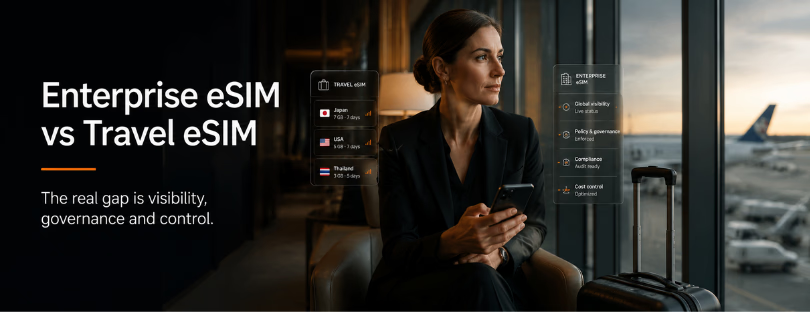
What an Enterprise eSIM Management Platform Does
A company with staff moving across airports, hotels, client sites, and temporary project locations does not have a connectivity problem. It has an operational control problem. That is where an enterprise eSIM management platform enters the picture – not as another dashboard, but as the layer that decides who gets mobile access, on which network, under what policy, and at what cost.
For travel-heavy businesses, multinational teams, and mobility-led operations, this matters more than the marketing usually admits. Mobile connectivity has shifted from a procurement line item to a live business system. If devices, plans, and policies are managed poorly, costs rise quietly, compliance gets messy, and employee experience takes the hit first.
Why enterprises are looking at centralized mobile control
The old model was simple enough when companies issued a limited number of phones tied to long contracts in one or two markets. That model breaks fast once a business has contractors, short-term travel, bring-your-own-device policies, cross-border operations, connected tablets, and embedded mobile devices in field equipment.
At that point, telecom management becomes fragmented. Procurement owns contracts, IT owns devices, security owns access, finance sees invoices too late, and travelers just want their connection to work when they land. A centralized platform promises to pull those threads together.
The appeal is obvious. Instead of managing connectivity market by market, carrier by carrier, or device by device, an enterprise can provision profiles remotely, set usage rules, monitor inventory, and track spend from one control layer. But the real value depends on how deep that control goes.
What an enterprise eSIM management platform actually does
At its core, an enterprise eSIM management platform handles the lifecycle of mobile connectivity across a business fleet. That usually includes remote provisioning, activation, suspension, reassignment, usage visibility, policy controls, and integration with enterprise systems.
The practical use case is straightforward. A business traveler lands in Singapore, a field engineer starts a project in Germany, or a contractor joins a logistics team for six weeks in Texas. Instead of shipping physical SIM cards, relying on expensive roaming defaults, or manually coordinating with local carriers, the business can assign connectivity digitally and apply rules based on role, geography, device type, or budget.
READ MORE: Enterprise Connectivity Needs More Than eSIM
That sounds clean on paper. In reality, platforms differ sharply. Some are little more than telecom inventory portals with remote activation. Others are closer to mobility orchestration systems, combining connectivity management with security policies, analytics, and automation.
For buyers, that distinction matters. If the platform only makes activation easier, it may reduce admin work but not transform mobile economics. If it can enforce policies, optimize carrier selection, and feed usage data into finance and IT workflows, it starts to become strategic.
The biggest gains are usually operational, not technical
The technology itself gets a lot of attention, but enterprise buyers tend to see the first payoff in operations. Manual provisioning drops. Device onboarding gets faster. Temporary workers can be connected without a long procurement cycle. International teams avoid some of the friction and delay tied to local physical distribution.
Finance teams also gain a better shot at visibility. Mobile spend is notoriously hard to control when it is spread across multiple carriers, business units, and travel patterns. A well-built platform can show which users are underutilizing plans, where roaming is creating avoidable expense, and when connectivity is being provisioned without business justification.
There is also a customer-facing angle for travel and hospitality businesses. Airlines, hotel groups, travel platforms, and mobility providers increasingly see mobile connectivity as part of the service layer around the trip. If the business can manage connected staff devices, partner devices, and service hardware from one place, service reliability improves in ways customers notice even if they never see the platform itself.
Where the trade-offs start
This is not a category where more features automatically mean better outcomes. The right platform depends heavily on the company’s operating model.
A global enterprise with distributed procurement and complex travel policies may need broad carrier interoperability, regional compliance support, and strong API access. A mid-market company may care less about advanced orchestration and more about simple provisioning, spend controls, and integration with its existing mobile device management stack.
READ MORE: Enterprise eSIM: The Buyer’s Guide to Global Workforce
There is also the question of carrier dependence. Some platforms are effectively tied to one operator ecosystem. That can make deployment easier, but it can also limit commercial flexibility. Others are more network-agnostic, which is attractive for multinational enterprises but may introduce more implementation complexity.
Then there is governance. Centralized control sounds efficient until local business units push back. A regional team may want local carrier relationships for pricing or coverage reasons. Corporate IT may want one standard globally. The platform can support either approach, but it cannot resolve internal operating politics on its own.
 Enterprise eSIM management platform buying criteria that matter

The strongest platforms tend to stand out less on flashy interface design and more on execution. Buyers should care about provisioning reliability, policy granularity, usage analytics, auditability, and integration depth.
Provisioning speed matters because mobile access is often needed immediately, not eventually. Policy controls matter because different employee groups should not be treated the same way. A finance executive on international travel, a seasonal hospitality worker, and a field technician using connected hardware create very different usage patterns and risk profiles.
Analytics are equally important, but only if they are actionable. Raw data is easy. Useful data is harder. A platform should help answer operational questions such as where roaming spend is spiking, which departments are overprovisioned, how many inactive lines are still billable, and which markets are causing recurring support issues.
Integration is where many deployments either mature or stall. If the platform cannot connect to identity systems, expense management, device management, procurement workflows, and reporting tools, teams end up recreating the same silos the platform was supposed to remove.
Security and compliance are part of the value proposition
For enterprise mobility teams, mobile connectivity is now tied directly to access control and risk management. Remote activation is useful, but remote deactivation is just as important. If a device is lost, a contractor leaves, or a policy violation occurs, the business needs fast control.
That makes security workflows central to platform evaluation. Role-based access, administrative audit trails, provisioning approvals, and policy enforcement all matter. So does compliance across regions where telecom regulation, data residency expectations, and identity requirements differ.
This is especially relevant for sectors with regulated data or mobile workforces spread across borders. A platform that works well in one region may create process friction in another if local telecom rules are not handled cleanly.
Why travel-heavy industries should pay attention
Travel businesses sit in an interesting position here. They are both large consumers of mobile connectivity and, increasingly, participants in the broader connected travel ecosystem. Airlines, hotel groups, travel management companies, and mobility service providers all rely on connected staff, connected devices, and time-sensitive operations across markets.
That makes centralized connectivity management less of a back-office issue and more of a service reliability issue. If airport staff devices, hotel operations tablets, driver handsets, or temporary event teams cannot be connected quickly and predictably, service disruption follows.
For these sectors, the platform question is not only about cost. It is about whether mobile infrastructure can be treated as a dynamic operating asset instead of a static procurement category. That is a meaningful shift, and it is one reason coverage of this segment is moving from telecom trade language into broader enterprise mobility strategy, including at publishers like Alertify.
What the market still gets wrong
The market often presents these platforms as simple efficiency tools. That undersells the category. The better way to think about an enterprise eSIM management platform is as a control plane for distributed mobile operations.
Still, there are limits. It will not erase bad carrier contracts. It will not fix poor internal ownership between IT, procurement, and finance. It will not automatically reduce roaming costs if the business has no policy discipline. And it will not matter much if the workforce barely travels and devices rarely move across networks.
But for enterprises with global movement, temporary staffing, multi-country operations, or connected field assets, the platform can shift connectivity from reactive administration to managed infrastructure. That is a much bigger story than digital activation alone.
The smart move is not to ask whether the category is promising. It is to ask whether your business has reached the point where mobile complexity is already costing more than a centralized control layer would. Once the answer is yes, waiting usually gets more expensive, not less.


