Cricket eSIM: What Travelers and Switchers Should Know
Cricket eSIM is not trying to be glamorous. That is probably the point. In the US prepaid market, where customers care about price, store access and predictable bills, eSIM can sound like a tech feature looking for a problem. Cricket’s approach is practical: remove the plastic SIM card, speed up activation, and let compatible phone users join the network without waiting for something in the mail.
Cricket explains eSIM as an embedded SIM already built into the phone, allowing customers to switch and activate service in as little as 15 minutes. Prepaid has always had a friction problem. You buy a plan, wait for a SIM, insert it, hope the phone is compatible, then troubleshoot. eSIM does not remove every pain point, but it cuts out one of the clumsiest steps.
For Alertify readers, the story is not simply that Cricket supports eSIM. It is how eSIM is becoming normal in prepaid.
How it works
Cricket’s eSIM setup is aimed at people bringing their own compatible phone, especially those who do not want to visit a store. The company says eSIM-capable devices can be activated online, including supported iPhones and Android phones. It also points customers to its compatibility checker, because eSIM support is not only about whether the phone has eSIM hardware. It also depends on whether that device works properly on Cricket’s network.
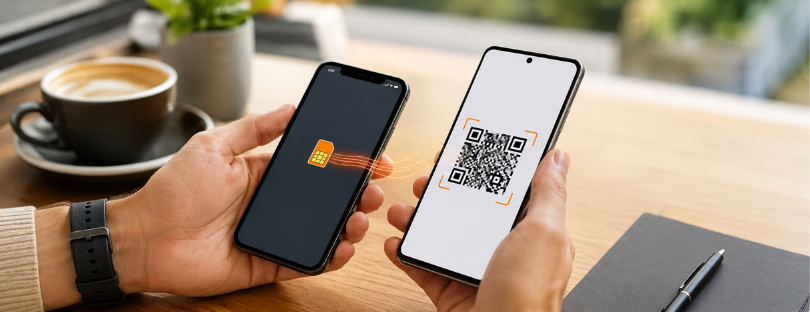
After activation, customers follow push notification prompts on the phone. If that notification does not appear, Cricket provides a QR code, also available by email. It is not the slickest eSIM experience on the market, but familiar is not bad when people are moving their main phone number.
Cricket says iPhones need iOS 16.0.2 or later for eSIM activation, while Android devices should be updated to the most current software.
Why it matters
Cricket sits in an interesting place. It is a prepaid brand, but not a tiny app-only MVNO trying to look bigger than it is. Its offer is built around no-contract wireless plans, stores, family options and straightforward pricing.
That makes its eSIM feel different from something like Mint Mobile or Visible. Mint has leaned hard into online-first value and multi-month savings. Visible has pushed the simple app-led unlimited model. Cricket is more hybrid. It has digital activation, but still has a retail footprint and a traditional prepaid customer base.
READ MORE: Get the Most Out of Your Cricket Wireless Phone with These SIM Card Tips
Someone switching from another US carrier with a newer iPhone or Android phone may simply want a lower monthly bill without entering a fully self-service experiment. For them, Cricket eSIM is less about being cutting-edge and more about making prepaid less annoying.
It is also useful for travelers staying in the US for longer periods, students, seasonal workers or anyone who wants local US service rather than a short-term travel eSIM. A travel eSIM might be better for a two-week trip where data is the only priority. Cricket makes more sense when the user needs a proper US mobile plan.
The limits
Cricket eSIM is not the same thing as a global travel eSIM. It is a domestic US mobile service feature. It also may not be the easiest choice for people with older phones, locked devices or imported models. Cricket’s compatibility checker is not a formality. It should be the first stop before eSIM activation. The same goes for software updates. eSIM is digital, but the boring basics still matter.
READ MORE: AT&T Introduces eSIM Free Trial to Compete with T-Mobile, Verizon
The improvement area is transparency around edge cases. Carrier eSIM pages often explain the happy path well, then get thinner when users need to transfer eSIMs between devices, recover after a failed setup, or switch from a physical SIM to eSIM. Cricket’s support page covers the essentials, but customers may still want clearer guidance.
The prepaid shift
The bigger market signal is clear: eSIM is no longer a premium-only feature. GSMA describes eSIM as part of remote SIM provisioning, allowing devices to store and download operator profiles digitally. The FCC also points to security benefits, including the fact that an eSIM cannot be removed from a phone the way a physical SIM can.
That shift matters because prepaid has historically been associated with physical retail, SIM kits and manual activation. Now the same category is becoming more digital, while still serving cost-conscious users who may not care about the technology itself.
Final take
Cricket Wireless eSIM is a sensible option, not a flashy one. Compared with Mint Mobile, it feels less aggressive online and less focused on multi-month bargain hunting. Compared with Visible, it is less minimalist and more traditional. Compared with AT&T prepaid, it may appeal to users who want the AT&T network family feel with Cricket’s prepaid branding and store-backed comfort.
Where Cricket wins is practical adoption. It gives compatible-phone users a cleaner way into prepaid service without turning the whole experience into a tech hobby. Where it could improve is in explaining transfers and troubleshooting with more confidence, because those are the moments where eSIM either feels modern or maddening.
The trend is bigger than Cricket. US prepaid is becoming digital by default, but the best providers will not be the ones that simply say “we support eSIM.” They will be the ones that make switching feel boring, safe and reversible. Cricket is moving in that direction. For many prepaid users, that may be exactly enough.