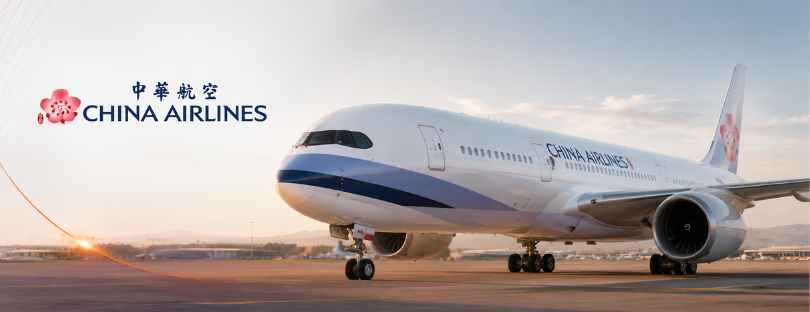
China Airlines: Why Taiwan’s Carrier Deserves Attention
China Airlines has always carried a slightly confusing name for global travellers. It is not based in mainland China. It is Taiwan’s flag carrier, headquartered in Taipei, and that distinction matters more than many casual passengers realise. In a region where aviation is tied to trade, politics, tourism, cargo, and national identity, China Airlines sits in a very specific place: smaller than the Chinese “big three,” less globally glamorous than Singapore Airlines or Cathay Pacific, but quietly important in the way Asia-Pacific travel is being rebuilt.
For Alertify readers, the interesting part is not simply whether China Airlines has nice seats or decent meals. The more useful question is this: can a legacy Asian carrier stay relevant when travellers now expect smoother digital journeys, better long-haul comfort, transparent connectivity, and fewer airport headaches?
Right now, China Airlines seems to understand the assignment.
A serious fleet signal
The clearest signal came from its long-haul fleet renewal. China Airlines announced a major order split between Airbus and Boeing, including Airbus A350-1000s, Boeing 777-9s, and Boeing 777-8 freighters, with deliveries expected from 2029. Reuters reported the deal at around $11.9 billion, while the airline’s own sustainability news page confirmed the 24-aircraft plan for passenger and cargo growth.
That split is not accidental. It gives China Airlines flexibility, politically and operationally. The A350 already has a strong reputation for long-haul passenger comfort, lower noise, and better fuel efficiency. The 777X, if Boeing finally gets the programme running at scale, gives carriers a large-capacity aircraft for premium trunk routes. And the 777-8F keeps China Airlines close to one of its underrated strengths: cargo.
This is where the airline differs from some more consumer-famous competitors. Singapore Airlines sells polish. Cathay Pacific sells Hong Kong connectivity and premium recovery. EVA Air, China Airlines’ closest Taiwanese rival, sells consistency and a strong premium economy reputation. China Airlines, meanwhile, has to balance passenger growth with Taiwan’s position as a high-value manufacturing and logistics hub. That makes cargo more than a side business.
The Taiwan gateway question
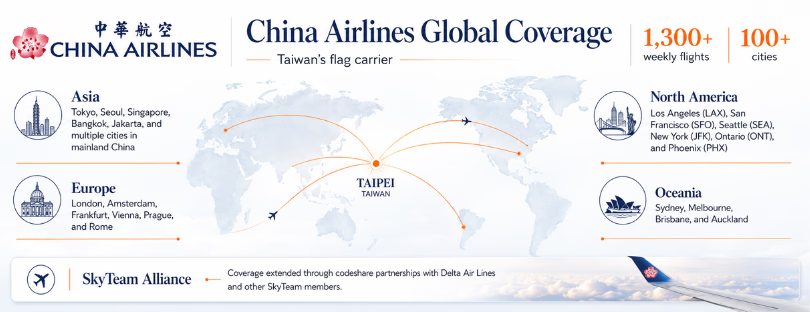
Taipei Taoyuan is not Dubai, Doha, Singapore, or Hong Kong. It is not the default mega-hub that pulls every traveller through by habit. That means China Airlines has to work harder to make its network feel intentional.
For European and North American travellers, the pitch is quite clear: Taiwan as a smarter gateway into Northeast Asia and parts of Southeast Asia. Japan, Korea, Vietnam, Thailand, and the Philippines are all within logical reach. For business travellers, Taiwan’s semiconductor and technology economy gives the airline a strong corporate travel base that many tourism-first carriers would love to have.
READ MORE: Agoda Powers China Airlines’ StayMiles Shift
There are signs of ambition in the United States too. China Airlines has been linked with possible future expansion to cities such as Boston, Washington Dulles, and Phoenix as new long-haul aircraft arrive. That tells us where the airline thinks growth may come from: not just classic leisure traffic, but business, diaspora, education, and tech-linked travel.
The passenger experience
China Airlines is certified as a 4-Star Airline by Skytrax, with product and service ratings covering seats, amenities, catering, in-flight entertainment, cleanliness, and staff service.
That sounds good, but let’s be honest: 4-star is not the same as “market leader.” It means the airline is credible, comfortable, and competitive, but not necessarily the one setting global expectations. In Asia, that bar is brutally high. Singapore Airlines, ANA, Japan Airlines, Qatar Airways, Emirates, and Cathay Pacific have trained travellers to expect excellent cabins, clean digital flows, good lounges, and small service details that actually matter on a 13-hour flight.
China Airlines’ opportunity is to sharpen its identity. It does not need to pretend to be Singapore Airlines. It needs to be the carrier that makes Taiwan feel easy, premium enough, connected, and reliable. That includes the aircraft, yes, but also the digital layer: booking, disruption handling, Wi-Fi clarity, mobile check-in, loyalty, roaming partnerships, and arrival experience.
This is where airlines often lose modern travellers. The seat can be good, but if the app is clumsy, the Wi-Fi pricing is unclear, and the passenger lands without easy connectivity, the total experience feels dated.
Sustainability with real pressure
China Airlines has also been publishing sustainability materials, including its 2024 Sustainability Report, which covers the reporting period from January to December 2024 under GRI standards.
For airlines, sustainability claims are tricky. Travellers like the idea, regulators demand progress, but aviation remains hard to decarbonise. New aircraft help because they burn less fuel, but they are not magic. Sustainable aviation fuel is still expensive and supply-limited. So the more credible airlines are the ones that connect sustainability to fleet renewal, operational efficiency, cargo optimisation, and measurable reporting rather than soft lifestyle messaging.
China Airlines appears to be moving in that direction, but the next test is execution. Announcing aircraft is one thing. Deploying them profitably, improving the passenger product, and proving lower emissions intensity over time is another.
Final thoughts
China Airlines is not the loudest airline in Asia, and that may actually be its advantage. The market already has enough carriers shouting about luxury, lifestyle, and “seamless journeys.” What China Airlines needs is sharper relevance: Taiwan as a high-value gateway, long-haul aircraft that can compete, cargo strength that supports the business model, and a digital passenger experience that does not feel like an afterthought.
Compared with EVA Air, it still needs clearer brand warmth. Compared with Cathay Pacific, it lacks the same global hub mythology. Compared with Singapore Airlines, it will not win on pure premium theatre. But compared with many legacy carriers trying to recover their position after the pandemic, China Airlines looks disciplined. The fleet decisions are serious. The network logic makes sense. The cargo angle gives it resilience.
The bigger aviation trend is simple: airlines are no longer judged only in the sky. They are judged across the whole travel stack, from booking to baggage to Wi-Fi to arrival connectivity. If China Airlines wants to move from respected regional player to more visible global contender, that is where the next battle will be won. Not only with bigger aircraft, but with a smoother, smarter journey around them.