Breeze eSIM: Plans, Pricing and the Fine Print
Most travel eSIM providers compete for individual customers searching for affordable mobile data abroad. Breeze eSIM is playing a second game: helping airlines, financial services companies and travel brands sell connectivity to their own customers.
That distinction makes Breeze more interesting than its consumer storefront initially suggests.
Alongside conventional prepaid eSIM packages, Breeze offers annual travel passes, reusable connectivity and branded eSIM solutions for businesses. Its partnerships with Wizz Air, Lufthansa Group and Western Union reveal a company focused as much on distribution as mobile data.
But a strong distribution strategy does not automatically guarantee a better connection. For travellers, the important questions remain considerably simpler: what does the data cost, which networks can you use, and what happens when something goes wrong?
What Breeze eSIM actually is
Breeze is a UK-based travel connectivity business operating under Breezesim Limited, registered in England and Wales. It sells prepaid mobile data for international travel and provides white-label connectivity services to commercial partners.
Its underlying infrastructure comes from eSIM Go, which supplies the connectivity, network agreements and provisioning technology. Breeze handles customer-facing products, pricing, distribution and partner integrations.
That makes Breeze primarily a connectivity retailer and solutions partner rather than a traditional mobile network operator with its own radio infrastructure.
The company advertises coverage across more than 190 destinations, with 4G and 5G access depending on the country and network.
Its consumer proposition is straightforward: purchase data before departure, install the eSIM and connect abroad without replacing your existing SIM card.
The business proposition is more ambitious. Breeze enables other companies to offer essentially the same connectivity under their own brands.
What you can actually buy
Breeze has three main product categories.
Prepaid destination and regional eSIMs cover individual countries and multinational journeys. Customers can choose fixed-data packages with specified validity periods, while regional options reduce the need to purchase separate eSIMs at every border.
For example, Breeze’s Europe Lite offering covers Croatia, Slovenia, Bosnia and Herzegovina, Serbia, Montenegro and Italy. That is useful for Balkan road trips, where standard EU roaming arrangements do not necessarily extend across every destination.
Its destination catalogue also includes unlimited-style day plans and higher-allowance Premium Unlimited packages.
On Breeze’s Croatia product page, Premium Unlimited allowances are described as 30GB over five days, 60GB over ten days or 90GB over fifteen days before reduced speeds apply. Day plans offer 1GB of full-speed data per 24 hours before throttling.
Annual Travel Passes take a different approach. Customers pay once for 365 days of connectivity across approximately 130 countries, with monthly allowances of 1GB, 2GB, 3GB, 5GB or 10GB.
A 3GB monthly pass, for example, represents 36GB distributed across twelve monthly periods, not a flexible 36GB balance to spend whenever necessary.
Breeze also offers top-ups when the monthly allowance becomes insufficient.
The third category is white-label and partner connectivity, allowing established brands to sell travel eSIMs without building their own telecommunications operations.
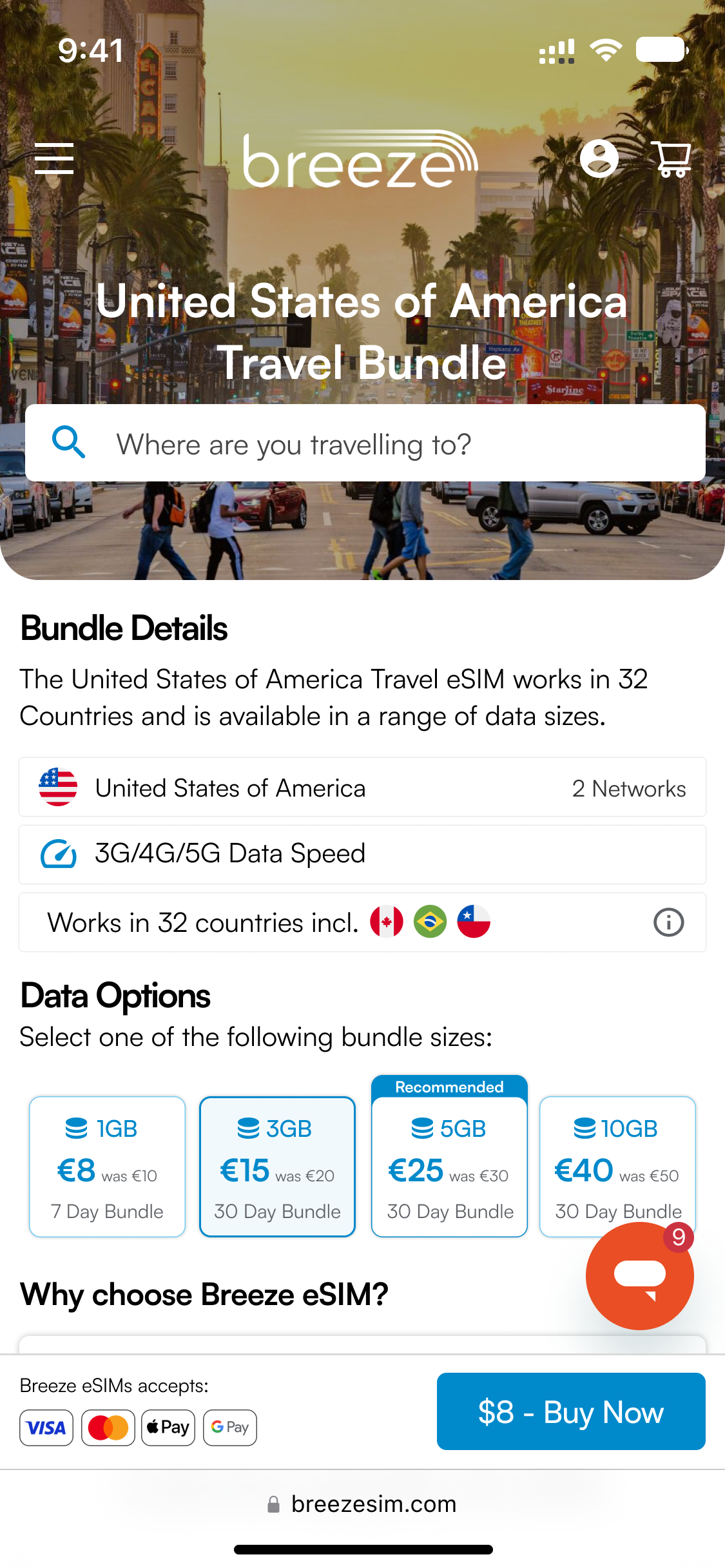
Representative consumer prices also provide context. Breeze’s Booking.com-branded storefront displayed 10GB/30-day packages at £12 for the United States, reduced from £16, and £10 for Spain, reduced from £13. These are advertised promotional prices in British pounds on that partner storefront, not guaranteed prices across every Breeze sales channel. Customers should confirm the checkout total and any applicable taxes or fees.

What using Breeze is actually like
The purchase process follows a familiar travel eSIM model.
Choose a destination, select an allowance, complete checkout and receive the installation information electronically. Breeze supports QR-code installation and compatible devices may offer simpler installation methods.
An unlocked, eSIM-compatible device is essential.
For standard destination packages, Breeze says validity starts when the eSIM first connects in the supported destination, rather than immediately at purchase. Travellers can therefore install it before departure, preferably while connected to reliable Wi-Fi.
After arrival, the Breeze profile needs to be selected for mobile data, with data roaming enabled on that profile.
Importantly, roaming should generally remain disabled on the primary SIM unless the traveller understands their home operator’s charges.
Customers can monitor usage through their online account and purchase additional data. Breeze also describes usage notifications and website-based support, reducing dependence on a dedicated mobile app.
There are practical limitations.
Breeze is a data-only service. It does not provide conventional cellular voice calls, SMS or a local telephone number. WhatsApp, FaceTime and other internet-based communications work through the data connection, but ordinary SMS verification still requires another suitable mobile service.
Likewise, customers changing phones should check profile transfer and reinstallation arrangements before deleting an active eSIM. Breeze documents same-device reinstallation, but that should not be interpreted as unrestricted transfer between devices.
The connectivity reality: coverage is not performance
Breeze promotes access to multiple networks in many destinations, and some product pages identify the actual operators available.
Its Croatia listing, for instance, identifies A1 and Tele2-related network access and advertises hotspot functionality.
That transparency is useful. A traveller can investigate the relevant networks rather than relying entirely on a general promise of nationwide coverage.
However, access to multiple partner networks does not establish guaranteed switching between them under every circumstance.
Nor does a 5G-compatible plan guarantee 5G performance. Speeds depend on the local network, coverage, congestion and device capabilities.
Breeze also does not consistently provide detailed public information about traffic-routing locations, latency or every network-selection restriction.
For ordinary browsing, that may be unimportant. For latency-sensitive work, video conferencing or demanding enterprise applications, it is worth investigating.
Hotspot use is supported on the plans examined, allowing travellers to connect laptops and additional devices without purchasing another data subscription.

The fine print behind unlimited data
Breeze’s unlimited terminology deserves particular attention.
Its help centre explains that classic unlimited bundles provide 1GB per day at unrestricted network speed, after which downloads are limited to 512kbps.
That remains usable for messaging and some basic online activities, but it is substantially less attractive for video meetings, streaming and laptop tethering.
Meanwhile, the newer Premium Unlimited descriptions use larger cumulative high-speed allowances before speed reductions.
These are meaningfully different products. Customers should examine the specific plan’s current speed and fair-use information rather than assuming every Breeze unlimited package follows identical rules.
Refunds also require attention.
Breeze’s current destination pages advertise full refunds for unused data, but specify that plans activated in the destination are ineligible. Its annual pass documentation describes a fourteen-day refund window where the plan has not been activated.
That matters when an eSIM installs successfully but subsequently develops connection problems. Eligibility is not necessarily the same as simply having unused data.
Customer feedback presents a mixed but informative picture. Breeze had approximately 2,700 Trustpilot reviews and a 4.2/5 rating when checked. Positive feedback frequently mentions straightforward purchasing and successful connections. Recent negative reviews include complaints about failed activation, unavailable support and disputed data consumption.
These are customer-reported experiences, not independently verified service failures, but they reinforce the value of installing early and retaining an alternative connection.
Where Breeze gets genuinely interesting
Breeze‘s strongest distinction is its combination of reusable consumer connectivity and business distribution.
The annual Travel Pass addresses a specific problem: frequent travellers who repeatedly purchase small destination packages.
Someone travelling internationally every few weeks may prefer one installed profile and a predictable monthly allowance to managing multiple individual purchases.
But the larger commercial opportunity sits behind the scenes.
Breeze enables airlines, loyalty programmes and financial-services brands to incorporate connectivity into an existing customer relationship. Its eSIM Go-backed model includes branded storefronts, provisioning, support and partner integrations.
That means an airline can sell destination connectivity as an ancillary service without becoming a telecom operator.
Compared with retail-focused alternatives such as Airalo and Nomad, Breeze’s business-facing distribution model is particularly relevant. For persistent consumer connectivity, BNESIM represents another useful comparison.
Breeze is not necessarily offering fundamentally different radio connectivity. It is making connectivity easier for other businesses to distribute.
Who should consider Breeze?
Breeze makes sense for holidaymakers needing straightforward prepaid data, travellers crossing multiple countries and frequent flyers interested in a reusable annual arrangement.
Its regional products and hotspot support are particularly practical for travellers carrying several connected devices.
It is less compelling for customers requiring a local number, native calling, SMS verification or guaranteed unrestricted high-speed data.
Heavy users should compare fixed allowances with the effective high-speed limits on unlimited plans.
For businesses, the strongest fit is a company that already has international customers and wants to add connectivity without constructing a telecom platform.
Alertify Reality Check
Best for: Frequent international travellers and travel brands seeking embedded eSIM services.
Less suitable for: Customers needing native calls, SMS or consistently unrestricted high-speed data.
Standout feature: White-label distribution combined with reusable annual travel connectivity.
Watch out for: Unlimited-plan throttling, monthly allowance resets and activation-related refund exclusions.
Alertify take: Breeze’s most interesting competitive advantage is how it distributes connectivity, not simply how many gigabytes it sells.
Conclusion: A travel eSIM business with a broader commercial purpose
Breeze is a credible option in the crowded prepaid travel eSIM market, but its real strategic strength lies elsewhere.
Its partnership model connects telecom infrastructure with airlines, financial institutions and existing travel audiences. That creates distribution opportunities many consumer-focused eSIM retailers struggle to replicate.
For individual travellers, however, Breeze still needs to win on the ordinary fundamentals: competitive pricing, usable networks, clear data limits and responsive support.
Its annual passes offer a practical alternative to repeated purchases, while the different unlimited-plan rules require careful reading.
The larger lesson is that travel eSIM competition increasingly concerns who owns the customer relationship, not merely who supplies the data.
Breeze appears to understand that distinction particularly well.